帕博利珠单抗一线治疗PD-L1高表达的晚期非小细胞肺癌的药物经济学评价
2021-07-20刘国强康朔王欣晨
刘国强 康朔 王欣晨
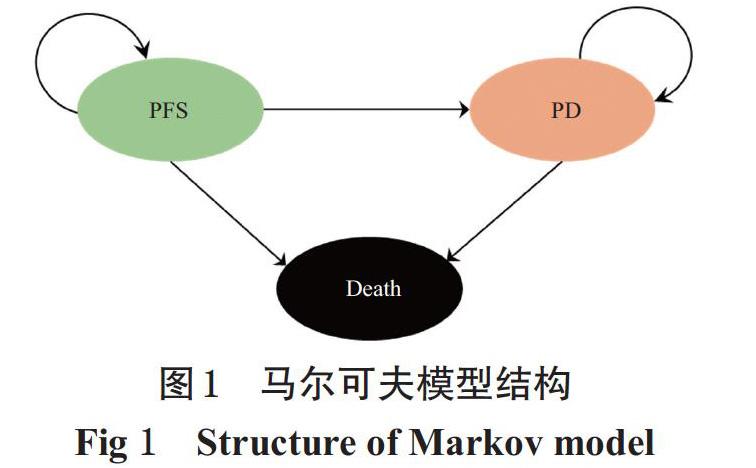
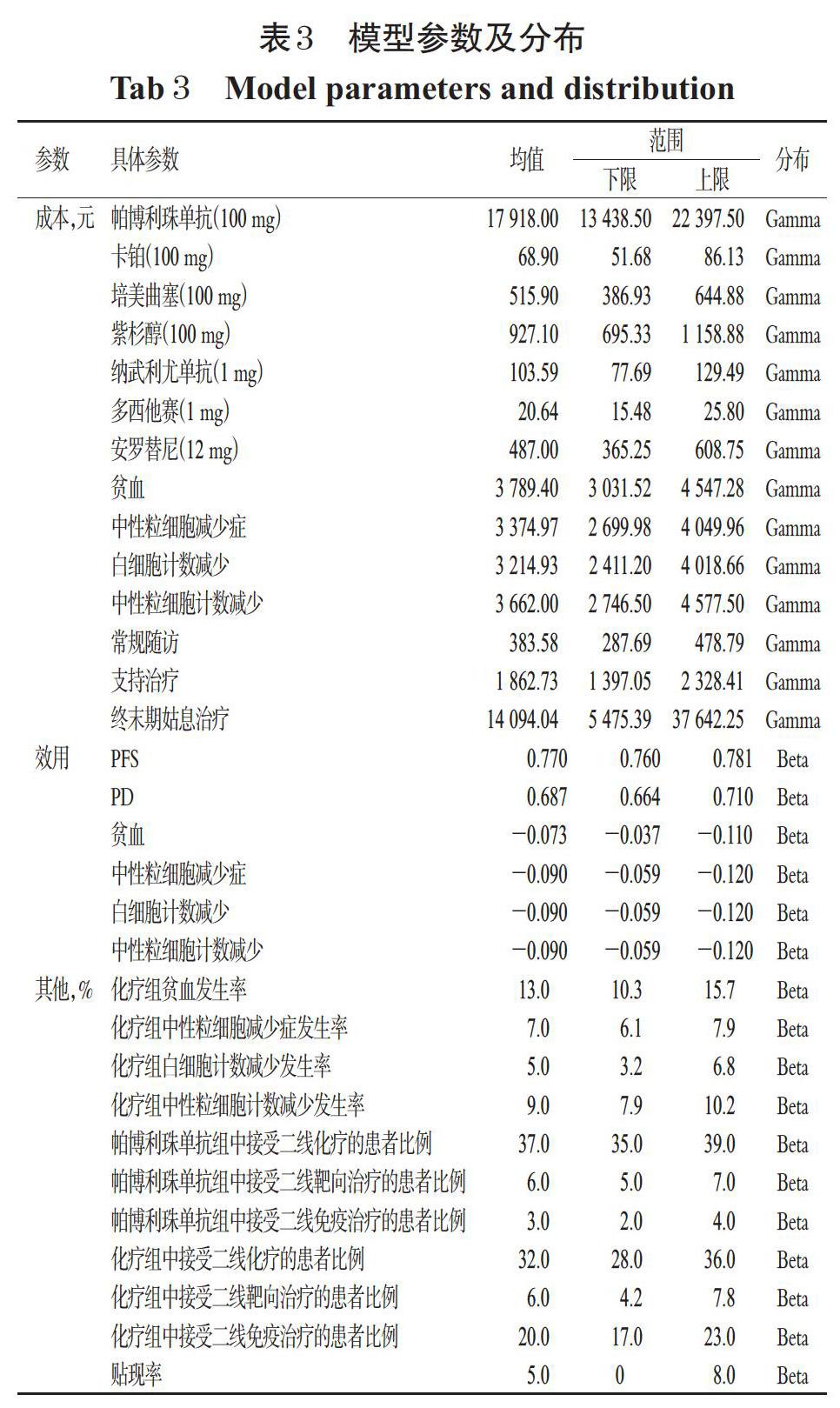
摘 要 目的:从我国卫生体系角度评价帕博利珠单抗对比一线化疗方案治疗程序性细胞死亡蛋白配体1(PD-L1)高表达的晚期非小细胞肺癌的经济性。方法:利用已发表的KEYNOTE-042临床试验数据和相关文献数据建立马尔可夫模型,评价帕博利珠单抗对比一线化疗方案的经济性;模拟时限为20年,周期为3周,对成本和效用采用5%的贴现率进行贴现。采用单因素敏感性分析和概率敏感性分析法评价模型结果的稳定性。结果:基础分析结果显示,帕博利珠单抗对比一线化療方案可多获得1.62个质量调整生命年(QALY),增量成本为54 648元,增量成本-效用比为33 686元/QALY,低于我国的意愿支付阈值(WTP)。单因素敏感性分析结果显示,纳武利尤单抗价格、帕博利珠单抗价格、一线化疗方案组中接受二线免疫治疗的患者比例这3个变量对结果的影响较大。概率敏感性分析结果显示,在0~140 000元/QALY的WTP范围内,帕博利珠单抗具有经济性的概率逐渐增加;当WTP为70 892元/QALY时(2019年我国1倍人均国内生产总值),帕博利珠单抗具有经济性的概率为95%;当WTP超过100 000元/QALY时,帕博利珠单抗具有经济性的概率为100%。结论:在我国,帕博利珠单抗一线治疗PD-L1高表达的晚期非小细胞肺癌较一线化疗方案更具有经济学优势。
关键词 帕博利珠单抗;化疗;程序性细胞死亡蛋白配体1;非小细胞肺癌;药物经济学;成本-效用分析
ABSTRACT OBJECTIVE: To evaluate the economics of pembrolizumab versus first-line chemotherapy in the treatment of advanced non-small cell lung cancer with high programmed cell death protein ligand 1 (PD-L1) expression from the perspective of Chinese healthcare system. METHODS: Published KEYNOTE-042 clinical trial data and relevant literature data were used to establish a Markov model to evaluate the economics of pembrolizumab versus first-line chemotherapy with a 20-years horizon and a 3-week cycle length, discounting costs and utilities using a discount rate of 5%. One-way sensitivity analysis and probabilistic sensitivity analysis were used to evaluate the stability of the model results. RESULTS: The base-case results showed that pembrolizumab yield additional 1.62 QALYs more than first-line chemotherapy, with an incremental cost of 54 648 yuan; the incremental cost-utility ratio was 33 686 yuan/QALY, which was lower than the willingness-to-pay threshold (WTP) in China. The results of one-way sensitivity analysis showed that the price of nivolumab, the price of pembrolizumab and the proportion of patients who received second-line immunotherapy in first-line chemotherapy group had the greatest impact on the results. The results of probabilistic sensitivity analysis showed that the probability of pembrolizumab to be cost-effective gradually increased within the WTP of 0-140 000/QALY. When WTP was 70 892 yuan/QALY (one time of the per capita GDP of China in 2019), the probability of pembrolizumab to be cost-effective was 95%. When WTP beyond 100 000 yuan/QALY, the probability of pembrolizumab to be cost-effective was 100%. CONCLUSIONS: Pembrolizumab has economic advantages than first-line chemotherapy in the first-line treatment of non-small cell lung cancer with high PD-L1 expression in China.
KEYWORDS Pembrolizumab; Chemotherapy; Programmed cell death protein ligand 1; Non-small cell lung cancer; Pharmacoeconomics; Cost-utility analysis
肺癌是我国及全世界范围内发病率和病死率较高的恶性肿瘤之一[1]。据国家癌症中心统计,2014年肺癌的发病率和病死率均居我国恶性肿瘤首位[2]。……