加味桃红四物汤对骨质疏松性胸腰椎压缩性骨折术后骨质疏松的效果
2021-06-20郑树恒喻学军王威
郑树恒 喻学军 王威

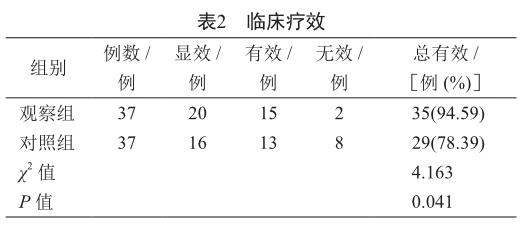
摘 要 目的:研究分析加味桃红四物汤对骨质疏松性胸腰椎压缩性骨折术后骨质疏松的临床辅助治疗效果。方法:74例患者随机分为观察组和对照组(各37例),对照组实施常规治疗,观察组另加加味桃红四物汤辅助治疗,分析并比较两组的疼痛和骨密度情况以及临床疗效。结果:治疗后观察组的总有效率、相关评分、改善疼痛和骨密度情况均优于对照组(P<0.05)。结论:加味桃红四物汤能增加骨质疏松性胸腰椎压缩性骨折术后骨质疏松的临床辅助治疗效果,改善体质,提高骨密度,值得临床进一步试用。
关键词 加味桃红四物汤 骨质疏松症 胸腰椎压缩性骨折 椎体成形术 骨密度
中图分类号:R289.5; R274.9 文献标志码:B 文章编号:1006-1533(2021)09-0016-02
Effect of Jiawei Taohong Siwu decoction on osteoporosis after osteoporotic thoracolumbar compression fracture
ZHENG Shuheng*, YU Xuejun, WANG Wei
(Department of Orthopaedic, Xinyang Central Hospital, Henan Xinyang 464000, China)
ABSTRACT Objective: To study and analyze the clinical effect of Jiawei Taohong Siwu decoction on osteoporosis after thoracolumbar compression fracture. Methods: A total of 74 patients were enrolled and randomly divided into an observation group and a control group with 37 cases each. Routine treatment was carried out in the control group and the auxiliary treatment of Jiawei Taohong Siwu decoction was additionally given in the observation group. The pain, bone density and clinical effect were analyzed and compared between the two groups. Results: The clinical effect, pain and bone mineral density were better in the observation group than the control group (P<0.05). Conclusion: Jiawei Taohong Siwu decoction can increase the clinical effect of patients with osteoporotic thoracolumbar compression fracture, improve the body quality and the bone density and is worthy of further clinical trial.
KEy WORDS Jiawei Taohong Siwu decoction; osteoporosis; thoracolumbar vertebral compression fracture; vertebroplasty; bone density
隨着年龄的增长,人体骨骼的退行性改变容易引发骨质增生、骨质疏松,增加了胸腰椎压缩性骨折的发病概率。而一旦发生胸腰椎压缩性骨折,患者在接受椎体成形术后容易出现骨质疏松等不良反应,因此需要有针对性进行治疗[1]。本研究对我院收入的74例椎体成形术后骨质疏松患者分别实施常规治疗和在常规治疗基础上实施加味桃红四物汤辅助治疗,并对两组的疼痛、骨密度情况以及临床疗效作比较分析。
1 资料与方法
1.1 临床资料
以我院2019年1—12月收治的因骨质疏松性胸腰椎压缩性骨折接受椎体成形术且术后发生骨质疏松的74例患者为研究对象,随机分为观察组和对照组各37例。其中观察组男性19例,女性18例,年龄为30~74岁,平均(58.76±5.42)岁,病程为3~12个月,平均(7.83±1.42)个月;对照组男性18例,女性19例,年龄为31~73岁,平均(58.82±5.50)岁,病程为3~12个月,平均(7.75±1.36)个月。两组的临床资料没有明显差异(P>0.05),具有可比性。
