垂体腺瘤在显微镜或神经内镜下经单鼻孔蝶窦入路治疗的效果比较
2021-06-15任广军
任广军


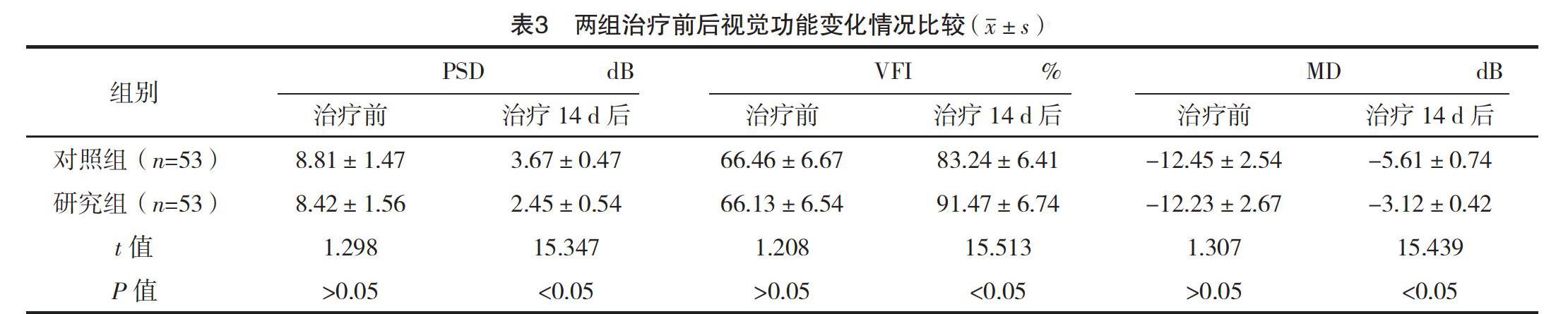
【摘要】 目的:探討垂体腺瘤在显微镜或神经内镜下经单鼻孔蝶窦入路治疗的效果。方法:选取2017年10月-2018年10月于本院治疗的垂体腺瘤患者106例。随机均分为对照组和研究组,每组53例。对照组应用显微镜下经单鼻孔蝶窦入路治疗,研究组应用神经内镜下经单鼻孔蝶窦入路治疗。比较两组手术相关指标及应激指标、视觉功能、激素水平变化情况。结果:研究组手术时长、住院时长均短于对照组,手术出血量少于对照组,差异均有统计学意义(P<0.05)。两组治疗前应激指标、视觉功能、激素水平比较,差异均无统计学意义(P>0.05)。两组治疗中应激指标均较治疗前升高,但研究组均低于对照组,差异均有统计学意义(P<0.05);研究组治疗14 d后PSD低于对照组,MD、VFI均高于对照组,差异均有统计学意义(P<0.05);两组治疗14 d后激素水平较治疗前均降低,且研究组均低于对照组,差异均有统计学意义(P<0.05)。结论:垂体腺瘤应用神经内镜下经单鼻孔蝶窦入路手术治疗和显微镜下相比效果更佳,可以降低术中和术后的应激水平以及机体的激素水平,缩短手术时长、住院时长,改善患者的视觉功能,治疗效果好。
【关键词】 垂体腺瘤 显微镜 神经内镜 经单鼻孔蝶窦入路
Comparison of Effects of Pituitary Adenomas Via Single-nostral Transsphenoidal Approach under Microscope or Neuroendoscopy/REN Guangjun. //Medical Innovation of China, 2021, 18(12): -127
[Abstract] Objective: To explore the comparison of the effects of pituitary adenomas under microscope or neuroendoscope via single-nostral transsphenoidal approach. Method: A total of 106 patients with pituitary adenoma who were treated in our hospital from October 2017 to October 2018 were selected. They were randomly divided into control group and study group, 53 cases in each group. The control group was treated with a single-nostral transsphenoidal approach under microscope, and the study group was treated with a single-nostral transsphenoidal approach under neuroendoscopy. The surgical related indexes, stress indexes, visual function and hormone levels were compared between two groups. Result: The duration of operation and hospitalization in the study group were shorter than those in the control group, and the amount of surgical bleeding was lower than that in the control group, the differences were statistically significant (P<0.05). The stress indexes, visual function and hormone levels between two groups before treatment were compared, there were no significant differences (P>0.05). The stress indexes in two groups during the treatment were higher than those of before treatment, but the study group were lower than those of the control group, there were significant differences (P<0.05). After 14 d of treatment, PSD of the study group was lower than that of the control group, while MD and VFI of the study group were higher than those of the control group, the differences were statistically significant (P<0.05). Compared with before treatment, the hormone levels of two groups after 14 d of treatment decreased, and the study group were lower than those of the control group, the differences were statistically significant (P<0.05). Conclusion: Neuroendoscopic transsphenoidal approach for pituitary adenoma has a better effect than that under microscope. It can reduce intraoperative and postoperative stress levels and hormone levels, shorten the duration of surgery and hospitalization, and improve the visual function of patients with good therapeutic effect.
[Key words] Pituitary adenoma Microscope Neuroendoscopy Via single-nostral transsphenoidal approach
First-authors address: Central Hospital of Hongxinglong Administration Bureau of State Farms of Heilongjiang Province, Youyi 155811, China
doi:10.3969/j.issn.1674-4985.2021.12.029
神经外科常见的一种良性肿瘤就是垂体腺瘤,高发于女性,是垂体前叶、后叶的局部组织引发的内分泌性占位病变,主要表现为不育,阳痿,肢端肥大等[1]。垂体瘤会影响机体中生长激素、促甲状腺素的分泌,同时也会对视神经造成压迫,影响视力,且手术中的组织损伤均会导致应激反应,延缓预后。临床中主要通过手术治疗垂体腺瘤,常用的有显微镜和神经内镜下经单鼻孔蝶窦入路切除术,其是一种微创手术,能有效降低术中对患者的损伤,保证完整切除肿瘤[2-4]。虽然两种方式均在临床中广泛应用,但对其操作和疗效暂时没有明确的定论,神经内镜能多角度、近距离对残留肿瘤进行观察,但镜头容易受血污影响;显微镜下止血简单,立体感强。基于此本文主要探讨垂体腺瘤在显微镜或神经内镜下经单鼻孔蝶窦入路的治疗效果,现报道如下。……