CT分级联合血清miR-29c对重症胰腺炎预后评估的研究
2021-06-15郑业锟
郑业锟
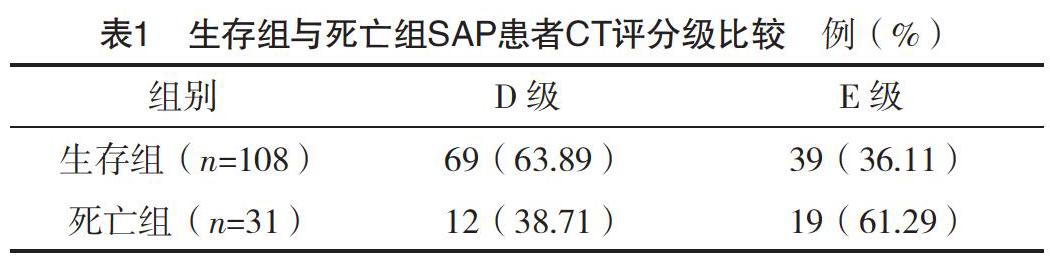
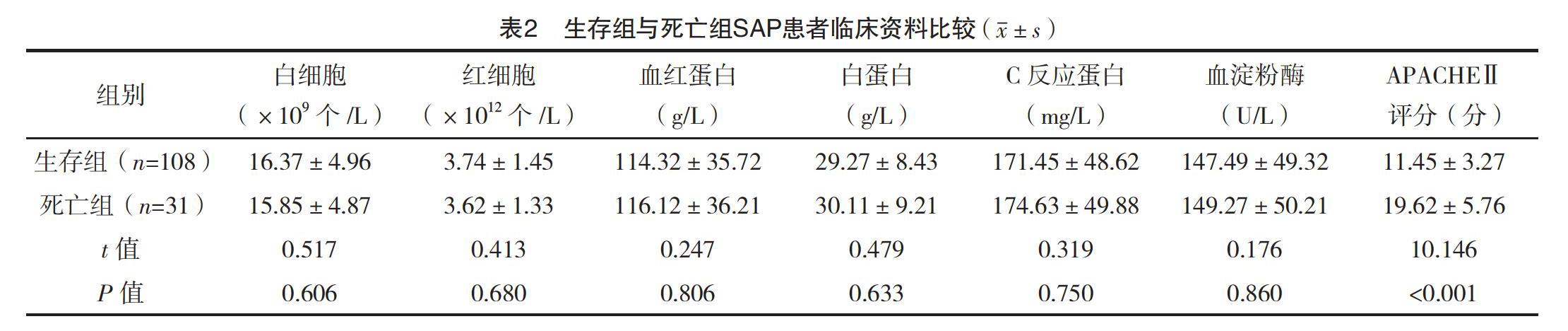

【摘要】 目的:探討CT分级联合血清微小RNA-29c(miR-29c)对重症胰腺炎(SAP)预后的评估作用。方法:回顾性分析2015年6月-2019年11月于本院就诊的139例SAP患者的资料。根据患者预后结果分为生存组108例和死亡组31例。收集患者CT影像学资料,采用实时荧光定量聚合酶链式反应(qRT-PCR)法检测各组血清miR-29c水平,采用logistic回归分析影响SAP患者死亡的危险因素,采用ROC曲线分析CT分级联合血清miR-29c对SAP不良预后的预测价值。结果:死亡组D级患者所占比例低于生存组,E级患者所占比例高于生存组,差异有统计学意义(P<0.05)。死亡组SAP患者血清miR-29c水平低于生存组,差异有统计学意义(P<0.05)。两组白细胞、红细胞、血红蛋白、白蛋白、C反应蛋白及血淀粉酶指标比较,差异均无统计学意义(P>0.05);死亡组SAP患者APACHEⅡ评分高于生存组,差异有统计学意义(P<0.05)。logistic回归分析结果显示,APACHEⅡ评分、CT分级、血清miR-29c水平均是影响SAP患者死亡的独立危险因素(P<0.05)。ROC曲线分析结果显示,CT分级预测SAP不良预后的曲线下面积为0.626,灵敏度为61.3%,特异度为63.9%。血清miR-29c预测SAP不良预后的曲线下面积为0.966,灵敏度为96.8%,特异度为88.9%。CT分级联合血清miR-29c预测SAP不良预后的曲线下面积为0.972,灵敏度为96.8%,特异度为90.7%。结论:CT分级、血清miR-29c均是影响SAP患者死亡的独立危险因素,应用CT分级联合血清miR-29c共同评估SAP患者的预后具有一定临床指导意义。
【关键词】 重症胰腺炎 微小RNA-29c CT分级 预后
Study on Evaluation of CT Grading Combined with Serum miR-29c in Prognosis of Severe Pancreatitis/ZHENG Yekun. //Medical Innovation of China, 2021, 18(12): 00-010
[Abstract] Objective: To evaluate the effect of CT grading combined with serum microRNA-29c (miR-29c) in the evaluation of prognosis of severe pancreatitis (SAP). Method: Data of 139 cases of SAP patients admitted to our hospital from June 2015 to November 2019 were retrospectively analyzed. According to the prognosis, the patients were divided into survival group (108 cases) and death group (31 cases). CT imaging data were collected, and the level of serum miR-29c in each group was detected by real-time fluorescence quantitative polymerase chain reaction (qRT-PCR). Logistic regression was used to analyze the risk factors affecting the mortality of patients with SAP, and ROC curve was used to analyze the predictive value of CT grading combined with serum miR-29c for poor prognosis of SAP. Result: The proportion of grade D patients in the death group was lower than that in the survival group, and the proportion of grade E patients was higher than that in the survival group, the difference was statistically significant (P<0.05). The serum miR-29c level of SAP patients in the death group was lower than that in the survival group, the difference was statistically significant (P<0.05). There were no significant differences in WBC, RBC, hemoglobin, albumin, C-reactive protein and blood amylase between the two groups (P>0.05). The APACHEⅡ score of SAP patients in the death group was higher than that in the survival group, the difference was statistically significant (P<0.05). Logistic regression analysis showed that APACHEⅡ score, CT grade and serum miR-29c level were all independent risk factors affecting the death of SAP patients (P<0.05). The results of ROC curve analysis showed that the area under the curve of CT grading to predict the poor prognosis of SAP was 0.626, the sensitivity was 61.3%, and the specificity was 63.9%. The area under the curve of serum miR-29c for predicting poor prognosis in SAP was 0.966, with a sensitivity of 96.8% and a specificity of 88.9%. The area under the curve of CT grading combined with serum miR-29c for predicting poor prognosis in SAP was 0.972, with a sensitivity of 96.8% and a specificity of 90.7%. Conclusion: CT grading and serum miR-29c are both independent risk factors affecting the death of patients with SAP, and the application of CT grading combined with serum miR-29c to evaluate the prognosis of patients with SAP has certain clinical guiding significance.
[Key words] Severe pancreatitis microRNA-29c CT grading Prognosis
First-authors address: The Sixth Peoples Hospital of Huizhou, Huizhou 516200, China
doi:10.3969/j.issn.1674-4985.2021.12.002
重症急性胰腺炎(severe acute pancreatitis, SAP)是因急性胰腺炎由局部发展累及全身器官及系统而起,伴有脏器功能障碍或出现坏死、脓肿或假性囊肿等局部并发症,或两者兼有,多表现为上腹部明显压痛、肌紧张、腹胀、肠鸣音减弱或消失等,该病病死率高,临床治疗关键是及早发现和诊断,在疾病早期对病情严重程度及预后情况进行评估,对降低SAP患者病死率具有重要意义[1-2]。CT分级评分系统是目前临床上应用最为广泛的诊断SAP最有效的方法,其对预后估计主要是根据胰腺局部的大体病理变化,但须与患者的全身情况的急性生理与慢性健康评分(acute physiology and chronic health evaluation,APACHEⅡ)等评分系统综合分析,较为客观[3-4]。目前,尚未有较高敏感性和特异性的生物学指标用于指导SAP的诊断和预后评估,因此为进一步提高SAP的诊治成功率,急需寻找能有效判断病情、推测预后的生物学指标。……