云南保山喀斯特石漠化地区农田杂草种群组成与多样性特征
2021-06-15刘倩严炜张林辉沈正松熊贤坤李忠贤周迎春段春芳姜太玲李月仙李亚男邰杰杜丽刘光华
刘倩 严炜 张林辉 沈正松 熊贤坤 李忠贤 周迎春 段春芳 姜太玲 李月仙 李亚男 邰杰 杜丽 刘光华
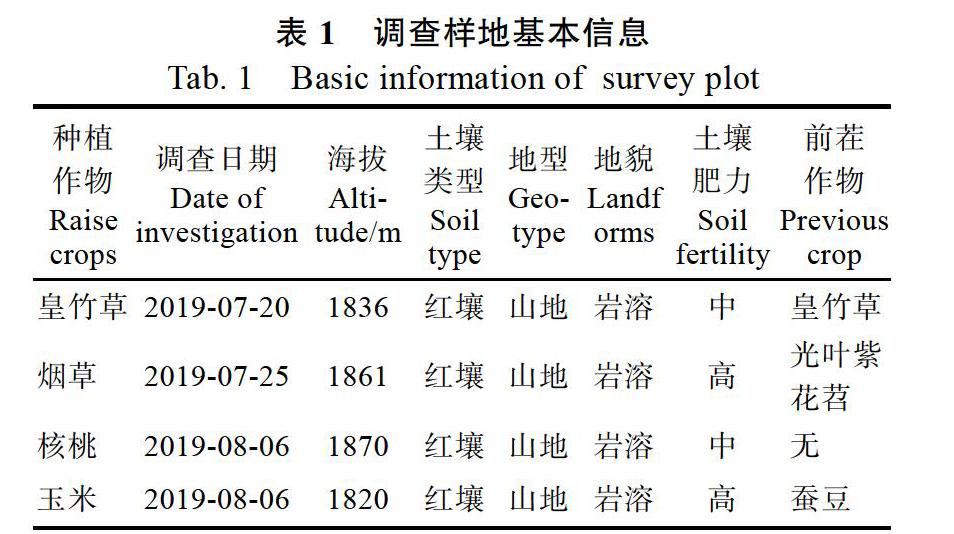
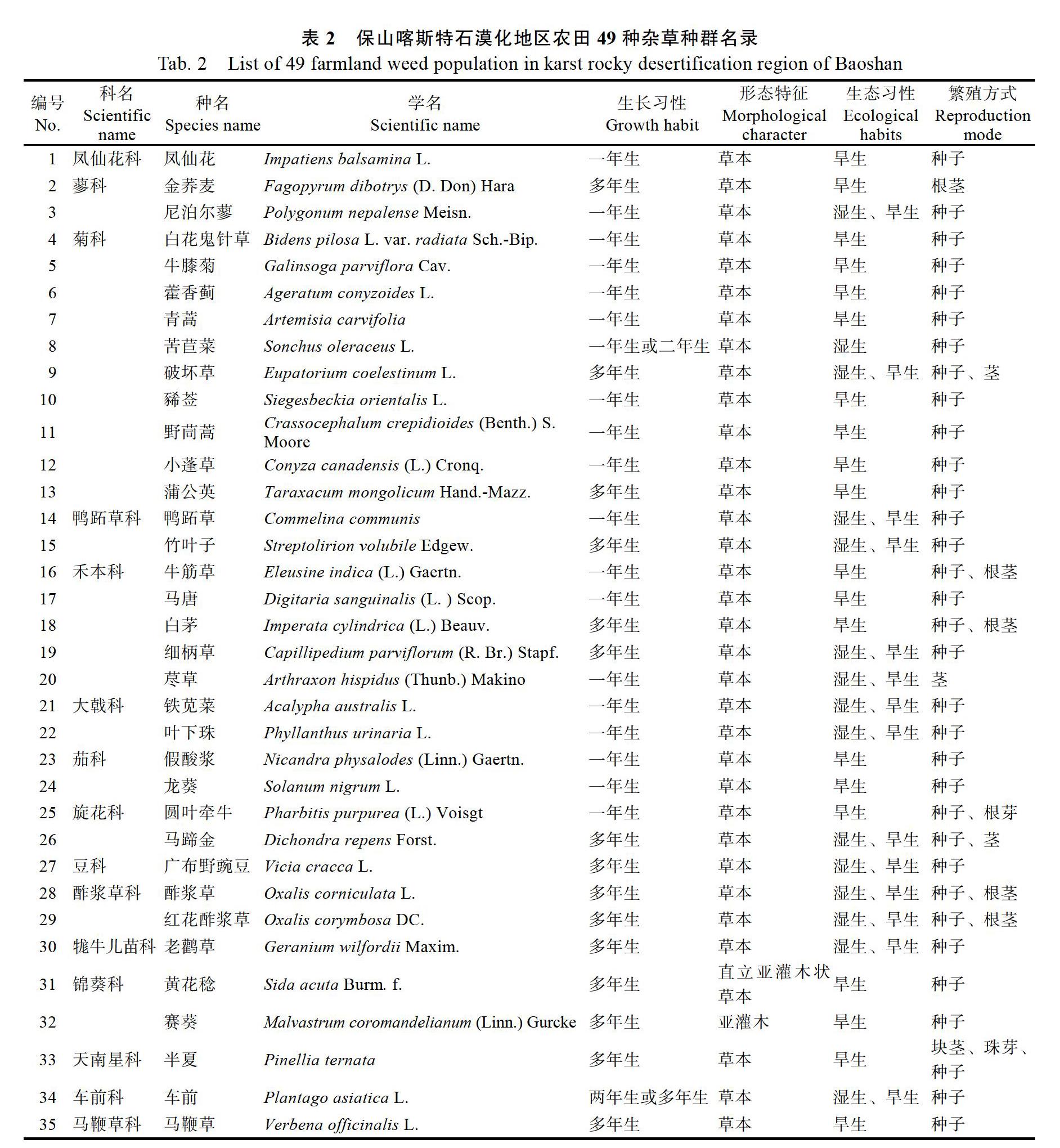
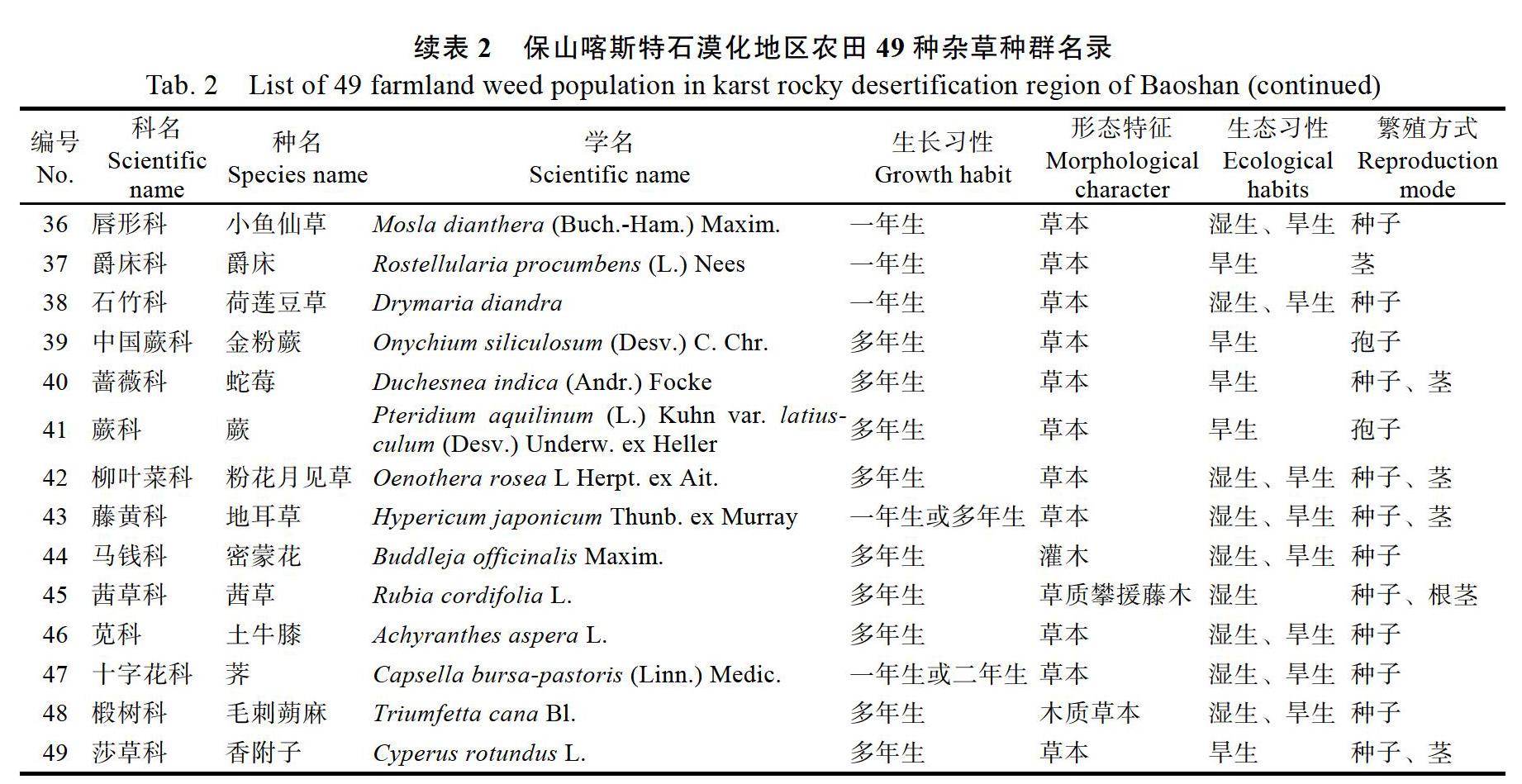
摘 要:為了解云南保山喀斯特石漠化地区农田杂草种群组成及多样性特征,为当地的农田杂草的科学防治提供依据。在保山石漠化地区选择主要作物皇竹草(Pennisetum sinese Roxb)、核桃(Juglans regia L.)、烟草(Nicotiana tabacum L.)、玉米(Zea mays L.)进行农田杂草多样性调查。结果表明,该地区共有30科49种杂草,其中菊科(Compositae)和禾本科(Gramineae)杂草种类最多,发生频度最高的前10种杂草分别是:白花鬼针草(Bidens pilosa L. var. radiata Sch.-Bip.)、牛膝菊(Galinsoga parviflora Cav.)、马唐[Digitaria sanguinalis (L.) Scop.]、鸭跖草(Commelina communis)、金荞麦[Fagopyrum dibotrys (D. Don) Hara]、尼泊尔蓼(Polygonum nepalense Meisn.)、豨莶(Siegesbeckia orientalis L.)、牛筋草[Eleusine indica (L.) Gaertn.]、荷莲豆草(Drymaria diandra)、铁苋菜(Acalypha australis L.);生态位宽度值前10的杂草与发生频度最高的杂草种类一致。核桃地的杂草物种数最多,烟草地最少,样地Shannon(H)指数、均匀度平均数分别为2.83、0.64,农田两两间的Jaccard相异系数、Baray-Curtis距离系数最大的为核桃与烟草,烟草与玉米的Jaccard相异系数最小,距离系数最小的为核桃与玉米,其平均数分别是0.67、0.74,说明保山喀斯特石漠化地区农田杂草多样性高,应结合土壤气候、农事操作等科学防治杂草。
关键词:保山;喀斯特石漠化;种群;多样性
中图分类号:S451 文献标识码:A
Population Composition and Diversity Features of Weed in Farmland of Karst Rocky Desertification Region of Baoshan, Yunnan, China
LIU Qian1, YAN Wei1, ZHANG Linhui1,2, SHEN Zhengsong1, XIONG Xiankun1, LI Zhongxian1, ZHOU Yingchun1, DUAN Chunfang1, JIANG Tailing1, LI Yuexian1, LI Yanan1, TAI Jie3, DU Li4, LIU Guanghua1*
1. Institute of Tropical and Subtropical Cash Crops, Yunnan Academy of Agriculture Sciences, Baoshan, Yunnan 678000, China; 2. Baoshan Quanxin Agricultural Science and Technology CO., Ltd, Baoshan, Yunnan 678000, China; 3. Baoshan Fruits & Vegetables Techniques Support Centre, Baoshan, Yunnan 678000, China; 4. Agricultural Comprehensive Service Center of Wafang Yi and Miao Nationality Township in Longyang District, Baoshan, Yunnan 678009, China
Abstract: In order to understand the population composition and diversity features of weeds in farmland of karst rocky desertification region of Baoshan, Yunnan, and to provides a basis for the scientific control of local farmland weeds, a survey on the diversity of farmland weeds was carried out in the main crops (Pennisetum sinese Roxb, Juglans regia L., Nicotiana tabacum L. and Zea mays L.) in the rocky desertification region of Baoshan. There were 49 species of weeds in 30 families in the region, of which Compositae and Gramineae weeds had the most species. The top ten weeds with the highest occurrence frequency were Bidens pilosa L. var. radiata Sch.-Bip., Galinsoga parviflora Cav., Digitaria sanguinalis (L.) Scop., Commelina communis, Fagopyrum dibotrys (D. Don) Hara, Polygonum nepalense Meisn., Siegesbeckia orientalis L., Eleusine indica (L.) Gaertn., Drymaria diandra, Acalypha australis L.. The top ten weeds in the niche breadth value were consistent with the most frequent weed species. Juglans regia L. fields had the largest number of weed species and Nicotiana tabacum L. fields the least. The average of Shannon (H) index and evenness of the plots was 2.83 and 0.64, respectively. The Jaccard dissimilarity coefficient and Baray-Curtis distance coefficient of Juglans regia L. and Nicotiana tabacum L. were the largest between the farmland. The smallest Jaccard dissimilarity coefficient was Nicotiana tabacum L. and Zea mays L., the Baray-Curtis distance coefficient was Juglans regia L. and Zea mays L., and the averages was 0.67 and 0.74, respectively. It shows that the diversity of weeds in the farmland of karst rocky desertification area of Baoshan is high, and the weed control should be combined with soil climate and agricultural operation scientific controls.
Keywords: Baoshan; karst rocky desertification; population; diversity
DOI: 10.3969/j.issn.1000-2561.2021.04.038
喀斯特石漠化被称为“地球癌症”,是由于自然和人为因素的双重影响,造成地表植被遭破坏,严重的土壤侵蚀导致基岩大面积裸露,砾岩堆积,土壤生产力严重下降,地表呈现类似荒漠化景观的土地退化乃至消失的现象,全球喀斯特分布面积达2.2×10⁷ km2,约占陆地面积的15%,我国西南岩溶地区面临的最为严重的环境灾害,其中以贵州省和云南省最为严重[1-4]。……
