逆境信号下木薯MeMYC2转录因子表达及功能分析
2021-06-15于晓玲郭鑫李淑霞阮孟斌彭明
于晓玲 郭鑫 李淑霞 阮孟斌 彭明
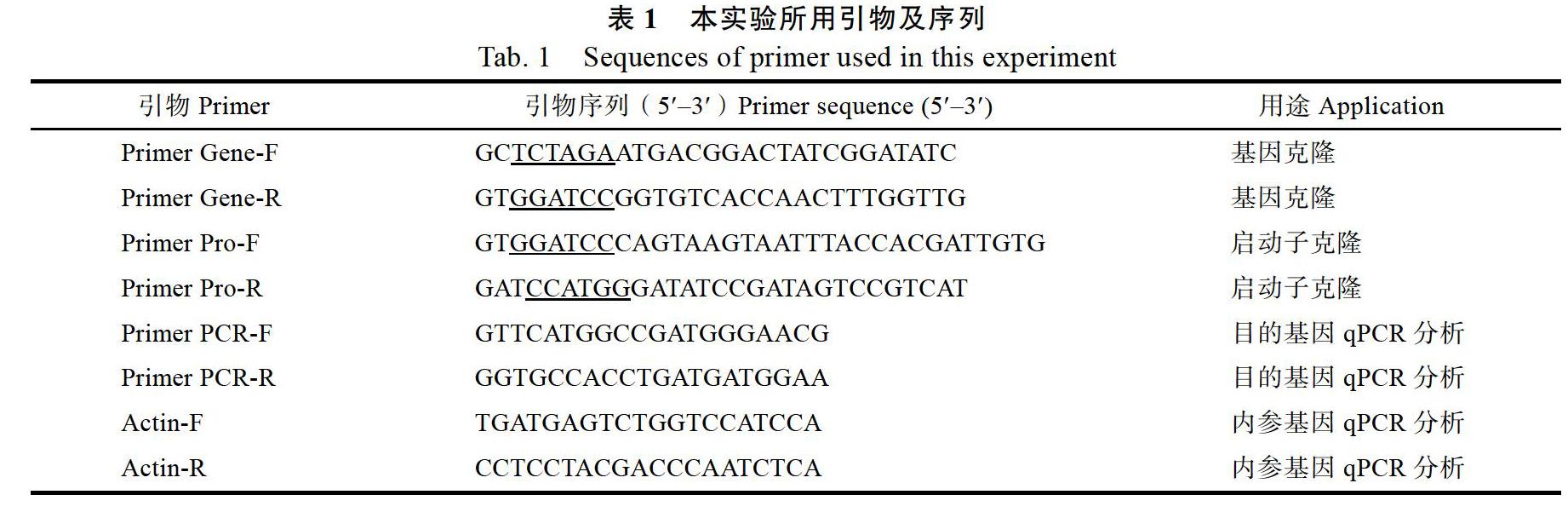
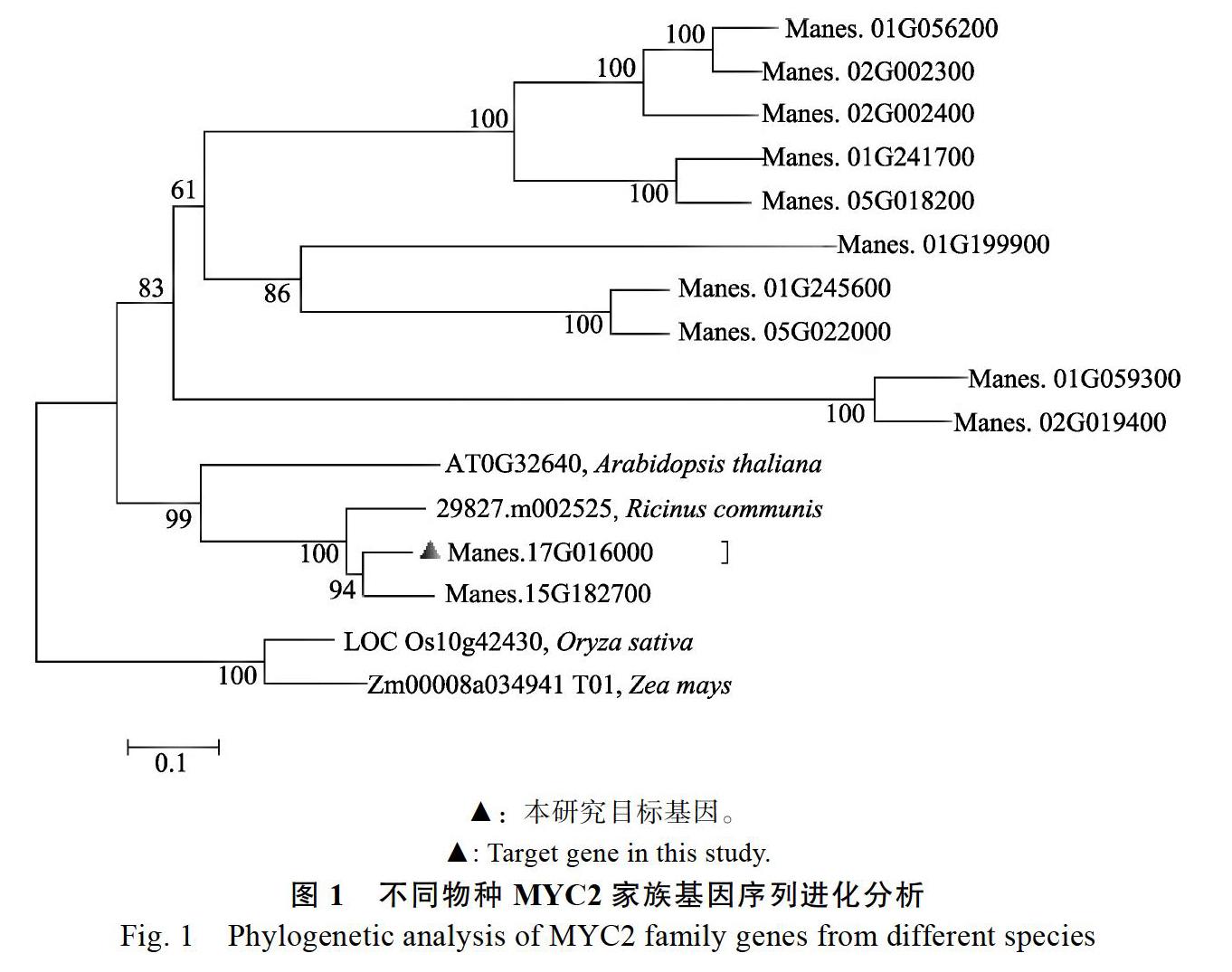
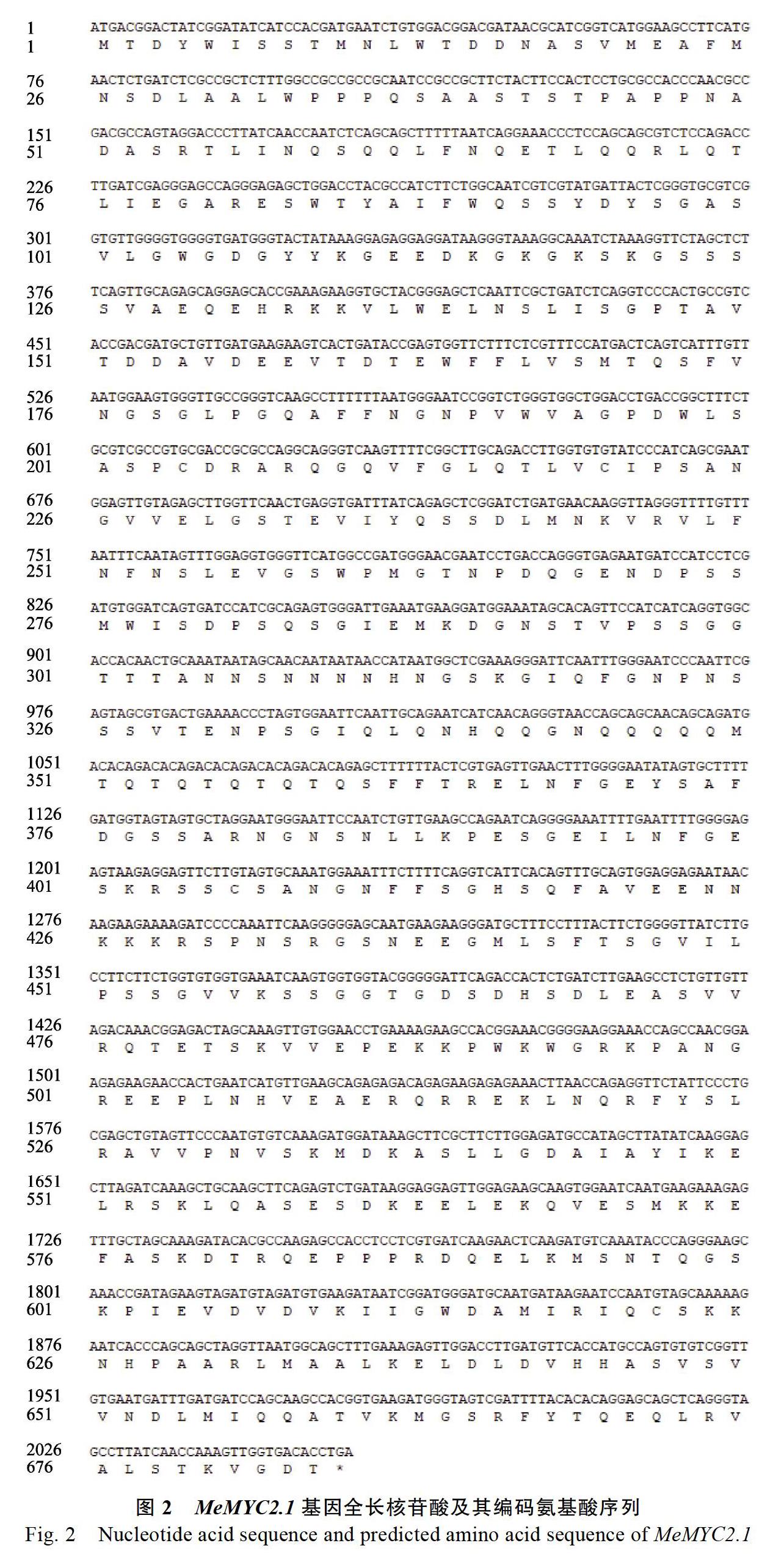
摘 要:MYC2是茉莉酸信号途径中的关键节点基因,在植物生长发育及逆境信号响应过程中发挥重要作用。本研究基于木薯基因组数据库序列,以木薯‘cv. 60444品种为材料,采用RT-PCR方法同源克隆得到MYC2基因(数据库No. Manes.17G016000),命名为MeMYC2.1。MeMYC2.1基因开放阅读框(ORF)全长2055 bp,无内含子,氨基酸序列中包含典型的bHLH保守结构域;序列比对分析发现MeMYC2与蓖麻MYC2具有较高同源性。外源施加植物激素水杨酸(SA)、茉莉酸甲酯(MeJA)、过氧化氢(H2O2)以及低温胁迫下,木薯葉片中MeMYC2.1的表达被显著诱导。进一步克隆获得MeMYC2.1基因上游1500 bp启动子序列,利用在线数据库PlantCare分析发现,MeMYC2.1启动子序列中不仅含有响应茉莉酸的顺式元件CGTCA/TGACG,还含有低温响应元件LTR及ABA响应元件ABRE。以上研究结果表明,MeMYC2.1可能是植物激素茉莉酸(JA)、脱落酸(ABA)响应低温物胁迫分子网络中的一个节点基因,对其功能的深入研究将有助于探讨JAs在植物低温胁迫应答中的作用机制。
关键词:木薯;MeMYC2;逆境信号;茉莉酸;低温胁迫
中图分类号:S533 文献标识码:A
Expression Analysis of MeMYC2 Transcription Factor in Cassava under Stress Signal
YU Xiaoling, GUO Xin, LI Shuxia, RUAN Mengbin, PENG Ming*
Institute of Tropical Bioscience and Biotechnology, Chinese Academy of Tropical Agricultural Science / Hainan Academy of Tropical Agricultural Resource, Haikou, Hainan 571101, China
Abstract: MYC2 TFs is a key node member in Jasmonic acid (JA) signaling pathway, which plays an important role in plant growth, development and response to stress signals. In this study, according to the homologous similarity to AtMYC2 protein sequence, the MYC2 gene (No. Manes.17G016000) was cloned from cassava ‘cv. 60444 cultivar, named as MeMYC2.1. The characteristics of MeMYC2 protein was analyzed using bioinformatics, it encodes 2055 bp open reading frame (ORF) without introns. The N-terminal domain of MeMYC2.1 protein contain a conservative bHLH domain. According to the phylogenetic tree analysis of MYC2, the MeMYC2.1 has high homology with Ricinuscommunis. Under different abiotic stress (exogenous SA/MeJA and low-temperature (4 ℃)/H2O2), the expression pattern of MeMYC2.1 in leaf was analyzed using qRT-PCR. The results showed that the expression of MeMYC2.1was significantlyinduced in leaves under exogenous MeJA/SA/Cold/H2O2 stress. A 1500 bp sequence located in MeMYC2.1 promoter was obtained. PlantCare analysis indicates that MeMYC2.1 promoter sequence contains not only CGTCA/TGACG elements in response to Jasmonic acid but also some stress-defense related elements like LTR, ABRE et al cis-elements. Together, these results indicate that MeMYC2.1 might be a node gene in the molecular interactive network of different phytohormone response to abiotic stress, which contributes to understanding plant resisting abiotic stress through JAs signaling pathway.
Keywords: cassava; MeMYC2; stress signals; JA; low-temperature stress
DOI: 10.3969/j.issn.1000-2561.2021.04.003
起源于南美洲的木薯(Manihot esculenta Cra ntz)是热区(尤其非洲地区)主要的块根粮食作物,生产过程中表现出明显的抗旱、耐贫瘠、对低温敏感的特性。低温条件下木薯发育迟缓、毒性物质累积,其品质、产量受到很大的影响[1]。增强木薯对低温的耐受性,对木薯产业发展具有重要作用。
目前国内外对木薯低温响应的研究主要集中在低温下游功能基因的表达对植株耐低温的影响,如苯丙胺代谢途径关键基因(苯丙胺酸解氨酶PAL)的克隆与分析[1];SAD硬酯酞脱-ACP脱饱和酶促進膜脂不饱和脂肪酸的含量[2];ROS清除相关MeCu/ZnSOD和MeCAT1过表达株系对低温表现为显著的耐受性[3]。……
