8种杀菌剂对马铃薯炭疽病病菌室内毒力测定
2021-05-12惠娜娜王立郑果李继平李培玲郭子坤
惠娜娜 王立 郑果 李继平 李培玲 郭子坤
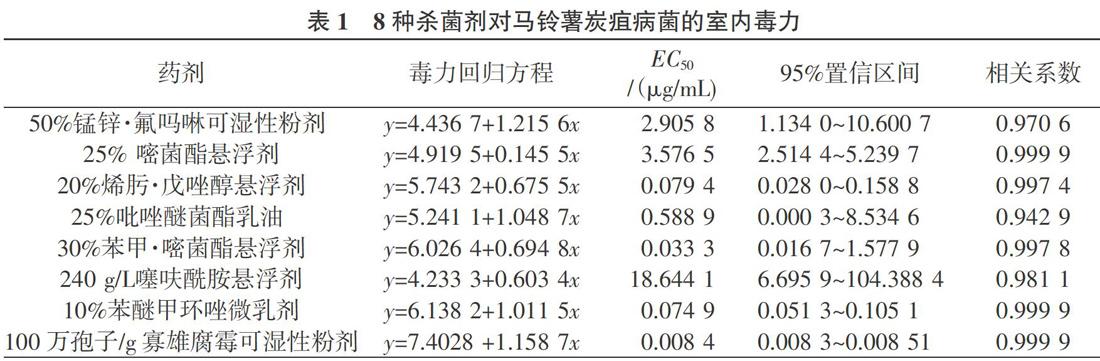
摘要:由球炭疽菌(Colletotrichum coccodes)引起的马铃薯炭疽病在甘肃省马铃薯产区发生日趋严重,严重影响马铃薯的产量和品质。选用8种杀菌剂开展了马铃薯炭疽病菌室内毒力测定,结果表明,生物药剂100万孢子/g寡雄腐霉可湿性粉剂对炭疽病菌毒力最强,EC50为0.008 2 μg/mL;其次为30%苯甲·嘧菌酯悬浮剂、10%苯醚甲环唑微乳剂、20%烯肟·戊唑醇悬浮剂和25%吡唑醚菌酯悬浮剂,EC50分别为0.033 3 μg/mL、0.074 9 μg/mL、0.079 4 μg/mL和0.822 9 μg/mL。表明寡雄腐霉、苯甲·嘧菌酯、苯醚甲环唑、烯肟·戊唑醇和吡唑醚菌酯对马铃薯炭疽病菌抑制效果较好,理论上可用于马鈴薯炭疽病防治。
关键词:马铃薯炭疽病;杀菌剂;毒力测定
中图分类号:S435.32 文献标志码:A 文章编号:1001-1463(2021)04-0022-03
doi:10.3969/j.issn.1001-1463.2021.04.007
Report on Breeding of New Tartary Buckwheat Line Dingkuqiao 2
MA Ning, ZHAO Xiaoqin, LIU Yanming, LIU Junxiu, JIA Ruiling
(Dingxi Academy of Agricultural Sciences, Dingxi Gansu 743000, China)
Abstract:A new tartary buckwheat line Dingkuqiao 2 was systematically bred from Zhenbakuqiao. In 2016 — 2018, the average yield of 3 a 15 sites(times) of Dingkuqiao 2 was 2 693.40 kg/hm2 and 10.57% higher than that of the control Chuanqiao 1 in Regional Experiment. The line is medium and early maturing, the growth period was 97 days, and the plant height was about 121.7 cm, the branch of stem was 6.1, node number of stem was 16.3, 1 000-grains weight was 3.0 g and seeds weight per-plant was 18.0 g. The plant type is compact, the grain is long conical, grayish black. The grain content of crude starch, crude fat, protein, water content and flavonoids compounds were 57.60%, 2.48%, 11.7%, 9.18 g/100 g and 2.94 g/100 g, respectively. It has good drought resistance, resistance to brown spot disease and rotation disease, high yield and stable yield. It is suitable to be grown in below 1 800~2 400 m in Arid and Semi-arid Area and similar areas.
Key words:Fagopyrum tartaricun;New Line Dingkuqiao 2;Breeding
马铃薯(Solanum tuberosum Linn.)属茄科作物,耐旱、耐寒、耐瘠薄,对环境适应性强等,现已遍布世界各地。马铃薯是全球仅次于小麦和玉米的第三大粮食作物,得天独厚的地理环境和自然条件使甘肃省成为全国马铃薯三大主产区之一和全国最大的脱毒种薯繁育基地、全国重要的商品薯生产基地和薯制品加工基地。近年来,随着产业升级及种植结构的调整,球炭疽菌(Colletotrichum coccodes)引致的马铃薯炭疽病已成为甘肃省马铃薯生产中的主要储藏病害之一[1 ],该病害主要通过种薯和土壤传播,侵染马铃薯各个生长部位[2 ],造成马铃薯植株提前枯死,可减产22%~30%[3 ],严重影响马铃薯的产量和品质[4 - 5 ]。马铃薯炭疽病菌以小菌核的形式在块茎、作物的碎屑和土壤中越冬,且在土壤中可存活13 a之久,具有潜在危害性 [6 ]。……