低分子肝素联合左卡尼汀治疗对终末期肾病患者临床疗效及Alb、Hb、TP、PAB水平的影响
2021-05-07李红微
李红微
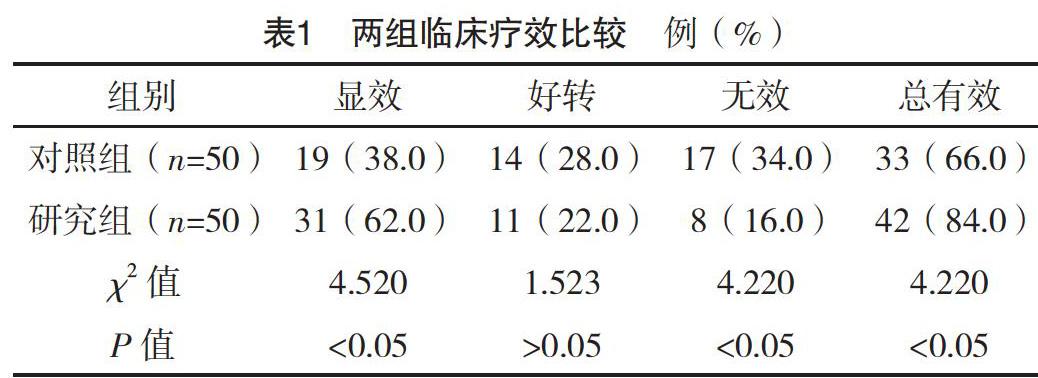
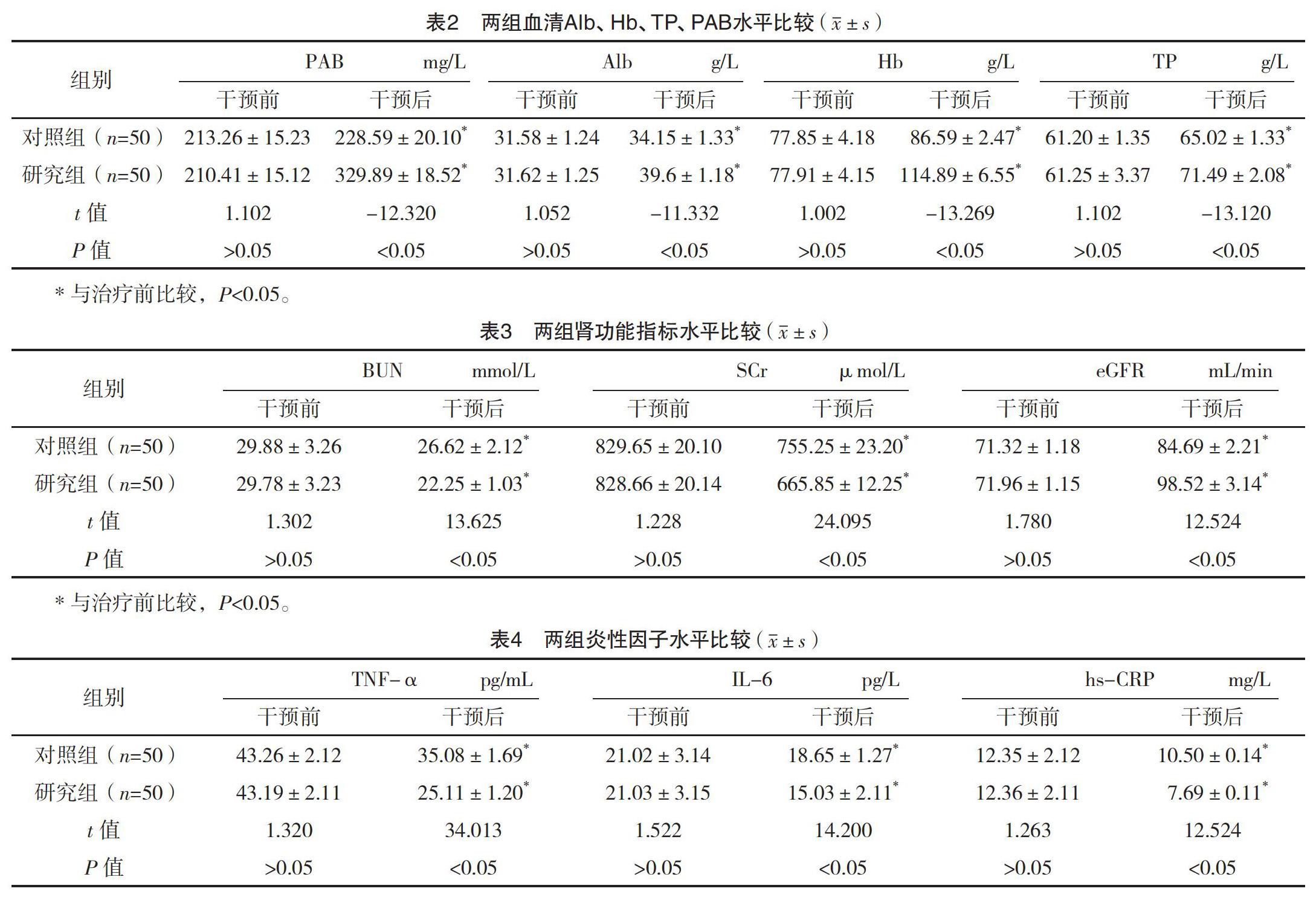
【摘要】 目的:探讨低分子肝素联合左卡尼汀治疗对终末期肾病患者临床疗效及Alb、Hb、TP、PAB水平的影响。方法:选取2018年7月-2020年6月本院治疗的终末期肾病患者100例,依据治疗方案的不同分为研究组和对照组,各50例。对照组低分子肝素治疗,研究组应用低分子肝素联合左卡尼汀治疗。对比两组患者临床治疗效果、两组血清Alb、Hb、TP、PAB水平、腎功能水平以及对比两组血清中炎性水平。结果:研究组的总效率高于对照组,差异有统计学意义(P<0.05)。干预后,两组血清Alb、Hb、TP、PAB水平均升高,且研究组各指标水平均高于对照组,差异均有统计学意义(P<0.05)。干预后,两组BUN、SCr水平均降低,且研究组BUN、SCr水平均低于对照组,研究组eGFR升高且高于对照组,差异均有统计学意义(P<0.05)。干预后,两组血清中IL-6、TNF-α、hs-CRP水平均降低,且研究组各指标水平均低于对照组,差异均有统计学意义(P<0.05)。结论:将低分子肝素联合左卡尼汀治疗方案应用至终末期肾病患者的治疗当中,利于患者治疗效果的提升,还利于改善血清Alb、Hb、TP、PAB水平,调节炎性状态,促进肾功能改善。
【关键词】 低分子肝素 左卡尼汀 终末期肾病
[Abstract] Objective: To investigate the effect of Low Molecular Weight Heparin combined with Levocarnitine on the clinical efficacy and the levels of Alb, Hb, TP and PAB in patients with end-stage renal disease (ESRD). Method: A total of 100 end-stage renal disease patients admitted to our hospital from July 2018 to June 2020 were selected, they were divided into study group and control group according to different treatment regimens, 50 cases in each group. The control group was treated with Low Molecular Weight Heparin, the study group was treated with Low Molecular Weight Heparin combined with Levocarnitine. The clinical therapeutic effect, serum Alb, Hb, TP, PAB levels, renal function levels and serum inflammatory levels were compared between the two groups. Result: The total efficiency of the study group was higher than that of the control group, the difference was statistically significant (P<0.05). After intervention, serum Alb, Hb, TP and PAB levels in the two groups were all increased, the levels of all indicators in the study group were higher than those in the control group, with statistically significant differences (P<0.05). After the intervention, the levels of Bun and SCr in the two groups were decreased, the levels of Bun and SCr in the study group were lower than those in the control group, the eGFR in the study group was increased and higher than that in the control group, the differences were statistically significant (P<0.05).After intervention, serum levels of IL-6, TNF-α and hs-CRP in the two groups were all decreased, the levels of all indicators in the study group were lower than those in the control group, with statistically significant differences (P<0.05). Conclusion: Low Molecular Weight Heparin combined with Levocarnitine in the treatment of patients with end-stage renal disease, is conducive to the improvement of the treatment effect of patients, but also conducive to improve the level of serum Alb, Hb, TP, PAB, regulate the inflammatory state, promote the improvement of renal function.
[Key words] Low Molecular Weight Heparin Levocarnitine End-stage renal disease
First-authors address: Liaoyang City Central Hospital, Liaoyang 111000, China
doi:10.3969/j.issn.1674-4985.2021.03.031
终末期肾病属于全身性炎症状态性疾病,该病的发生跟慢性肾衰竭存在者密切关联。当前医疗阶段,医院多对患者进行血液透析进行治疗,血液透析治疗可在一定程度上促进机体内的代谢废物排除,维持机体电解质及酸碱平衡,使各临床患病症状得到有效缓解[1]。但单纯进行血液透析治疗所产生的临床疗效与预期目标相差甚远,由于血液透析所产生的血流动力学水平较小,需要应用抗凝剂[2]。相关研究指出,低分子肝素不但可发挥抗凝效果,还适用于患者透析后微炎症状态的维持,降低并发症发生率[3]。此外,虽然长期血液透析治疗可使患者存活率得到提升,但透析治疗不能完全清除代谢产物,会引发神经系统以及消化系统发生异常,且透析患者往往存在营养不良及微炎性反应状态[4]。所以为提升患者机体营养状态,确保临床效果,本研究对患者应用低分子肝素联合左卡尼汀治疗,并探究该治疗方案产生的临床疗效及对Alb、Hb、TP、PAB水平的影响,现报道如下。……