右美托咪定腰丛-坐骨神经阻滞麻醉对胫腓骨骨折患者镇静效果及苏醒质量的影响
2021-05-06杨妍蓉
杨妍蓉
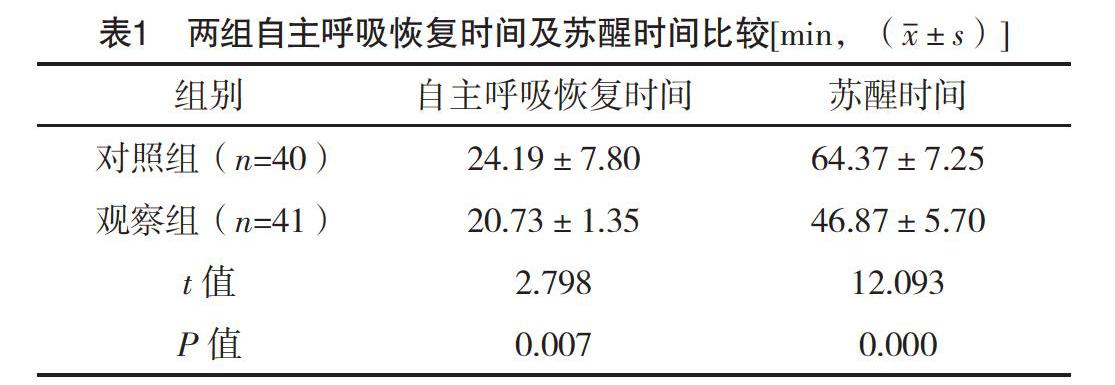


【摘要】 目的:探討右美托咪定腰丛-坐骨神经阻滞麻醉对胫腓骨骨折患者镇静效果及苏醒质量的影响。方法:选择2019年3月-2020年3月本院接收的81例胫腓骨骨折患者,采用随机数字表法将其分为对照组(40例)与观察组(41例)。对照组采用达唑仑腰丛-坐骨神经阻滞麻醉,观察组采用右美托咪定腰丛-坐骨神经阻滞麻醉。记录两组血流动力学指标、苏醒质量及不良反应。结果:于T1、T2时间段,两组SpO2水平较T0时均降低,MAP、HR水平较T0时均升高,且观察组SpO水平均高于对照组,MAP、HR水平均低于对照组,差异均有统计学意义(P<0.05);于T3、T4时间段,两组SpO2、MAP、HR水平均呈逐渐恢复状态,且观察组SpO2水平均高于对照组,MAP、HR水平均低于对照组,差异均有统计学意义(P<0.05)。观察组自主呼吸恢复与苏醒时间均比对照组短,差异均有统计学意义(P<0.05)。观察组不良反应发生率比对照组低,但两组比较差异无统计学意义(P>0.05)。结论:对胫腓骨骨折患者采用右美托咪定腰丛-坐骨神经阻滞麻醉的镇静效果显著,血流动力学稳定,可缩短自主呼吸恢复时间及苏醒时间,且未增加不良反应,值得借鉴。
【关键词】 胫腓骨骨折 右美托咪定 腰丛-坐骨神经阻滞麻醉 镇静效果 苏醒质量
The Effect of Dexmedetomidine Lumbar Plexus-sciatic Nerve Block Anesthesia on Sedation and Recovery Quality of Patients with Tibiofibular Fracture/YANG Yanrong. //Medical Innovation of China, 2021, 18(01): 0-026
[Abstract] Objective: To investigate the effect of Dexmedetomidine lumbar plexus-sciatic nerve block anesthesia on the sedative and recovery quality of patients with tibiofibular fracture. Method: A total of 81 patients with tibiofibular fractures admitted to our hospital from March 2019 to March 2020 were selected, they were divided into control group (40 cases) and observation group (41 cases) by random number table method. The control group was anestheted with Dazolam lumbar plexus-sciatic nerve block, while the observation group was anestheted with Dexmedetomidine lumbar plexus-sciatic nerve block. Result: At T1 and T2, SpO2 levels in both groups decreased compared with T0, MAP and HR levels increased compared with T0, SpO2 levels in the observation group were higher than those in the control group, MAP and HR levels were lower than those in the control group, the differences were statistically significant (P<0.05); in the time period of T3 and T4, the SpO2, MAP, and HR levels of the two groups showed a gradual recovery state, the SpO2 level of the observation group was higher than that of the control group, MAP and HR levels of the observation group were lower than the control group, the differences were statistically significant (P<0.05). The spontaneous breathing recovery and wake-up time of the observation group were shorter than those of the control group, the difference was statistically significant (P<0.05). The incidence of adverse reactions in the observation group was lower than that in the control group, but the difference between the two groups was not statistically significant (P>0.05). Conclusion: Dexmedetomidine lumbar plexus-sciatic nerve block anesthesia for patients with tibia and fibula fractures has a significant sedative effect, stable hemodynamics, can shorten the recovery time and recovery time of spontaneous breathing without increasing adverse reactions, its worth learning.
[Key words] Tibiofibular fracture Dexmedetomidine Lumbar plexus-sciatic nerve block anesthesia Sedative effect Recovery quality
First-authors address: Jiamusi Hospital of Traditional Chinese Medicine, Jiamusi 154002, China
doi:10.3969/j.issn.1674-4985.2021.01.006
脛腓骨骨折是临床上较为常见的骨折类型之一,临床表现为功能障碍、疼痛、局部肿胀、成角畸形及患肢缩短等,严重影响患者的身心健康[1]。以往临床采用较多的是椎管内麻醉等传统麻醉方式,镇静效果虽良好,但局部患者易出现阻滞平面过高,血流动力学大幅度波动,严重干扰脏器灌注状态,以至于增加了术中麻醉管理的难度系数[2-3]。因此,选择合理的麻醉方式至关重要。神经刺激器引导下腰丛联合坐骨神经阻滞具有麻醉定位准确的特点,且对呼吸系统与循环均无较大影响,目前已被临床广泛应用。……
