静脉用药调配中心2 219条不合理医嘱分析
2021-03-27黄享贞温坚坤陈伟钊
黄享贞 温坚坤 陈伟钊

【关键词】 静脉用药调配中心 不合理医嘱 改进措施
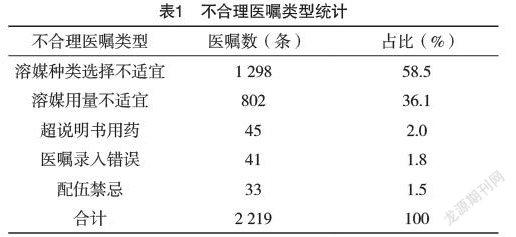
[Abstract] Objective: To summarize and analyze the types and characteristics of irrational medical orders in pharmacy intravenous admixture service (PIVAS) of Jiangmen Central Hospital, so as to provide reference materials for clinical rational drug use and promote the safety and rational drug use of patients. Method: The retrospective analysis was performed on 669 989 medical orders of intravenous drug dispensing in PIVAS of our hospital from January 2020 to September 2020, and the irrational medical orders were classified and statistically analyzed from the aspects of information integrity, incompatibility, usage and dosage of drugs, and suitability of solvent carrier. Result: Among the 669 989 prescriptions, 2 219 (0.3%) were irrational medical orders. Among them, 1 298 (58.5%) were unsuitable for solvent type selection; 802 (36.1%) were unsuitable for solvent dosage; 45 (2.0%) were off label medication; 41 (1.8%) were medical order entry errors; 33 (1.5%) were incompatibility. Among the 802 irrational medical orders of solvent dosage, the most irrational medical orders were 201 (25.1%) involving Chinese patent medicine injection. Irrational medical orders involved 12 categories of drugs, 87 varieties, mainly anti infective drugs, digestive system drugs and Chinese patent medicines. Conclusion: After the audit and intervention of PIVAS pharmacists, our hospital has achieved certain results in rational drug use, but there are still many deficiencies, it is necessary to further strengthen the communication and cooperation among doctors, drugs and nurses, continuously improve, give full play to the role of pharmaceutical personnel, and promote rational, safe and economic drug use in clinical practice.
[Key words] Pharmacy intravenous admixture service Irrational medical orders Improvement measures
First-author’s address: Jiangmen Central Hospital, Jiangmen 529000, China
doi:10.3969/j.issn.1674-4985.2021.26.044
静脉用药调配中心(PIVAS)是指医疗机构药学部门根据医生用药医嘱,经药师适宜性审核后,按无菌操作要求在洁净环境下由药学技术人员进行集中调配。随着“智能静配”的发展,提高了药品管理水平、提升了工作效率,降低了药学人员工作强度,投入更多的精力开展优质、安全、个体化的药学服务,加快药学服务模式向“以患者为中心”转变[1-2]。PIVAS的建立确保了医院成品输液的质量安全,有效促进临床合理用药、减少用药错误[3]。江门市中心医院(以下简称“本院”)PIVAS成立于2011年,目前负责全院48个病区的静脉用药医嘱审核与调配,本研究拟通过对2020年1-9月PIVAS审核不合理的2 219条医嘱进行归纳汇总,为临床用药提供参考,进一步促进临床用药合理性,保障患者用药的安全性、有效性、经济性。
1 对象与方法
1.1 研究对象 调取2020年1-9月本院PIVAS的全部静脉用药调配医嘱,共669 989条。均为住院长期医嘱,临时医嘱不纳入统计范围,并排除化疗和肠外营养医嘱。
1.2 方法 按照《处方管理办法》的相关规定,参照药品说明书、《新编药物学》(第17版)、《459种中西药注射剂临床配伍应用检索表》[4-6]。采用回顾性分析本院全部静脉用药调配医嘱。主要审核内容包括:医嘱信息的完整性、合理性;药品的正确性与适宜性(给药途径、用法用量等);药物配伍的合理性;溶媒载体的适宜性等。
1.3 统计学处理 计数资料以率(%)表示。
2 结果
2.1 不合理医嘱类型 经PIVAS药师审核干预,在669 989条配液医嘱中,不合理医嘱有2 219条,占比0.3%。……
