脓毒症患者预后的影响因素分析
2021-03-27程坤余广炜赵力澜薛贻敏
程坤 余广炜 赵力澜 薛贻敏
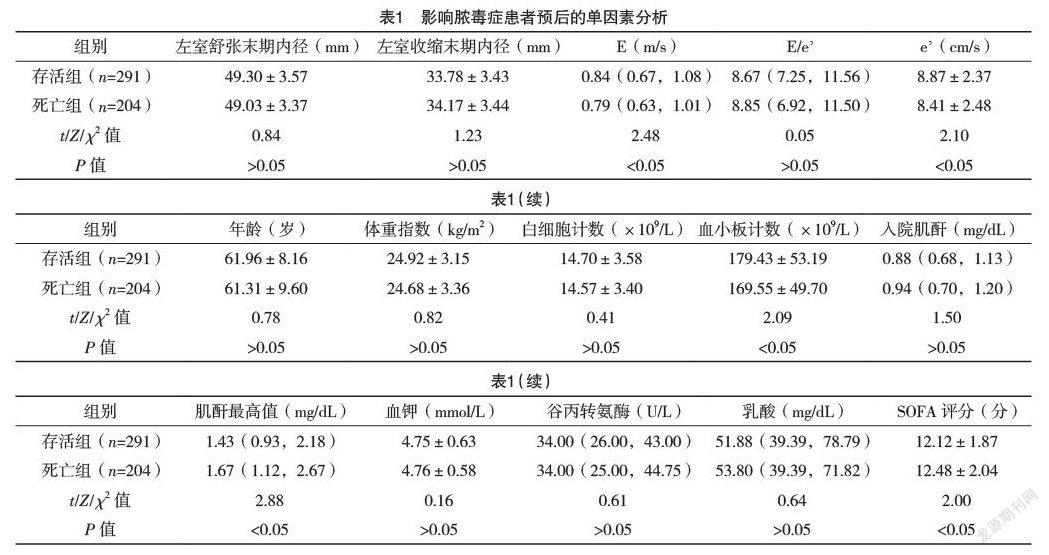

【摘要】 目的:探讨影响脓毒症患者预后的因素。方法:回顾性分析2013年1月-2019年12月福建省立医院重症医学四科及福建医科大学附属协和医院急诊监护室(统称ICU)495例脓毒症患者的临床资料。根据在院临床结局,将患者分为死亡组(n=204)和存活组(n=291)。采用多因素logistic回归分析影响预后的独立危险因素。结果:两组E、e、血小板计数、肌酐最高值、SOFA评分、ICU住院时间、心功能分级、腹腔感染、机械通气、2型糖尿病、冠心病比较,差异均有统计学意义(P<0.05)。多因素分析结果显示,E、血小板计数、ICU住院天数、腹腔感染、机械通气、2型糖尿病、冠心病是影响脓毒症患者死亡的独立影响因素(P<0.05)。结论:E、血小板计数、ICU住院时间、机械通气、腹腔感染、合并冠心病、2型糖尿病是影响脓毒症患者预后的独立因素。
【关键词】 脓毒症 左心室舒张功能障碍 二尖瓣舒张早期血流峰速度 预后
[Abstract] Objective: To explore the factors affecting the prognosis of patients with sepsis. Method: Clinical data of 495 patients with sepsis in the fourth department of Critical Care Medicine of Fujian Provincial Hospital and the Emergency Care Unit of Union Hospital affiliated to Fujian Medical University (general ICU) from January 2013 to December 2019 were retrospectively analyzed. According to the clinical outcome in hospital, the patients were divided into death group (n=204) and survival group (n=291). Multivariate logistic regression was used to analyze independent risk factors affecting prognosis. Result: Comparison of E, e, platelet count, maximum creatinine, SOFA score, ICU stay, cardiac function grade, abdominal infection, mechanical ventilation, type 2 diabetes and coronary heart disease between the two groups, the differences were statistically significant (P<0.05). Multivariate analysis showed that E, platelet count, ICU stay, abdominal infection, mechanical ventilation, type 2 diabetes and coronary heart disease were independent factors affecting the death of sepsis patients (P<0.05). Conclusion: E, platelet count, ICU hospitalization time, mechanical ventilation, abdominal infection, coronary heart disease, and type 2 diabetes are independent factors affecting the prognosis of patients with sepsis.
[Key words] Sepsis Left ventricular diastolic dysfunction Mitral valve early diastolic peak velocity Prognosis
First-authors address: Fujian Provincial Hospital, Fuzhou 350001, China
doi:10.3969/j.issn.1674-4985.2021.26.001
膿毒症是指由宿主对感染的反应失调导致器官功能障碍的一种危及生命的情况,是一种常见的高死亡率综合征[1]。随着潜在感染的治疗,器官灌注的优化是脓毒症治疗的主要手段,包括静脉输液和升压药的使用。心脏是脓毒症受累的重要器官之一,脓毒症患者常发生心肌损伤,并出现舒张和/或收缩功能障碍在内的心功能不全,也是脓毒症患者死亡的重要原因[2]。脓毒症舒张功能障碍与脓毒症患者液体复苏相关,左心室充盈压升高与死亡率密切相关[3-4]。随着血流动力学监测和心脏超声技术的发展,2009年美国超声心动图学会修订了舒张功能障碍的定义,但是由于其测量的复杂性,且危重症患者中经常发生心动过速或心房颤动等心律失常,因此操作测量上常存在一定困难。……
