凝血指标对颅脑损伤患者病情程度和预后的影响
2021-01-05闻贤强颜艾
闻贤强 颜艾


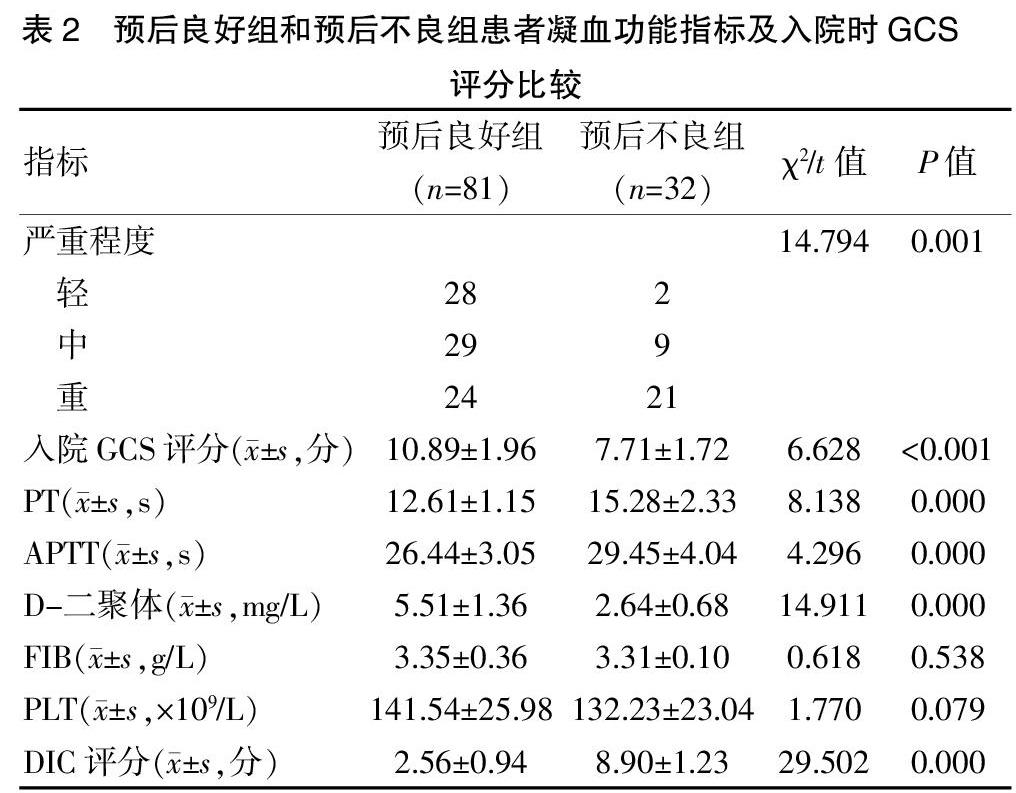
[摘要] 目的 評价凝血指标对颅脑损伤患者病情程度和预后的影响。 方法 选取2016年10月至2019年12月我院收治的113例颅脑损伤患者作为研究对象,分别于入院时、伤后3个月检测所有患者的凝血功能指标(PT、APTT、D-二聚体、FIB、PLT及DIC评分),并采用格拉斯哥昏迷量表(GCS)进行评分,根据GCS评分将患者分为轻度组、中度组及重度组,比较各组患者凝血功能指标差异,根据伤后3个月格拉斯哥预后量表(GOS)评分将患者分为预后良好组和预后不良组,采用多因素Logistic回归分析影响颅脑损伤预后的独立危险因素。 结果 轻度组、中度组及重度组颅脑损伤患者PT明显延长,D-二聚体及DIC评分明显升高,差异有统计学意义(P<0.05),两两比较结果显示,三组患者PT、D-二聚体及DIC评分比较,差异均有统计学意义(P<0.05),而不同严重程度颅脑损伤患者APTT、FIB及PLT比较,差异无统计学意义(P>0.05);单因素分析结果显示,入院病情严重程度为重度、GCS评分、PT和APTT延长、D-二聚体升高及DIC评分升高是导致颅脑损伤患者预后不佳的影响因素(P<0.05);将上述指标纳入多因素Logistic分析结果显示,入院时低GCS评分、PT延长、D-二聚体及DIC评分升高是导致颅脑损伤患者预后不良的独立危险因素(P<0.05)。 结论 凝血功能指标异常与颅脑损伤患者病情严重程度和预后密切相关,临床上可根据凝血功能水平判断患者病情,从而采取针对性诊疗措施,改善患者预后。
[关键词] 凝血功能;颅脑损伤;预后;病情程度
[中图分类号] R651.1 [文献标识码] B [文章编号] 1673-9701(2021)30-0077-04
[Abstract] Objective To evaluate the influence of coagulation indexes on the severity and prognosis of patients with craniocerebral injury. Methods A total of 113 patients with craniocerebral injury admitted to our hospital from October 2016 to December 2019 were selected as research objects. Coagulation indexes (PT, APTT, D-dimer, FIB, PLT and DIC scores) of all patients were detected at admission and 3 months after injury. Patients were divided into mild group, moderate group and severe group according to Glasgow coma scale (GCS) score. The differences of coagulation function indexes of patients in each group were compared. According to GOS scores at 3 months after injury, the patients were divided into good prognosis group and poor prognosis group. Multivariate Logistic regression was used to analyze the independent risk factors affecting the prognosis of craniocerebral injury. Results PT was significantly prolonged. D-dimer and DIC scores were significantly increased in patients with mild, moderate and severe craniocerebral injury, with statistically significant differences (P<0.05). There were significant differences in PT, D-dimer and DIC scores among the three groups (P<0.05). There was no significant difference in APTT, FIB and PLT among patients with craniocerebral injury of different severity(P>0.05). Univariate analysis showed that the severity of disease at admission, GCS score, prolongation of PT and APTT, the increase of D-dimer and DIC score were the influencing factors leading to poor prognosis of patients with craniocerebral injury(P<0.05). The results of multivariate Logistic analysis showed that low GCS score, prolonged PT, increased D-dimer and DIC score were independent risk factors for poor prognosis of patients with craniocerebral injury(P<0.05). Conclusion Abnormal coagulation function indicators are closely related to the severity and prognosis of patients with craniocerebral injury. Clinically, patients′ condition can be judged according to the level of coagulation function, so that targeted diagnosis and treatment measures can be taken to improve the prognosis of patients.
[Key words] Coagulation function; Craniocerebral injury; Prognosis; Severity of illness
颅脑损伤(Traumatic brain injury,TBI)是临床常见外伤之一,因其高致残率、高死亡率倍受关注[1]。……