西瓜枯萎病田间调查及其病原菌鉴定
2020-12-21陈燕萍刘欣肖荣凤朱育菁刘波
陈燕萍 刘欣 肖荣凤 朱育菁 刘波
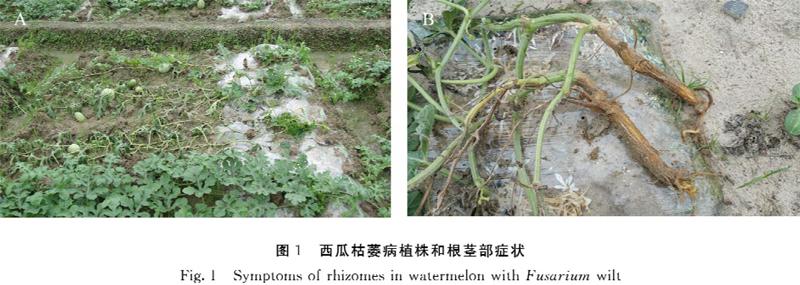
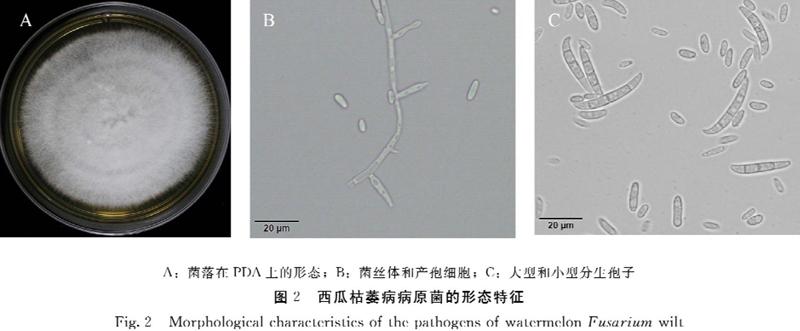

摘 要:对福建省4个地区种植西瓜实生苗田块的枯萎病发病率进行调查,结果表明:西瓜枯萎病的田间平均发病率在18.5%~38.2%。从不同地点采集的发病植株上共分离、纯化和保存了31株菌株,结合菌株的形态学特征、镰刀菌属特异引物Fu3/Fu4和尖孢镰刀菌特异性引物FOF1/FOR1检测以及致病性测定,确定了尖孢镰刀菌Fusarium oxysporum为福建省西瓜枯萎病的主要病原菌,其中尖孢镰刀菌占总分离菌株数量的93.54%。
关键词:西瓜;枯萎病;发病率;病原鉴定
中图分类号:S651 文献标志码:A 文章编号:0253-2301(2020)08-0032-06
DOI: 10.13651/j.cnki.fjnykj.2020.08.007
Abstract: The incidence of Fusarium wilt in the fields of planting the watermelon seedlings at the 4 regions of Fujian Province was investigated. The results showed that the average incidences of Fusarium wilt was from 18.5% to 38.2% in the different fields. A total of 31 strains were isolated, purified and preserved from the diseased plants collected from the different sites. Fusarium oxysporum was identified as the main pathogen of Fusarium wilt of watermelon in Fujian Province based on the morphological characteristics, PCR amplification of the specific primers Fu3/Fu4 for Fusarium gene and FOF1/FOR1 for Fusarium oxysporum, and the pathogenicity test. And Fusarium oxysporum accounted for 93.54% of the total number of isolated strains.
Key words: Watermelon; Fusarium wilt; Incidence; Pathogen identification
西瓜是福建省的主要經济作物之一,据不完全统计福建省西瓜年均栽培面积约3.5万hm2以上,产量约130万t以上[1]。随着西瓜种植年限的增加,连作障碍愈发凸显。其中,由土传病原菌引起的西瓜枯萎病发病率呈逐年上升趋势,普遍发病率为10%~30%,严重者高达50% 以上甚至绝产[2-3]。枯萎病在西瓜整个生育期均可发生,以伸蔓期至开花坐果期发病最为严重[4]。已有研究对西瓜枯萎病病原菌进行了分离与鉴定,研究结果表明,从病株上可分离获得尖孢镰刀菌Fusarium oxysporum、茄病镰刀菌F.solani和串株镰刀菌F.moniliforme等镰刀菌属菌株,但均表明尖孢镰刀菌是其主要病原菌[3,5]。由于镰刀菌属种类繁多、形态各异,仅依靠形态特征难以对其进行准确的分类鉴定。近年来,利用核糖体转录间隔区序列rDNAITS、翻译延伸因子EF1α
和RNA聚合酶Ⅱ第二大亚基rPB2等基因位点的核酸序列进行PCR测序为镰刀菌属种类的准确鉴定提供了便利[6-8]。但是,镰刀菌属特异引物Fu3/Fu4和尖孢镰刀菌特异性引物FOF1/FOR1,可分别快速、批量、准确地鉴定到镰刀菌属水平以及尖孢镰刀菌种水平[9-10]。……