双腔频率适应性起搏器对SSS患者的效果及对心功能、生活质量的影响
2020-09-22王秀君李健
王秀君 李健
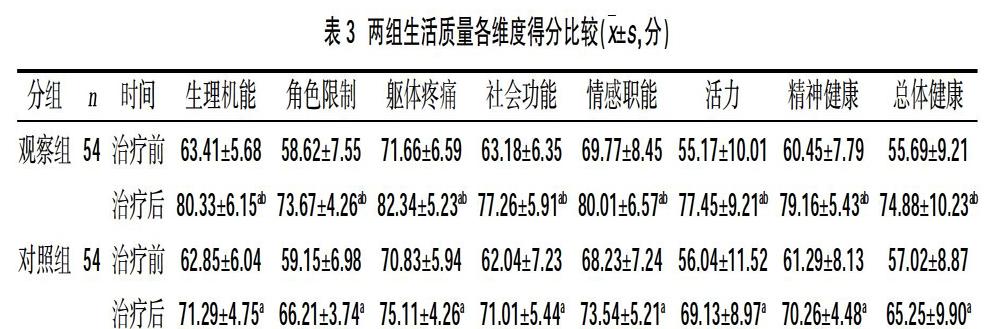

摘要:目的 对病态窦房结综合征(SSS)患者采用双腔频率适应性起搏器,分析治疗效果及其对患者心功能、生活质量的影响。方法 选取2015年1月~2019年1月我院收治的诊断为病态窦房结综合征的患者108例,随机分为对照组(54例)和观察组(54例),对照组采用双腔非频率适应性起搏器治疗,观察组采用双腔频率适应性起搏器治疗,比较两组治疗效果、治疗后6个月心功能指标及生活质量评分。结果 观察组的治疗总有效率为92.59%,高于对照组的83.33%,差异有统计学意义(P<0.05);两组治疗前后左房舒张末期内径(LAEDD)、左室舒张末期内径(LVEDD)比较,差异无统计学意义(P>0.05);观察组治疗后6个月6分钟步行实验(6-MWT)、左室射血分数(LVEF)水平均高于治疗前,脑钠肽(BNP)水平低于治疗前,且观察组改善情况优于对照组,差异有统计学意义(P<0.05)。两组治疗后生活質量各维度评分均高于治疗前,且观察组高于对照组,差异有统计学意义(P<0.05)。结论 在病态窦房结综合征患者中采用双腔频率适应性起搏器治疗的疗效确切,且能有效改善患者的心功能指标及生活质量。
关键词:病态窦房结综合征;双腔频率适应性起搏器;心功能;生活质量
Abstract:Objective To use a dual-chamber frequency-adaptive pacemaker for patients with sick sinus syndrome (SSS) to analyze the effect of treatment and its influence on patients' cardiac function and quality of life.Methods A total of 108 patients with sick sinus syndrome diagnosed in our hospital from January 2015 to January 2019 were selected and randomly divided into a control group (54 cases) and an observation group (54 cases). The control group was double-chambered For non-frequency adaptive pacemaker treatment, the observation group was treated with a dual-chamber frequency adaptive pacemaker. The treatment effects, cardiac function indexes and quality of life scores 6 months after treatment were compared between the two groups.Results The total effective rate of treatment in the observation group was 92.59%, which was higher than 83.33% in the control group,the difference was statistically significant (P<0.05);There was no significant difference in the left atrium end diastolic diameter (LAEDD) and left ventricular end diastolic diameter (LVEDD) between the two groups before and after treatment (P>0.05); the observation group 6-minute walk test (6-MWT) 6 months after treatment, Left ventricular ejection fraction (LVEF) and levels were higher than before treatment, brain natriuretic peptide (BNP) levels were lower than before treatment, and the improvement of the observation group was better than that of the control group, the difference was statistically significant (P<0.05). The scores of all dimensions of the quality of life after treatment in the two groups were higher than before treatment, and the observation group was higher than the control group, the difference was statistically significant (P<0.05). Conclusion The use of dual-chamber frequency-adaptive pacemaker therapy in patients with sick sinus syndrome has a definite effect and can effectively improve the patients' cardiac function and quality of life.
Key words:Sick sinus syndrome;Dual-chamber frequency-adaptive pacemaker;Cardiac function; Quality of life
病态窦房结综合征(sick sinus syndrome,SSS)属于心率失常的一种,是因窦房结发生问题,导致其不能自动的、规律的产生电信号并向下传导,从而引起患者心跳出现异常[1]。其好发于60~70岁的老年人[2]。持续性的心跳异常易导致患者心、脑、肾等重要器官供血不足,引起心悸、头晕、记忆力减退、腰痛、少尿等一系列相应的临床表现,严重者甚至发生晕厥或阿斯综合征。该病病程进展缓慢,一般预后良好,少数心脏病严重患者预后较差。临床治疗该病主要根据病情严重程度及患者的具体情况,植入心脏起搏器是目前最为有效的治疗方法[3]。有研究显示[4],部分SSS患者具有窦房结变时功能不全,选用具有频率适应功能的心脏起搏器治疗此类患者效果更佳,且能有效改善患者的心功能及生活質量。……