樟树叶片挥发性有机物释放季节动态和日动态变化规律
2020-08-26周琦王金凤徐永勤夏淑芳沈凤强徐卢雨陈卓梅
周琦 王金凤 徐永勤 夏淑芳 沈凤强 徐卢雨 陈卓梅
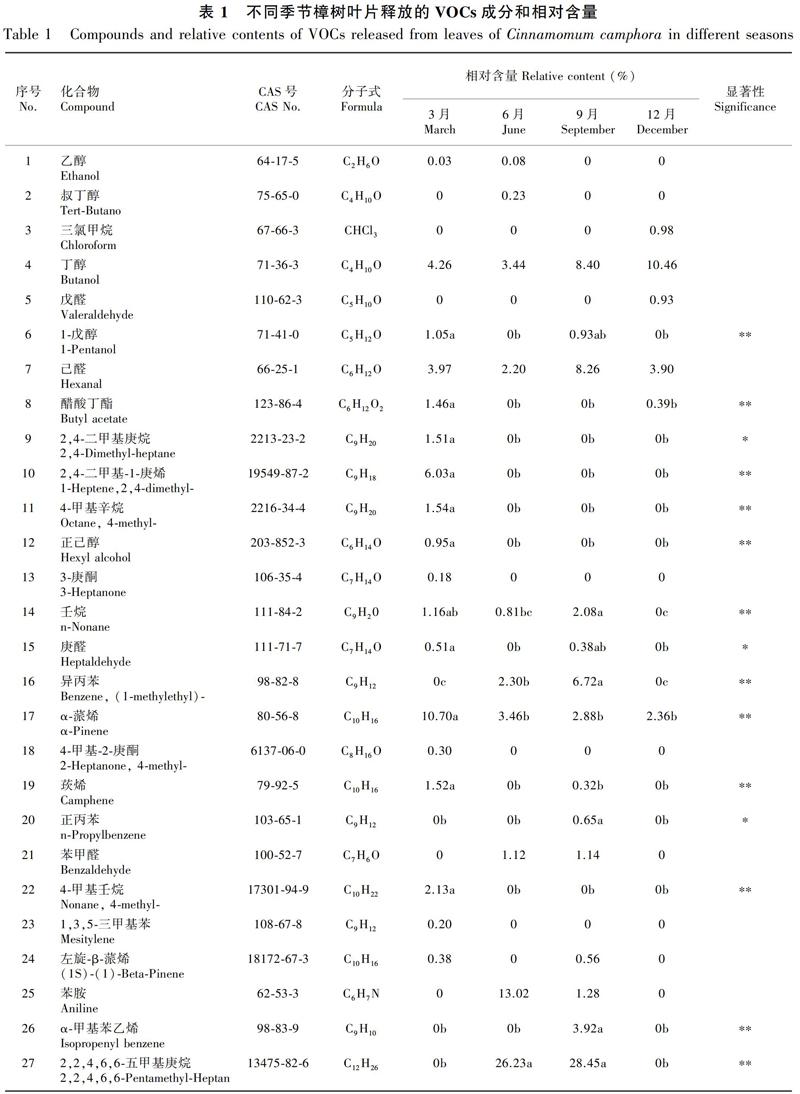

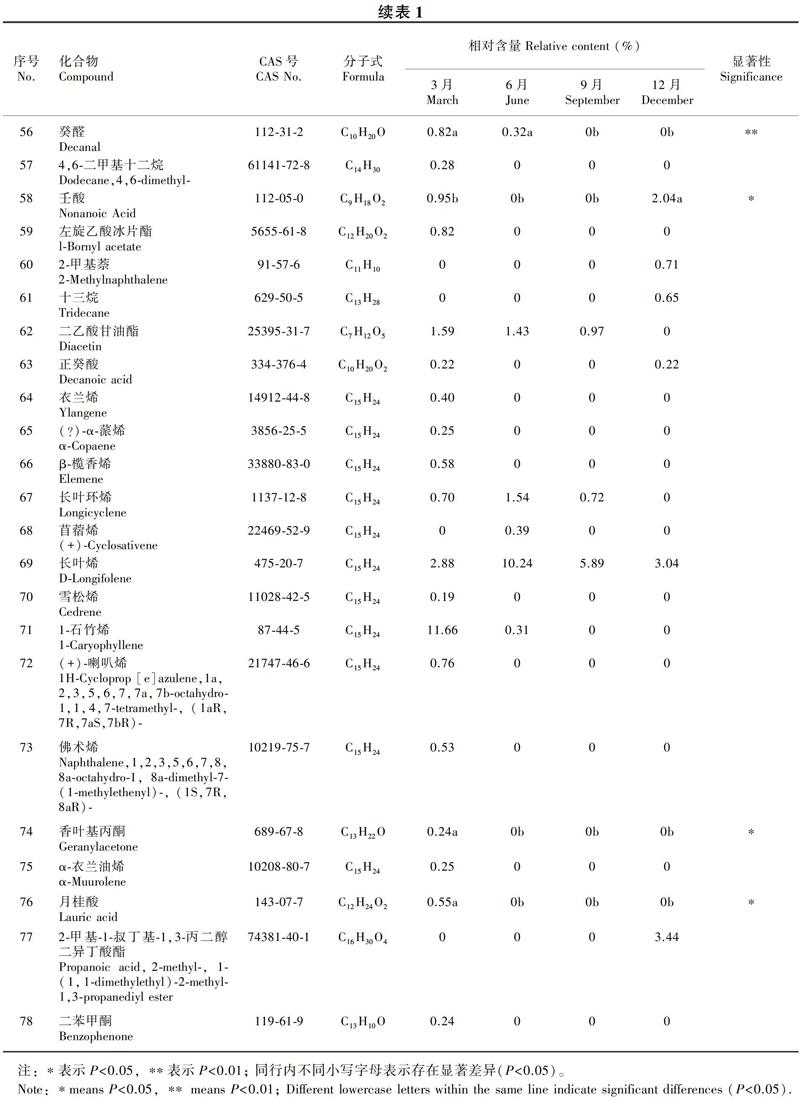
摘 要:采用动态顶空采集法和热脱附-气质联用技术,对不同季节和一天内不同时间点樟树叶片释放的挥发性有机物(VOCs)成分含量及其变化规律进行了分析。结果表明:全年樟树叶片释放的VOCs共计78种,其中萜烯类(19种)和烷烃类(18种)化合物种类较多;32种樟树叶片释放的挥发性成分相对含量在不同季节存在显著差异(P<0.05);3月份释放的VOCs种类最为丰富,萜烯类化合物相对含量最高(43.49%),主要为1-石竹烯、D-柠檬烯和α-蒎烯,其他月份释放的VOCs则以烷烃类和醇类为主;春季,樟树叶片在绝大多数时间点释放VOCs以萜烯类化合物为主,且早上8:00释放的萜烯類化合物相对含量最大。综上结果认为,樟树是营造保健型生态园林的理想树种,其叶片释放的VOCs中富含多种对人体健康有益的萜烯类化合物,春季的早晨是进行森林康养活动的最佳时间。
关键词:樟树,叶片,挥发性有机物,季节动态,日动态
中图分类号:Q945
文献标识码:A
文章编号:1000-3142(2020)07-1021-12
Abstract:Volatile organic compounds (VOCs) were collected in different seasons and different times of the day by dynamic headspace air-circulation method,and the relative contents and the change laws were also analyzed using the thermal desorption system gas chromatography/mass spectrum (GC-MS). The results were as follows:Cinnamomum camphora leaves released 78 types of VOCs during the whole year,and the types of terpenes (19) and alkanes (18) were more abundant than those of other compounds; The relative contents of 32 types of VOCs had significant differences (P<0.05) among different seasons; The number of types in March was the most abundant,and the relative contents of terpenes reached 43.49%,including 1-Caryophyllene,D-Limonene and α-pinene,and the types of VOCs released from C. camphora leaves in other months were mainly of alkanes and alcohols; In spring,the relative contents of VOCs released at most of the time were all mainly of terpenes,and the relative contents of terpenes released at 8:00 am were the highest. Therefore,C. camphora is an ideal species for ecological and heathy landscape,and the VOCs released from C. camphora leaves are rich in kinds of terpenes compounds,which are beneficial for human health,and spring and morning are the best time for forest recreation.
Key words:Cinnamomum camphora,leaves,volatile organic compounds(VOCs),seasonal change,diurnal change
植物挥发性有机物(volatile organic compounds,VOCs)是一种由植物次生代谢产生,且在常温下主要以液态形式存在的有机物质(陈洪伟等,2001;陈静,2016)。不同植物的合成与释放部位有所不同,对于绝大多数开花植物而言,花釋放出VOCs的量最大、种类最为丰富(Knudsen et al.,2006),营养组织(如叶和茎)是针叶树、草本植物的VOCs主要来源(McConkey et al.,2000; Vasso et al.,2006)。自然界中的VOCs组成十分丰富,种类在10 000种以上(杨小琴,2006),按结构特点大致可分为萜烯类、烷烃类、芳香烃类、醛类、酮类、醇类、酯类、有机酸类和其他类型(Atkinson & Arey,2003; Chen & Cao,2005)。这些植物源VOCs不仅具有吸引传粉者(Raguso,2008)、防御天敌(Degenhardt et al.,2009; Unsicker et al.,2009; Ali et al.,2012)、杀菌抑菌(Huang et al.,2012)、抵御非生物胁迫(Dudareva et al.,2006; Vickers et al.,2009)、促进植物间信息交流(Cojocariu et al.,2004;Baldwin et al.,2006)、改变大气组成(洪蓉,2002;Kaplan et al.,2006; Bao et al.,2010)等重要生物生态学作用,而且具有缓解疲劳、强身健体(房城等,2010;Zhang et al.,2015)、调节精神(Cruz-López et al.,2001;佟棽棽和姚雷,2009; Papiez et al.,2009)等保健作用。此外,一些VOCs会对环境造成一定负面影响(Renner & Münzenberg,2003)。由于温度、湿度、光照等环境因子以及植物自身的生理状态均会对部分VOCs释放产生影响,使得植物源VOCs的释放具有较强的季节和日变化动态性(Padhy & Varshney,2005;邓小勇,2009)。……