微创穿刺引流术联合尿激酶与开颅血肿清除方法对高血压基底节区出血患者预后情况探讨
2020-08-09黄沃斌吕建光李柱辉
黄沃斌 吕建光 李柱辉

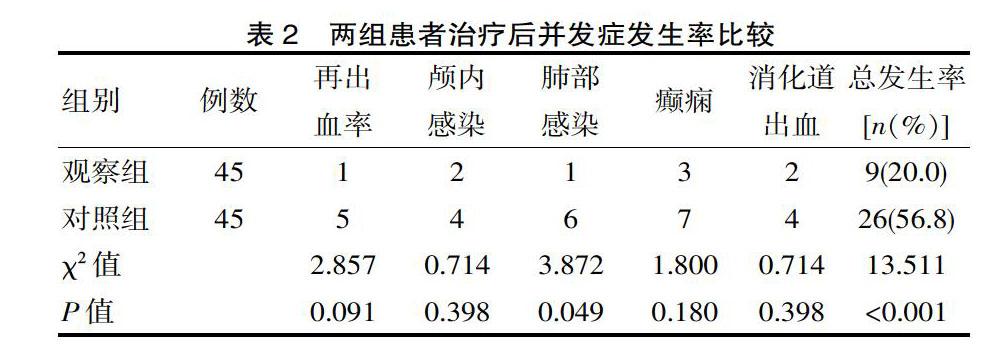
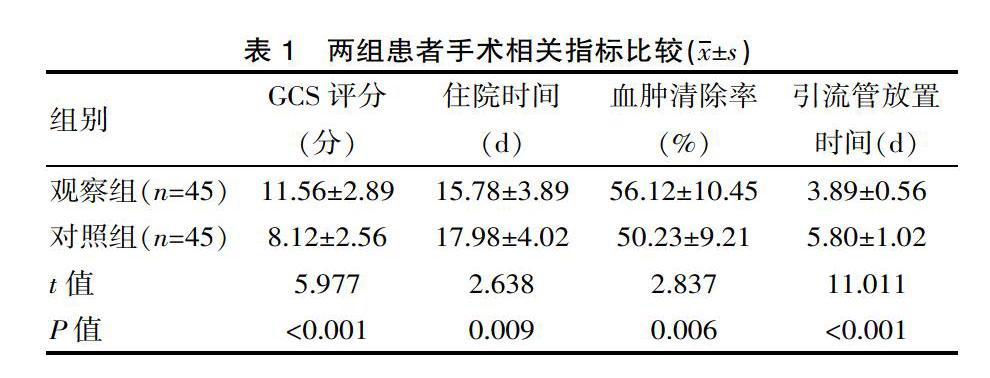
[摘要] 目的 探討微创穿刺引流术联合尿激酶与开颅血肿清除方法对高血压基底节出血患者预后的影响。方法 方便选取2014年11月—2016年10月在该院接受治疗的高血压基底节区出血患者90例,采用随机数表法将患者分为观察组(45例)和对照组(45例),对照组患者给予常规治疗,观察组患者给予微创穿刺引流术联合尿激酶的方法治疗。比较两组患者的手术情况,治疗后并发症发生率及患者生活质量改善情况。结果 观察组患者的GCS评分(11.56±2.89)分、血肿清除率(56.12±10.45)%高于对照组(8.12±2.56)分、(50.23±9.21)%,住院时间(15.78±3.89)d、引流管放置时间(3.89±0.56)d短于对照组(17.98±4.02)d、(5.80±1.02)d,两组差异有统计学意义(t=5.977、2.638、2.837、11.011,P<0.001);观察组总并发症发生率20.0%低于对照组57.8%,两组差异有统计学意义(χ2=13.511,P<0.001);观察组患者生活质量精神健康(53.23±5.02)分、总体健康(78.56±9.56)分等显著高于对照组(46.56±8.23)分、(65.45±10.23)分,两组差异有统计学意义(t=4.641、6.281,P<0.001)。结论 给予微创穿刺引流术联合尿激酶与开颅血肿清除方法治疗高血压基底节区出血患者,能够有效改善患者的神经功能,降低并发症的发生。
[关键词] 微创穿刺引流术;尿激酶;血肿清除术;高血压;基底节区出血
[Abstract] Objective To investigate the effect of minimally invasive puncture and drainage combined with urokinase and craniotomy on the prognosis of patients with hypertension basal ganglia hemorrhage. Methods Ninety patients with hypertensive basal ganglia bleeding who were treated in the hospital from November 2014 to October 2016 were convenienty selected, and the patients were divided into observation group (45 cases) and control group (45 cases) by random number table method. Patients in the control group were given conventional treatment, and patients in the observation group were given minimally invasive puncture and drainage combined with urokinase. The surgical conditions, the incidence of complications, and the improvement of patients' quality of life were compared between the two groups. Results The GCS score (11.56±2.89)points, hematoma clearance (56.12±10.45)% of the observation group were higher than that of the control group (8.12±2.56)points, (50.23±9.21)%, hospital stay (15.78±3.89)d, drainage tube The storage time (3.89±0.56)d was shorter than that of the control group (17.98±4.02)d and (5.80±1.02)d, and the difference between the two groups was statistically significant (t=5.977, 2.638, 2.837, 11.011, P<0.001); the total concurrency in the observation group The incidence of disease was 20% lower than that of the control group, 57.8%. The difference between the two groups was statistically significant(χ2=13.511, P<0.001); the quality of life of the observation group was mental health (53.23±5.02)points, overall health (78.56±9.56)points, etc. It was significantly higher than the control group (46.56±8.23)points and (65.45±10.23)points, and the differences between the two groups were statistically significant (t=4.641, 6.281, P<0.001).Conclusion Minimally invasive puncture and drainage combined with urokinase and craniotomy for hematoma removal in patients with hypertension basal ganglia hemorrhage can effectively improve the neurological function of patients and reduce the occurrence of complications.
[Key words] Minimally invasive puncture and drainage; Urokinase; Hematoma removal; Hypertension; Basal ganglia bleeding
临床资料表明,高血压脑出血病情发展比较迅速,且病情十分凶险,若不及时进行治疗,会对患者的神经功能产生严重的影响,导致治疗后患者预后效果不佳[1]。据悉,临床上对治疗高血压基底节区出血患者无论是国外还是国内都缺乏一种有效的治疗方法,已经成为临床医学者研究的重点[2]。有资料表明,常规的开颅手术操作难度大,对患者产生的创伤也很大,并且治疗后患者易出现癫痫、肺部感染等并发症[3]。微创穿刺引流术对患者产生的创伤小,并且治疗后患者的并发症发生率低,且能够显著改善患者的病情,被广泛的应用于临床治疗中[4]。该次该院方便选取2014年11月—2016年10月在该院接受治疗的高血压基底节区出血患者90例作为该次试验对象旨在研究探讨微创引流术联合尿激酶对高血压基底节区出血的治疗效果,以及对患者预后产生的影响,效果显著。……