基于行为转变理论的护理干预结合积极心理暗示对糖尿病合并冠心病患者遵医行为的影响
2020-08-06胡妙玲
胡妙玲
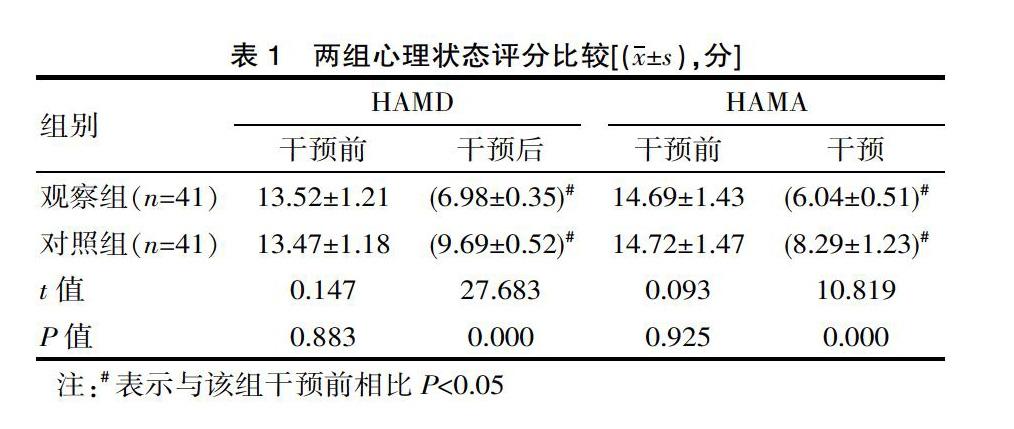

[摘要] 目的 探討基于行为转变理论的护理干预结合积极心理暗示对糖尿病合并冠心病患者遵医行为的影响。方法 选择2018年6月—2019年7月收治的2型糖尿病合并冠心病患者82例为研究对象,以随机数字表法分为对照组与观察组,各41例,对照组接受常规护理,观察组在对照组基础上加基于行为转变理论的护理干预结合积极心理暗示,对两组干预前后心理状态及遵医行为进行观察。 结果 两组干预前的汉密尔顿抑郁量表(HAMD)、汉密尔顿焦虑量表(HAMA)评分差异无统计学意义(P>0.05),观察组干预后的上述量表评分明显低于对照组(P<0.05);两组干预前的遵医服药、饮食管理、运动锻炼、按时复查等遵医行为评分差异无统计学意义(P>0.05),观察组干预后的上述遵医行为评分明显较对照组高(P<0.05)。结论 基于行为转变理论的护理干预结合积极心理暗示可改善糖尿病合并冠心病患者心理状态,也能提高其遵医行为。
[关键词] 行为转变理论;积极心理暗示;糖尿病;冠心病;遵医行为
[中图分类号] R587 [文献标识码] A [文章编号] 1672-4062(2020)05(b)-0016-03
Effect of Nursing Intervention and Positive Psychological Suggestion Based on Behavior Change Theory on the Compliance Behavior of Patients with Diabetes and Coronary Heart Disease
HU Miao-ling
Department of Emergency Medicine, Zhangzhou Hospital of Traditional Chinese Medicine, Zhangzhou, Fujian Province, 363000 China
[Abstract] Objective To explore the effect of nursing intervention based on behavior change theory combined with positive psychological cues on the compliance behavior of patients with diabetes mellitus and coronary heart disease. Methods Eighty-two patients with type 2 diabetes and coronary heart disease who were treated from June 2018 to July 2019 were selected as the research subjects. The random number table method was used to divide the control group and the observation group into 41 cases each. The control group received conventional care and the observation group. On the basis of the control group, a nursing intervention based on behavior change theory combined with positive psychological cues was used to observe the psychological state and compliance behavior of the two groups before and after the intervention. Results There were no statistically significant differences in the Hamilton Depression Scale (HAMD) and Hamilton Anxiety Scale (HAMA) scores before intervention between the two groups (P>0.05). The scores of the above scales in the observation group after intervention were significantly lower than those in the control group (P<0.05); There was no statistically significant difference in the compliance behavior scores between the two groups before the intervention, including medication, diet management, physical exercise, and regular review (P>0.05). The observation group's compliance behavior scores after the intervention were significantly higher than those in the control group (P<0.05). Conclusion Nursing intervention based on behavior change theory combined with positive psychological suggestion can improve the mental state of patients with diabetes and coronary heart disease, and can also improve their compliance behavior.
[Key words] Behavior change theory; Positive psychological cues; Diabetes; Coronary heart disease; Compliance behavior
冠心病为临床常见的心血管疾病,具有较高发病率,多见于老年群体,临床典型症状为胸痛。大量研究证实,糖尿病为导致冠心病的独立危险因素,与正常人相比,糖尿病患者发生冠心病的风险相对更高[1]。糖尿病合并糖尿病通常无典型临床表现,大多发现时病情已经较为严重,若不能有效控制患者血糖水平,可严重威胁患者生命安全。行为转变理论属心理学范畴,可帮助人们转变健康行为。积极心理暗示为心理治疗方法,主要通过一系列表情、言语、动作等对患者情绪产生影响,改变其对事物的认知,改善不良心理[2]。该研究于2018年6月—2019年7月将基于行为转变理论的护理干预结合积极心理暗示用于41例糖尿病合并冠心病患者中,旨在观察其对患者遵医行为的影响,现报道如下。