不同碳氮比对小球藻增殖及油脂积累的影响
2020-06-21范同强黄有军
范同强 黄有军


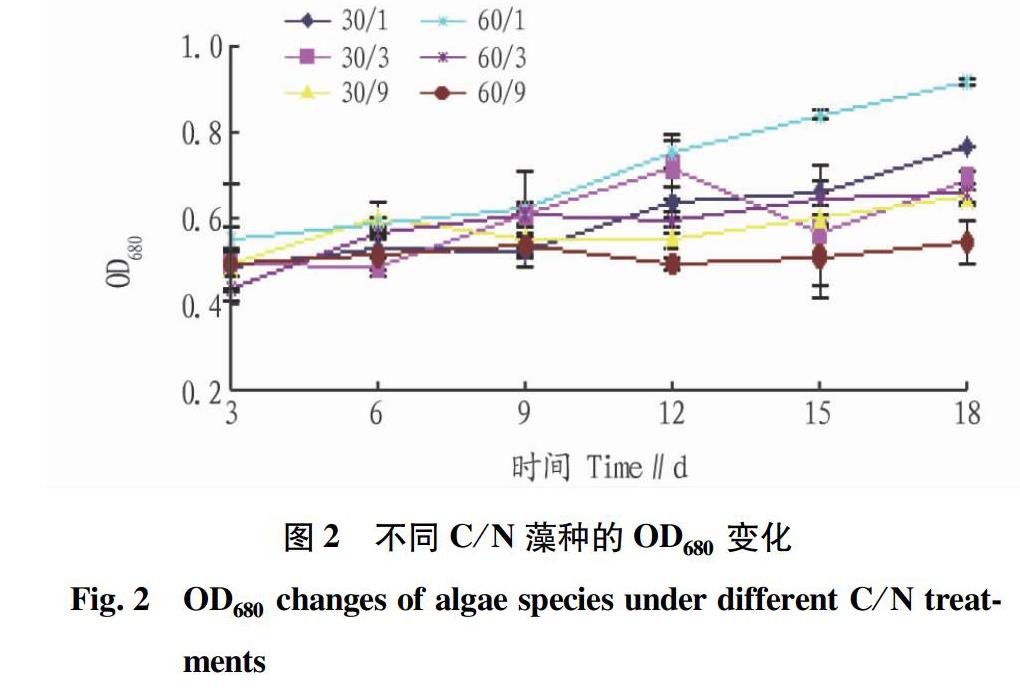
摘要 为了研究不同碳氮比对小球藻增殖及油脂积累的影响,采用BBM培养基,以蔗糖为碳源,硝酸铵为氮源,在12 h光照和12 h黑暗的条件下混合培养小球藻。设计不同的碳氮比例,采用OD680来评价小球藻的生长情况,以盐酸破壁后用提取液提取油脂,计算不同处理下的小球藻油脂积累情况,并利用气相测定脂肪酸成分。结果表明:60/1比例下藻种出现最大的生长量,其次是30/1。而30/1比例下藻种出现最大的油脂积累率,其次是60/1。检测得各处理所含脂肪酸成分基本相同,均含有C14、C15、C16、C17、C18、C20;而30/9和60/1处理还含有C12成分。30/1和60/1这2个处理含主要脂肪酸为C16∶0、C18∶0和C18∶2,含量为70%~74%,其余4个处理主要脂肪酸为C16∶0和C18∶0,含量为80%~86%。
关键词 小球藻;碳氮比;生长量;油脂积累
中图分类号 TE667文献标识码 A文章编号 0517-6611(2020)11-0007-04
Abstract To investigate the effects of different carbonnitrogen ratios on Chlorellas proliferation and lipid accumulation,BBM medium was used to culture Chlorella under 12hour of light and 12hour of darkness with sucrose as carbon source and ammonium nitrate as nitrogen source. Different ratios of carbon and nitrogen were designed,OD680was used to evaluate the growth of Chlorella,the oil was extracted after the cell wall was broken by hydrochloric acid. The oil accumulation of Chlorella was calculated under different treatments.And the composition of fatty acids was determined by gasphase. The experimental results showed that the maximum growth rate of Chlorella was 60/1, followed by 30/1. While 30/1 radio showed maximum oil accumulation rate, followed by 60/1. The fatty acid composition in each group was basically the same, including C14, C15, C16, C17, C18and C20, while the treatment of 30/9 and 60/1 also contained another C12. The main fatty acids in 30/1 and 60/1 groups were C16∶0, C18∶0and C18∶2, with the content of about 70%-74%, while the other four treatments were C16∶0and C18∶0, with the content of about 80%-86%.
Key words Chlorella;Carbonnitrogen ratio;Growth;Lipid accumulation
近年来随着煤炭、石油等化石燃料的日益枯竭,科学家们将研究对象转向高效、清洁、可再生的生物能源。生物柴油是一种以动植物油脂为原料制备、可替代化石柴油的绿色新能源。然而,以动植物油脂为原料的生物柴油其原料成本占总生产成本的75%左右并且消耗大;可食用的植物油脂以餐饮废弃油脂为原料虽然可有效降低生产成本,但原料来源有限,难以满足大规模生产的需要,且产品的质量难以保证。微藻是一类单细胞藻类,其在特定的条件下可大量积累油脂,而且藻油具有与一般植物油脂类似的脂肪酸结构,因此被认为是一种具有巨大潜力的新型生物柴油油脂原料[1]。与油料作物相比,微藻具有细胞增殖快、生产周期短、不受季节和土地的限制和所需的培养基来源丰富等优点[2]。……