终末期肝病营养状况评价及营养支持干预效果分析
2020-06-08鲍小燕
鲍小燕

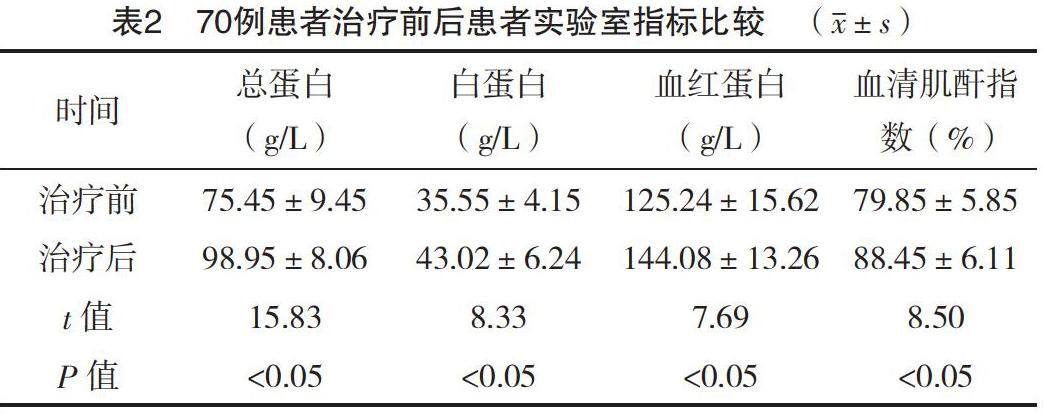
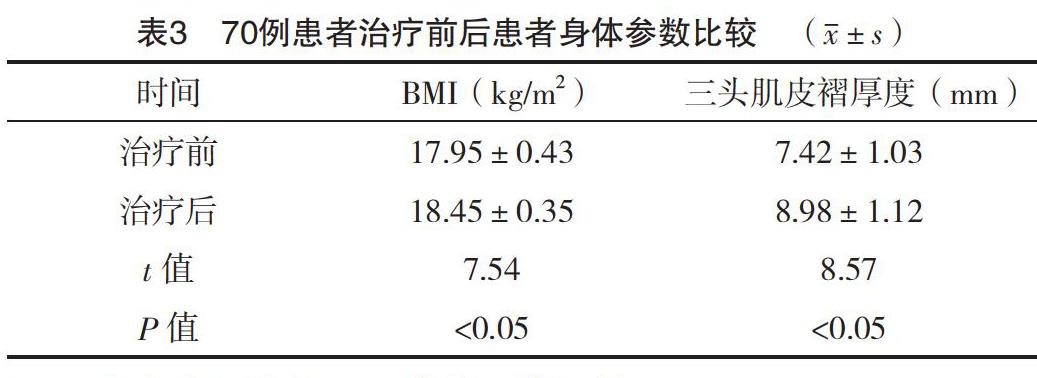
【摘要】 目的:探讨终末期肝病营养状况评价及营养支持干预效果分析。方法:研究选择2017年6月-2019年6月本院收治的终末期肝病患者70例作为资料,采用实验室生化指标、人体测量学参数、SGA营养评估等进行营养状况评价,并给予营养支持治疗,评价营养状态改善效果。结果:治疗前患者总蛋白、白蛋白、血红蛋白及血清肌酐指数等水平较低,治疗后明显提升,比较差异有统计学意义(P<0.05);治疗前患者BMI、三头肌皮褶厚度等身体参数较低,治疗后明显提升,比较差异有统计学意义(P<0.05);治疗后患者SGA营养评估明显优于治疗前(P<0.05)。结论:终末期肝病伴随明显营养不良,需针对性给予营养支持治疗,确保营养状态改善,增强机体功能,研究价值较高。
【关键词】 终末期肝病 营养不良评价 蛋白 血清肌酐 BMI
doi:10.14033/j.cnki.cfmr.2020.12.073 文献标识码 B 文章编号 1674-6805(2020)12-0-02
Evaluation of Nutritional Status of End-stage Liver Disease and Analysis of the Effect of Nutritional Support Intervention/BAO Xiaoyan. //Chinese and Foreign Medical Research, 2020, 18(12): -174
[Abstract] Objective: To evaluate the nutritional status of end-stage liver disease and the effect of nutrition support intervention. Method: From June 2017 to June 2019, 70 patients with end-stage liver disease were selected as data. Laboratory biochemical indexes, anthropometric parameters and SGA nutritional evaluation were used to evaluate the nutritional status, and nutritional support treatment was given to evaluate the effect of nutritional status improvement. Result: The levels of total protein, albumin, hemoglobin and serum creatine index were lower before treatment, and increased significantly after treatment (P<0.05). Before treatment, the levels of BMI, triceps skin fold thickness in patients were significantly higher than those in control group (P<0.05). The body parameters such as skinfold thickness of cephalic muscle were lower and increased significantly after treatment (P<0.05), and the nutritional evaluation of SGA after treatment was significantly better than that before treatment (P<0.05). Conclusion: Most of the patients with end-stage liver disease are accompanied by malnutrition, the nutritional support treatment are beneficial to the improvement of nutritional status, and the research value is high.
[Key words] End-stage liver disease Malnutrition evaluation Protein Serum creatinine BMI
First-authors address: Meng Chao Hepatobiliary Hospital of Fujian Medical University, Fuzhou 350001, China
當前临床对终末期肝病尚无完善的评价指标判断严重程度,一般以肝细胞功能无法满足人体生理需求为主要特征,病因多为慢性乙型肝炎、慢性丙型肝炎、自身免疫性肝病等[1]。终末期肝病患者由于肝功能异常,蛋白合成不足,易引起营养物质代谢异常及营养不良,继而导致机体功能减退,并发严重低蛋白血症、肺部感染、肝性脑病等,甚至多器官功能衰竭而危及生命,因此需重视对患者的营养状态评估及营养支持[2-3]。为此,本次研究对终末期肝病的营养不良状况评价及营养支持治疗干预效果进行了如下探讨。
1 资料与方法
1.1 一般资料
研究选择2017年6月-2019年6月本院收治的终末期肝病患者70例作为资料。纳入标准:均经症状及临床表现及辅助检查确诊为相关肝病[4]。排除标准:合并肝内或肝外恶性肿瘤患者;供肝冷却血时间>12 h患者;临床资料不全患者。其中男38例,女32例,年龄35~74岁,平均(58.74±3.02)岁,病程0.5~5年,平均(1.15±0.24)年,包含慢性乙型病毒性肝炎后肝硬化58例,酒精性肝硬化8例,原发性胆汁性肝硬化3例,原发性硬化性胆管炎1例。患……