持续低效血液透析联合血液灌流治疗 多脏器功能障碍综合征患者的疗效观察
2020-04-21黄欢许标罗玮
黄欢 许标 罗玮

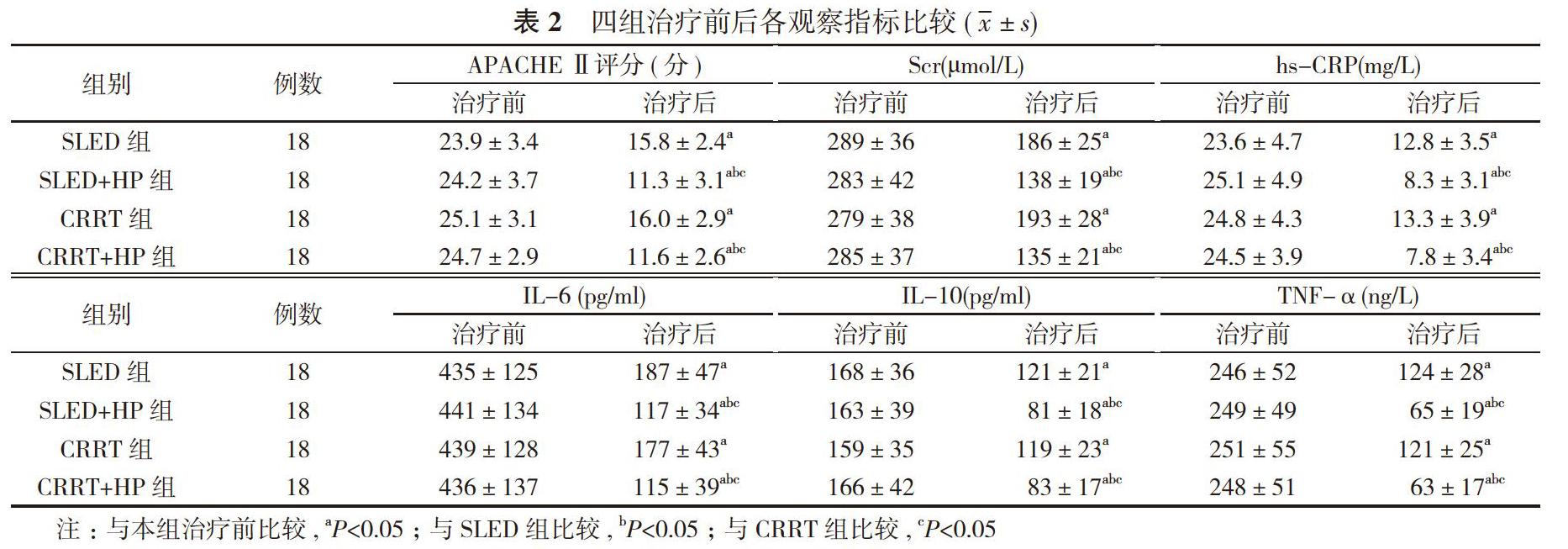

【摘要】 目的 觀察持续低效血液透析(SLED)联合血液灌流(HP)对多脏器功能障碍综合征(MODS)患者的炎症水平及预后的影响, 评价其疗效。方法 72例MODS患者, 根据所采用的血液净化方法不同分为SLED组(给予SLED治疗)、SLED+HP组(给予SLED+HP治疗)、持续静脉-静脉血液滤过(CRRT)组(给予CRRT治疗)、CRRT+HP组(给予CRRT+HP治疗), 各18例。比较四组患者治疗前和治疗后的急性生理学及慢性健康状况评分系统Ⅱ(APACHEⅡ)评分、血清肌酐(Scr)、超敏C反应蛋白
(hs-CRP)、白介素(IL)-6、IL-10、肿瘤坏死因子-α(TNF-α)水平, 治疗后28 d存活率。结果 治疗后, 四组患者的APACHEⅡ评分、Scr、hs-CRP、IL-6、IL-10、TNF-α水平均显著降低, 差异有统计学意义(P<0.05)。SLED+HP组的APACHEⅡ评分、Scr、hs-CRP、IL-6、IL-10、TNF-α水平降低大于SLED组, CRRT+HP组的APACHEⅡ评分、Scr、hs-CRP、IL-6、IL-10、TNF-α水平降低大于CRRT组, 差异均有统计学意义(P<0.05)。SLED+HP组和CRRT+HP组、SLED组和CRRT组比较差异无统计学意义(P>0.05)。SLED+HP组的28 d存活率为88.9%, CRRT+HP组的28 d存活率为83.3%, 均高于SLED组的55.6%与CRRT组的50.0%, 差异有统计学意义(P<0.05)。SLED+HP组与CRRT+HP组、SLED组和CRRT组患者的28 d存活率比较, 差异无统计学意义(P>0.05)。结论 四种血液净化治疗方案均能有效降低MODS患者的血清Scr、hs-CRP、IL-6、IL-10、TNF-α水平, 改善患者临床症状和体征。SLED联合HP具有更强的清除炎症因子能力和肾功能保护作用, 能改善患者的预后, 其治疗效果与CRRT联合HP相当。
【关键词】 持续低效血液透析;连续肾脏替代治疗;血液灌流;多脏器功能障碍综合征
DOI:10.14163/j.cnki.11-5547/r. 2020.05.001
Efficacy of sustained low-efficiency dialysis combined with hemoperfusion in patients with multiple organ dysfunction syndrome HUANG Huan, XU Biao, LUO Wei. Department of Physician, Guangning Vounty Peoples Hospital, Zhaoqin, 526300
【Abstract】 Objective To observe the effect of sustained low-efficiency dialysis (SLED)combined with hemoperfusion (HP) in patients with multiple organ dysfunction syndrome (MODS), and evaluate its efficacy. Methods A total of 72 MODS patients were divided into sustained low-efficiency dialysis group (SLED), sustained low-efficiency dialysis combined with hemoperfusion group (SLED+HP group), continuous renal replacement therapy group (CRRT group) and continuous renal replacement therapy combined with hemoperfusion group (CRRT+HP group), with 18 cases in each group. The Acute Physiology and Chronic Health Evaluation Ⅱ (APACHEⅡ) score, serum creatinine (Scr), hypersensitive C-reactive protein (hs-CRP), interleukin(IL)-6, IL-10, tumor necrosis factor α(TNF-α) before treatment and after treatment, occurrence of complications and survival rate after 28 d of treatment were compared among the four groups. Results After treatment, the APACHEⅡ score, serum Scr, hs-CRP, IL-6, IL-10 and TNF-α levels in four groups were decreased than those before treatment, and their difference was statistically significant (P<0.05). The degree of reduction of APACHEⅡ score, serum Scr, hs-CRP, IL-6, IL-10 and TNF-α levels in SLED+HP group was greater than those in SLED group, and CRRT+HP group was greater than CRRT group, and the difference was statistically significant (P<0.05). There was no statistically significant difference in APACHEⅡ score, serum Scr, hs-CRP, IL-6, IL-10 and TNF-α levels between SLED+HP group and CRRT+HP group (P>0.05). The 28 d survival rate was 88.9% in SLED+HP group and 83.3% in CRRT+HP group, which were higher than 55.6% in SLED group and 50.0% in CRRT group, and their difference was statistically significant (P<0.05). There was no statistically significant difference in 28 d survival rate between SLED+HP group and CRRT+HP group (P>0.05). Conclusion Four kinds of blood purification therapy can effectively reduce the levels of serum Scr, hs-CRP, IL-6, IL-10, TNF-α, and improve the clinical symptoms and signs of MODS patients. SLED combined with hemoperfusion has a stronger ability to clear inflammatory factors and protect renal function, and can improve the prognosis of patients. Its therapeutic effect is comparable to CRRT combined with hemoperfusion.Its therapeutic effect is similar to CRRT combined with hemoperfusion.
【Key words】 Sustained low-efficiency dialysis; Continuous renal replacement therapy; Hemoperfusion; Multiple organ dysfunction syndrome
全身炎症反应综合征(SIRS)是指感染、创伤和休克等等因素引发机体出现严重、全身和失控的炎症免疫反应, 患者机体内的炎性介质或细胞因子产生过多, 进而可以导致机体出现MODS, 而其中急性肾损伤(AKI)是最为常见的脏器功能障碍[1]。目前普遍认为MODS是SIRS恶化进展的结果, 也是导致危重症患者不良预后和死亡的主要原因。目前研究已经证实, 及时、有效地减轻机体的炎症反应, 清除过多的炎症因子和积极的脏器功能保护是成功救治危重病患者的关键环节[2]。……