冲动行为干预在重性精神病患者护理管理中的效果观察
2019-11-14曹允贞黄菊娟黄爱勤陈泳康
曹允贞 黄菊娟 黄爱勤 陈泳康
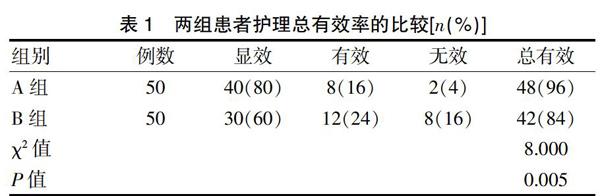
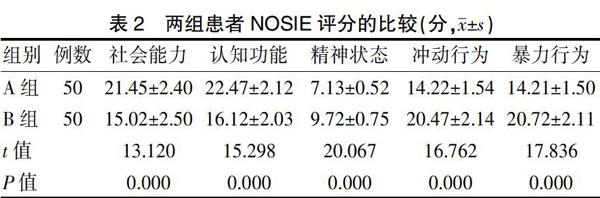
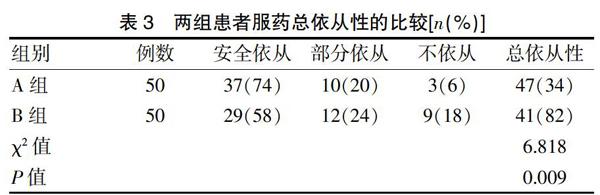
[摘要]目的 探讨冲动行为干预在重性精神病患者护理管理中的效果,为重性精神病患者的临床治疗与护理提供理论依据。方法 选取2015年1月~2018年1月本院收治的100例重性精神病患者作为研究对象,按照随机数字表法将其分成A组(50例)与B组(50例)。B组采用常规护理干预,A组采用冲动行为干预。比较两组患者的护理总有效率、护士用住院患者观察量表(NOSIE)评分和服药依从性。结果 A组的护理总有效率高于B组(P<0.05)。A组社会能力、认知功能的NOSIE评分,服药总依从性明显高于B组(P<0.05)。A组的精神状态、冲动行为、暴力行为评分明显低于B组,差异有统计学意义(P<0.05)。结论 在重性精神病患者护理管理中予以冲动行为干预对提高患者的护理总有效率、服药依从性等均有良好的应用效果。
[关键词]冲动行为;重性精神病;护理管理;神经科
[中图分类号] R473.74 [文献标识码] A [文章编号] 1674-4721(2019)9(b)-0247-03
Effect observation of impulsive behavior intervention in nursing management of severe psychiatric patients
CAO Yun-zhen HUANG Ju-juan HUANG Ai-qin CHEN Yong-kang
The First Department of Treatment, Guangzhou Civil Affairs Bureau Mental Hospital, Guangdong Province, Guangzhou 510430, China
[Abstract] Objective To explore the effect of impulsive behavior intervention in the nursing management of patients with severe psychosis, and to provide theoretical basis for clinical treatment and nursing of patients with severe psychosis. Methods All of 100 patients with severe psychosis admitted to our hospital from January 2015 to January 2018 were selected as study objects, and they were divided into group A (50 cases) and group B (50 cases) according to the random number table method. Group B was given routine nursing intervention, and group A was given impulsive behavior intervention. The total effective rate of nursing, NOSIE score and medication compliance were compared in patients between the two groups. Results The total effective rate of nursing in group A was higher than that of group B (P<0.05). NOSIE score of social ability and cognitive function in group A were significantly higher than those in group B (P<0.05). The score of mental state, impulsive behavior and violence in group A were significantly lower than those in group B (P<0.05). Conclusion Impulsive behavior intervention in the management of patients with severe psychosis has a application effect on improving the total effective rate of nursing and medication compliance.
[Key words] Impulsive behavior; Severe psychosis; Nursing management; Neurology
重性精神病(holergasia)的社會危害性极高,不仅危害自己,殃及家庭,也危及社会。据原卫生部提供的数据显示,精神疾病在我国疾病总负担中长期稳居榜首,尤其是重性精神病患者更为明显[1]。从世界卫生组织(WHO)的定义来看,突然产生且通常导致不良后果的行为则为冲动行为(compulsion),这种现象在精神分裂症,尤其是重性精神病患者中的发生比例极高,这与患者受幻觉或妄想(如被害妄想)的影响息息相关[2]。冲动行为干预属于精神心理卫生专科的常见专业术语,是医护人员及时采取包括心理疏导、行动约束、药物镇静等在内的措施控制、干预包括暴力、毁物、伤人、自伤、自杀等突发的冲动行为,以保护患者的安全或维护治疗效果。借此,笔者在本院医学伦理委员会批准和相关部门及科室相互配合的基础上选取100例重性精神病患者作为研究对象,探讨冲动行为干预在该病护理管理中的临床应用价值,现报道如下。……