分析脑肿瘤术后并发症风险分析及护理方法
2019-10-21李会
李会
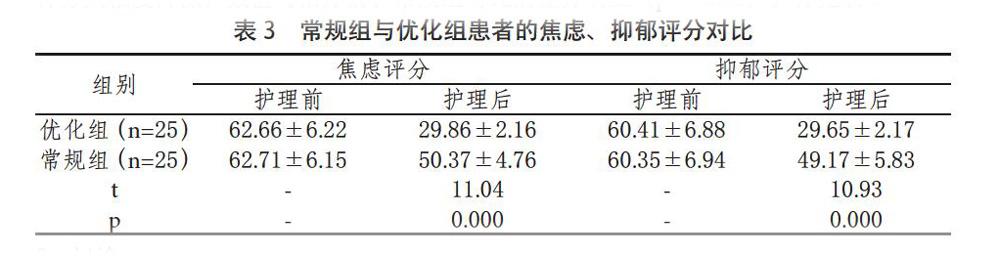


【摘 要】目的:分析脑肿瘤术后并发症风险分析及护理方法。方法:回顾性分析2017年1月至2019年1月在本院实施脑肿瘤术治疗的50例患者资料,根据其护理方式纳入优化组与常规组(n=25)。常规组实施常规护理,优化组实施优化护理,比较两组患者的并发症发生率、护理满意度及患者的焦虑、抑郁评分。结果:常规组术后发生5例并发症,优化组发生1例并发症,差值比较具备统计学意义(p<0.05)。常规组患者护理满意率为76%,数据比较明显低于优化组满意率96%,数据差距比较存在统计学意义(p<0.05)。护理前两组患者焦虑、抑郁评分对比未见显著区别,护理后优化组患者焦虑与抑郁评分大幅度降低,数值与治疗前、常规组对比的差异明显(p<0.05)。结论:脑肿瘤术后常见的并发症包含继发性癫痫、肺部感染及泌尿系统感染等,会影响患者治疗效果与预后效果,需要提升护理干预的重视程度。通过优化护理的方式,降低患者并发症发生率,使患者保持良好的身心状态。
【关键词】脑肿瘤术;术并发症风险;护理干预
Abstract:Objective To analyze the risk of postoperative complications of brain tumors and the nursing methods.Methods: the data of 50 patients who underwent brain tumor surgery in our hospital from January 2017 to January 2019 were retrospectively analyzed, and were included in the optimized group and the conventional group according to their nursing methods (n=25).Routine nursing was carried out in the conventional group, and optimized nursing was carried out in the optimized group.The complication rate, nursing satisfaction and anxiety and depression scores of patients in the two groups were compared.Results: postoperative complications occurred in 5 cases in the conventional group and 1 case in the optimized group, and the difference was statistically significant (p < 0.05).The nursing satisfaction rate of patients in the conventional group was 76%, which was significantly lower than that of the optimized group (96%), and the data gap was statistically significant (p < 0.05).There was no significant difference in the scores of anxiety and depression between the two groups before and after nursing, while the scores of anxiety and depression in the optimized group after nursing were significantly reduced, with significant difference between the values and those before and after treatment (p < 0.05).Conclusion: common postoperative complications of brain tumor include secondary epilepsy, pulmonary infection and urinary system infection, etc., which will affect the treatment effect and prognosis of patients, and the attention level of nursing intervention should be improved.By optimizing the way of nursing, reduce the incidence of complications, so that patients maintain a good state of mind and body.
Key words: brain tumor surgery;Risk of surgical complications;Nursing intervention
【中图分类号】R473.73【文献标识码】A【文章编号】1005-0019(2019)17-00-01
脑肿瘤为临床治疗中常见的神经外科疾病,患者发病原因尚不够清晰,多存在呕吐、乏力以及瘫痪等临床症状[1]。脑肿瘤患者感觉功能、运动功能会受到不同程度的影响,对其生活质量与身心状态会产生一定伤害[2]。合理预防脑肿瘤术后并发症,对患者的生活质量与预后效果会产生较大影响。文章回顾性分析2017年1月至2019年1月在本院实施脑肿瘤术治疗的50例患者资料,结合分组调查的结果展开讨论,评估护理干預对脑肿瘤术后患者并发症发生率的影响,且将内容归纳如下。
1 资料与方法
1.1 一般资料 回顾性分析2017年1月至2019年1月在本院实施脑肿瘤术治疗的50例患者资料,根据其护理方式纳入优化组与常规组(n=25)。常规组男女占比为13:12,年龄取值范围35-70岁,均值为(52.27±4.32)岁。优化组男女占比为14:11,年龄取值范围34-70岁,均值为(52.19±4.37)岁。组间一般资料比较无显著区别,入选患者均符合脑肿瘤诊断标准,签署知情同意书。排除合并存在高血压等基础疾病的患者,颅脑手术史的患者,两组可以实施分组调查(p>0.05)。