集束化护理脑梗死后运动性失语的康复效果
2018-09-13凌晓菁聂然
凌晓菁 聂然
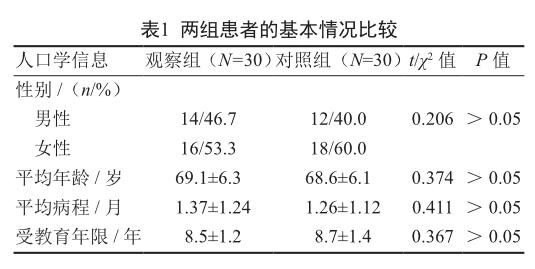
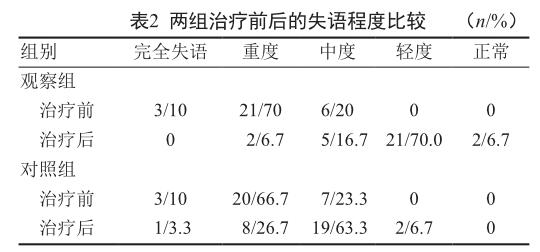
摘 要 目的:探索集束化护理对脑梗死后运动性失语患者语言康复的效果。方法:将我院2015年2月—2017年2月收治的60例脑梗死后运动性失语的患者分为观察组和对照组,每组30例。观察组患者的平均年龄(69.1±6.3)岁,对照组患者的平均年龄(68.6±6.1)岁。对照组给予常规语言康复训练治疗,观察组在对照组康复基础上给予集束化护理。结果:治疗后观察组失语程度改善优于对照组,差异有统计学意义(P<0.01);治疗后观察组的听说理解、口语表达及阅读能力评分提高均显著高于对照组,差异有统计学意义(P<0.05)。结论:集束化护理可提高脑梗死后运动性失语的康复效果。
关键词 集束化护理;脑梗死;运动性失语;康复
中图分类号:R743.3 文献标志码:A 文章编号:1006-1533(2018)16-0053-03
Rehabilitation effect of cluster nursing on motor aphasia after cerebral infarction
LING Xiaojing, NIE Ran
(Infusion Room of Changfeng Community Health Service Center of Putuo District, Shanghai 200062, China)
ABSTRACT Objective: To explore the effect of cluster nursing on language rehabilitation of patients with motor aphasia after cerebral infarction. Methods: From February 2015 to February 2017, 60 patients with aphasia after cerebral infarction in our hospital were randomly divided into an observation group and a control group with 30 cases in each group. The average age of patients in the observation group was (69.1±6.3) years, and that of the control group was (68.6±6.1) years. The control group was given routine language rehabilitation training, while the observation group was given cluster nursing based on the rehabilitation of the control group. Results: After treatment, the improvement degree of aphasia of the observation group was better than that of the control group, and the difference was statistically significant(P<0.01); after treatment, the listening and speaking comprehension, oral expression and reading ability scores of the observation group were significantly higher than those of the control group, and the difference was statistically significant(P<0.05). Conclusion: Cluster nursing can improve the rehabilitation effect of aphasia after cerebral infarction.
KEY WORDS cluster nursing; cerebral infarction; motor aphasia; rehabilitation
隨着人民生活质量的逐渐增高,人口老龄化进程的加快,脑梗死患者人数也在逐渐增加。脑梗死又称缺血性卒中,是神经内科的常见病,失语症是其主要后遗症之一。运动性失语(Broca失语)是以口语表达障碍为特点,听力理解相对较好,呈非流利型口语。集束化护理是基于循证医学理论,将已知有效和科学的护理方法集合在一起,以确保患者能获得最佳的护理方法,降低护理风险事件的发生,提高护理质量[1]。本研究旨在探索集束化护理对脑梗死后运动性失语患者语言康复的临床疗效。
1 对象与方法
1.1 对象
研究对象为2015年2月—2017年2月所收治的脑梗死后运动性失语患者。纳入标准为59~82岁,符合1995年第四届全国脑血管病学术会议修订的诊断标准[2],经头颅CT或MRI扫描确诊为脑梗死,并运用简易精神状态检查量表(MMSE)[3]评估为无智力障碍者。排除标准为合并严重心、肝、肾及造血系统等功能异常者,有精神疾病或由其他原因造成的语言功能障碍者,有大面积梗死伴意识障碍者,妊娠或哺乳期妇女。……