贫困家庭重性精神病患者接受免费救治后的危险行为改变
2018-09-13朱骅朱春凤黄腊根
朱骅 朱春凤 黄腊根
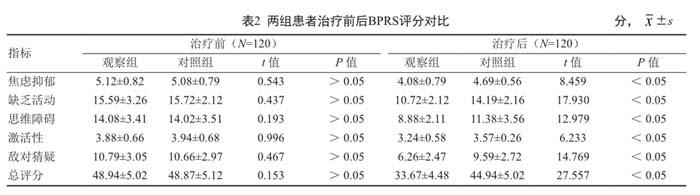
摘 要 目的:探讨贫困家庭重性精神病患者接受免费救治后的危险行为改变。方法:选取2013年11月至2015年1月在江西康宁医院接受住院治疗的240例贫困家庭重性精神病患者,年龄18~60岁,随机分为观察组和对照组。在观察组120例患者中,男性79例,女性41例,平均年龄(33.26±8.58)岁,在对照组120例患者中,男性80例,女性40例,平均年龄(32.76±8.24)岁。观察组接受免费救治的系统治疗干预,对照组接受常规住院和门诊治疗。结果:治疗后观察组患者的焦虑抑郁、缺乏活力、思维障碍、激活性、敌对猜疑和简明精神病量表(BPRS)总评分均明显低于对照组,差异均有统计学意义(P<0.05);个人与社会功能量表(PSP)评分明显高于对照组,差异有统计学意义(P<0.05)。结论:对贫困家庭重性精神病患者实施免费救治的系统治疗干预,可以较好的缓解患者的危险行为。
关键词 重性精神病;免费救治;贫困家庭;危险行为
中图分类号:R749 文献标志码:A 文章编号:1006-1533(2018)16-0038-03
Risky behavior changes in patients with severe psychosis in poor families after receiving free treatment
ZHU Hua, ZHU Chunfeng, HUANG Lagen
(The Third Ward of Corelle Hospital of Zhangshu, Jiangxi Province 331211, China)
ABSTRACT Objective: To explore the changes of risky behaviors in patients with severe psychosis in poor families after receiving free treatment. Methods: From November 2013 to January 2015, 240 patients with severe psychosis from poor families aged 18 to 60, who came to our hospital for hospitalization, were selected. Of the 120 patients in the observation group, 79 were males and 41 were females, with an average age of (33.26±8.58) years. Among the 120 patients in the control group, 80 were males and 40 were females, with an average age of (32.76 ± 8.24) years. The observation group received a free systemic treatment intervention, and the control group received regular inpatient and outpatient treatment. Results: After treatment, anxiety, depression, inactivity, thinking disorder, activation, hostile suspicion and total score of brief psychiatric rating scale(BPRS) of the observation group were significantly lower than those of the control group, and the difference was statistically significant(P<0.05); the score of personal social function scale(PSP) of the observation group was significantly higher than that of the control group, and the difference was statistically significant(P<0.05). Conclusion: The implementation of free treatment system intervention for patients with severe psychosis in poor families can better relieve the risk behavior of patients.
KEY WORDS severe psychosis; free treatment; poor family; dangerous behavior
重性精神病可分為精神分裂症、双相情感障碍、偏执性精神障碍、分裂情感性精神障碍、癫痫所致精神障碍、严重精神发育迟滞等6类[1-3]。该病症发病机制复杂,临床治疗难度较大。多数患者因各种原因难以主动就医,使得该病症成为社会的隐痛[4]。本文旨在评估贫困家庭重性精神病患者接受免费救治后的危险行为改变。
1 资料与方法
1.1 一般资料
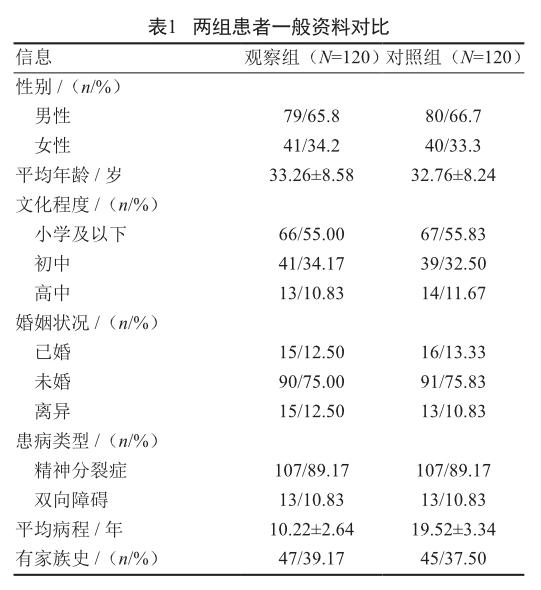
将2013年11月至2015年1月由江西康宁医院接诊的240例贫困家庭重性精神病患者纳入本次研究,年龄18~60岁。按照随机数字表法分为观察组120例和对照组120例,患者一般资料见表1。两组患者的性别比例、年龄构成等资料具有可比性(P>0.05)。患者均知情同意,签署知情同意协议书。
1.2 方法
对照组接受常规住院和门诊治疗。……