发育性髋关节异常筛查在社区儿童保健门诊中的意义
2018-02-25张伯英
张伯英
摘 要 目的:探讨社区儿童保健门诊在早期临床筛查婴幼儿发育性髋关节异常(DDH)的意义。方法:选择2014年1月至2017年3月在本社区卫生服务中心进行系统观察的婴儿898例,男性471例,平均月龄(2.15±0.50)月;女性427例,平均月龄(2.15±0.54)月。结果:体检中发现DDH可疑者151例(16.81%),其中男童检出率为12.53%(59/471),女童检出率为21.54%(92/427),差异有统计学意义(P<0.01)。经上级医疗单位影像学诊断出DDH患儿27例,诊断率为3.01%,男童的诊断率为1.27(6/471),女童的诊断率为4.91%(21/427),差异有统计学意义(P<0.05)。随访发现,经过干预治疗,所有DDH患儿均发育为正常髋关节。结论:社区儿童保健门诊临床筛查DDH患者具有重要作用。
关键词 发育性髋关节异常;儿保门诊;婴幼儿;临床筛查
中图分类号:R726.8 文献标志码:A 文章编号:1006-1533(2018)02-0061-02
The significance of screening for developmental dysplasia of the hip in the community child health care clinic
ZHANG Boying
(Children-Care Department of Tianlin Community Health Service Center of Xuhui District, Shanghai 200233, China)
ABSTRACT Objective: To explore the significance of community child health care clinic in early clinical screening of developmental dysplasia of the hip (DDH) in infants and children. Methods: From January 2014 to March 2017, 898 infants in the community health service center who were systematically observed were selected, including 471 males, mean age(2.15±0.50) months, and 427 females, with an average age of (2.15±0.54) months. Results: One hundred and fifty-one cases(16.81%) of suspicious DDH were found in the physical examination, among whom the detection rate of boys was 12.53%(59/471), and the detection rate of girls was 21.54%(92/427), and the difference was statistically significant(P<0.01). Twenty-seven cases of DDH were diagnosed by medical imaging of the higher medical units, the diagnostic rate was 3.01%, the diagnostic rate of boys was 1.27(6/471), the diagnostic rate of girls was 4.91%(21/427), and the difference was statistically significant(P<0.05). The followup found that after intervention all children with DDH developed normal hip joint. Conclusion: The clinical screening of DDH patients in the community child health care clinic is of great importance.
KEY WORDS developmental dysplasia of the hip; child health care clinic; infants and young children; clinical screening
发育性髋关节异常(developmental dysplasia of hip,DDH)是一种在婴幼儿中比较常见的畸形,如不及时治疗或处理不当,年长后可造成患侧髋和腰部疼痛,影响劳动力。1%~10%的新生儿出生时存在髋臼发育不良、半脱位和完全脱位倾向,其病因、发病机制和自然病程并不完全明确[1]。髋关节临床手法检查操作简单,无需器材,不受时间和地点限制,是目前基层儿童保健门诊筛查婴幼儿DDH的首选方法[2]。本文旨在探索社区婴幼儿DDH筛查的意义。
1 资料与方法
1.1 對象
选择2014年1月至2017年3月在田林社区卫生服务中心进行系统观察的婴幼儿898例,其中男性471例(52.45%),平均月龄(2.15±0.50)个月;女性427例(47.55%),平均月龄(2.15±0.54)个月。
1.2 临床检查方法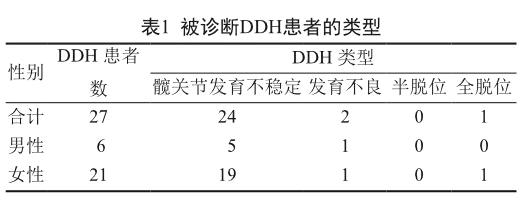 endprint
在体检时发现两侧大腿内侧皮肤皱褶不对称、会阴部增宽、髋关节活动少且受限、肢体短缩、牵拉下肢时有弹响声或弹响感;髋关节屈曲外展试验阳性。上述有一项阳性者均为DDH可疑者,转诊至二级以上医疗单位进行影像学检查治疗,对转出者做好定期随访工作。
1.3 统计学处理
用SPSS 17.0进行统计分析,计数资料用百分率(%)表……