基于PCR—DGGE分析云南牛干巴的细菌群落结构
2017-10-20刘姝韵尚思奇孙灿王桂瑛程志斌肖蓉蒋进仙汪善荣廖国周
刘姝韵++尚思奇++孙灿++王桂瑛++程志斌++肖蓉++蒋进仙++汪善荣++廖国周
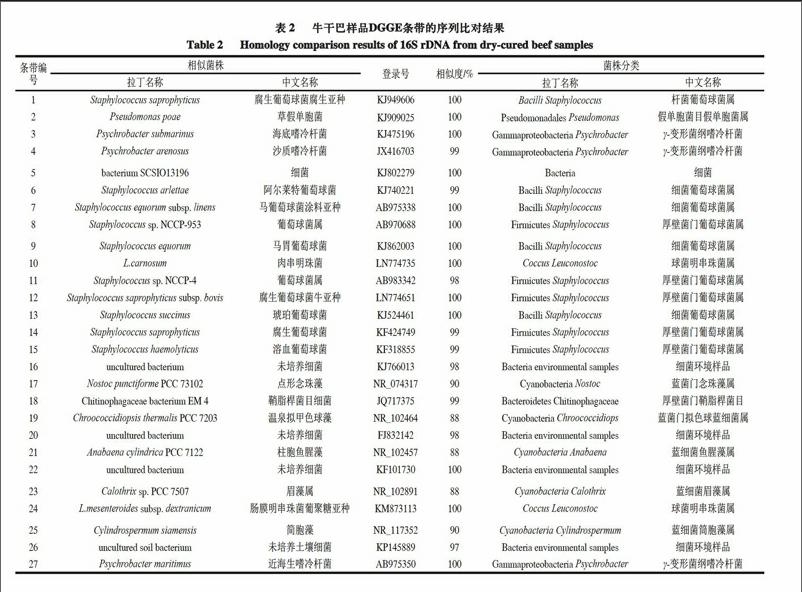
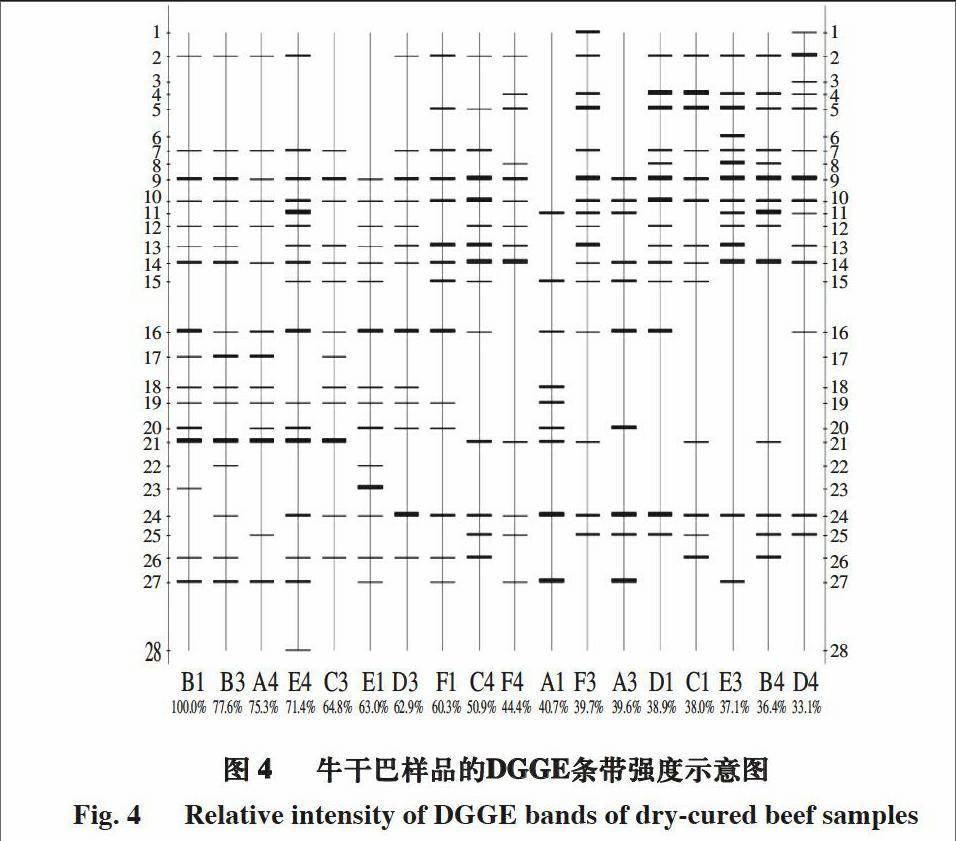
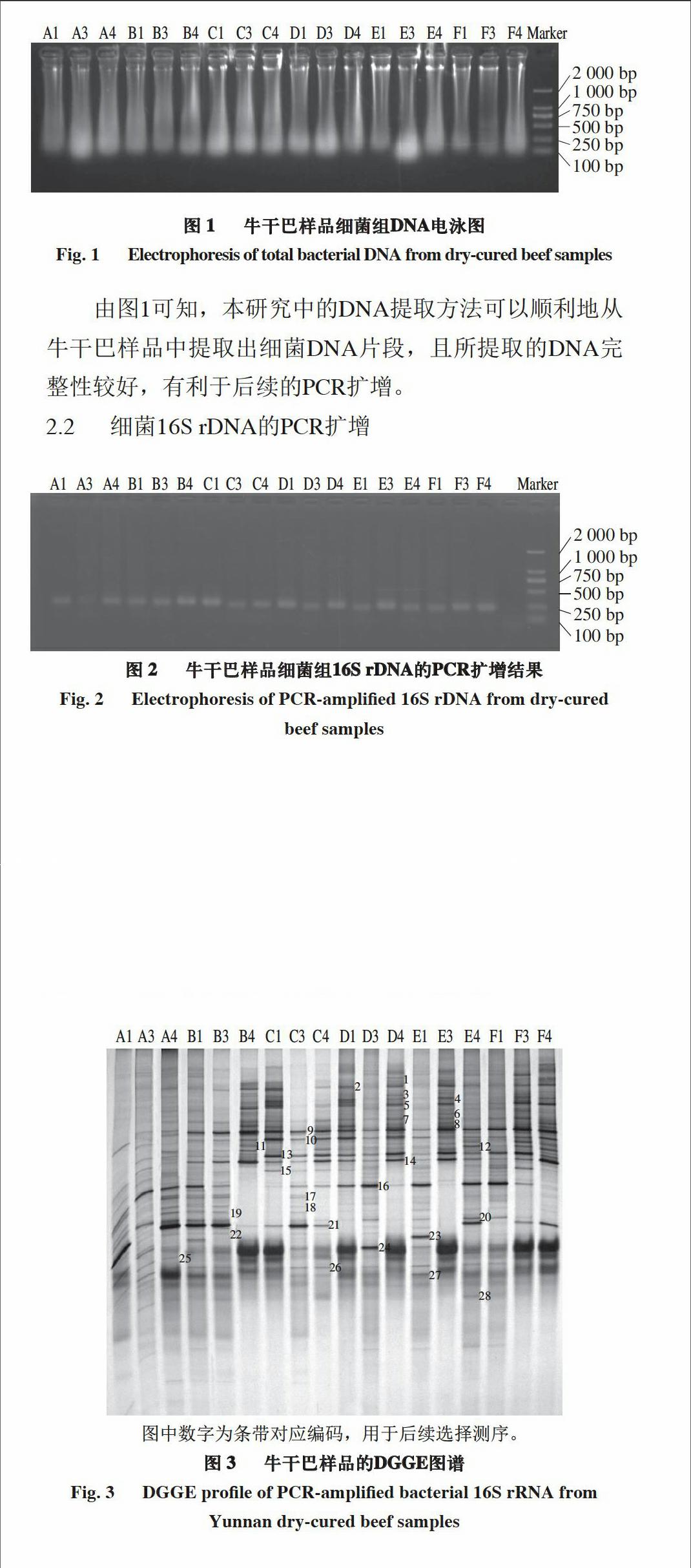
摘 要:以黄牛后腿肉为原料,采用传统工艺加工云南牛干巴,分别在腌制前、腌制中期、腌制后期、成熟1 个月、成熟2 个月与成熟3 个月6 个加工阶段取样,应用聚合酶链式反应-变性梯度凝胶电泳(polymerase chain reaction-denaturing gradient gel electrophorsis,PCR-DGGE)技术分析不同加工阶段牛干巴的细菌群落结构及多样性差异。结果表明:牛干巴具有较为丰富的细菌多样性,同时存在明显的优势种群结构变化。腌制阶段的细菌种类最为丰富;腌制前与腌制后的样品中细菌群落结构差异明显,同一阶段细菌群落结构组成类似;存在于牛干巴加工过程中的细菌主要为葡萄球菌属(Staphylococcus)、嗜冷杆菌(Psychrobacter)及明串珠菌属(Leuconostoc)等,其中肠膜明串珠菌葡聚糖亚种(L.mesenteroides subsp. dextranicum)是优势菌种;此外,牛干巴加工过程中还存在着不可培养(unculturable bacterium)的菌群。
关键词:云南牛干巴;聚合酶链式反应-变性梯度凝胶电泳;细菌群落结构;多样性
Analysis of Bacterial Community Structure of Yunnan Dry-Cured Beef by Polymerase Chain
Reaction-Denaturing Gradient Gel Electrophorsis
LIU Shuyun1,2, SHNAG Siqi1,2, SUN Can1, WANG Guiying1,2, CHENG Zhibin2, XIAO Rong1, JIANG Jinxian1,
WANG Shanrong3,*, LIAO Guozhou2,*
(1.College of Food Science and Technology, Yunnan Agricultural University, Kunming 650201, China;
2.Livestock Product Processing Engineering and Technology Research Center of Yunnan Province, Kunming 650201, China;
3.Yunnan Rural Leader College, Yunnan Agricultural University, Kunming 650201, China)
Abstract: Yunnan dry-cured beef was processed from beef hindquarter using the traditional method. Six samples were collected before curing, during the mid- and late-curing stages, and after one, two and three months of fermentation and ripening, respectively and then the bacterial community structure and diversity in dry-cured beef at different processing stages were analyzed using polymerase chain reaction-denaturing gradient gel electrophorsis (PCR-DGGE). The results showed that dry-cured beef was relatively rich in bacterial diversity, and the dominant bacterial populations in it were highly diverse. The highest bacterial diversity was found during the curing process of meat; there was a significant difference in the bacterial community structure between cured and uncured meat. The bacterial community structure remained similar at the same stage of processing. The bacterial community mainly consisted of Staphylococcus, Psychrobacter and Leuconostoc, with the predominance of L.mesenteroides subsp. dextranicum, along with unculturable bacteria, during the processing of dry-cured beef.
Key words: Yunnan dry-cured beef; polymerase chain reaction-denaturing gradient gel electrophorsis (PCR-DGGE); bacterial community structure; diversity
DOI:10.7506/rlyj1001-8123-201709008
中圖分类号:TS251.5 文献标志码:A 文章编号:1001-8123(2017)09-0044-07endprint
引文格式:
刘姝韵, 尚思奇, 孙灿, 等. 基于PCR-DGGE分析云南牛干巴的细菌群落结构[J]. 肉类研究, 2017, 31(9): 44-50. DOI:10.7506/rlyj1001-8123-201709008. http://www.rlyj.pub
LIU Shuyun, SHNAG Siqi, SUN Can, et al. Analysis of bacterial community structure of yunnan dry-cured beef by polymerase chain reaction-denaturing gradient gel electrophorsis[J]. Meat Research, 2017, 31(9): 44-50. DOI:10.7506/rlyj1001-8123-201709008. http://www.rlyj.pub
云南牛干巴是云南地區一种传统的民族肉制品,它是以黄牛后腿肉为原料,经腌制、晾晒、风干发酵而成的块状自然发酵肉制品[1]。牛干巴制作工艺考究、肉质酥脆、风味独特且营养丰富,但作为一种传统的腌腊肉制品,它在加工过程中主要依靠环境中的微生物生长来进行发酵,产品质量不稳定,其腌制发酵过程会形成复杂的微生物菌群,并产生一些对人体有害的有机化合物,降低了牛干巴的食用安全性[2]。……
