环境温度对中华蟾蜍间脑神经元电活动的影响
2017-07-01邓昕旸晁贺王勇王丽文梁传成
邓昕旸+晁贺+王勇+王丽文+梁传成

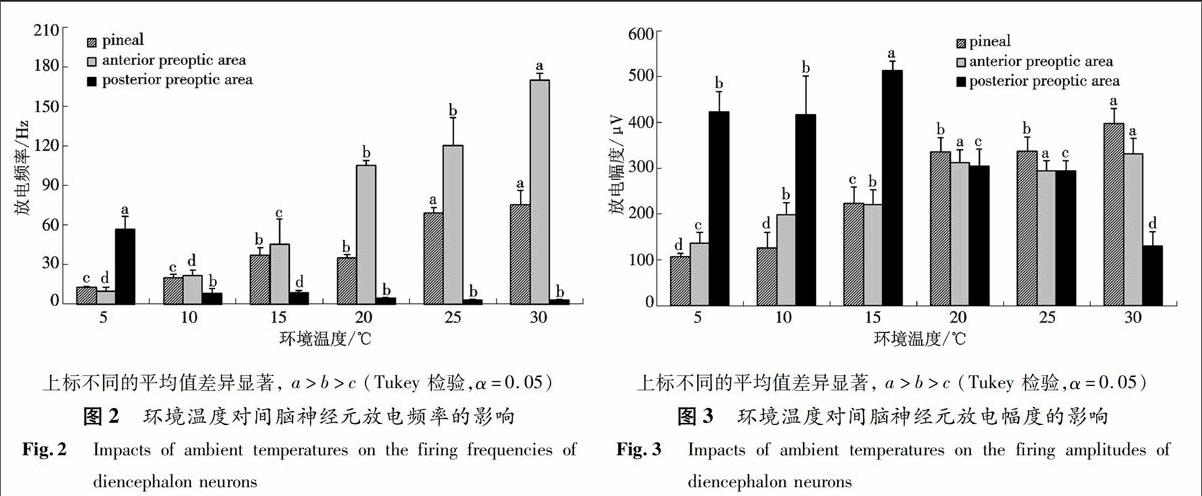
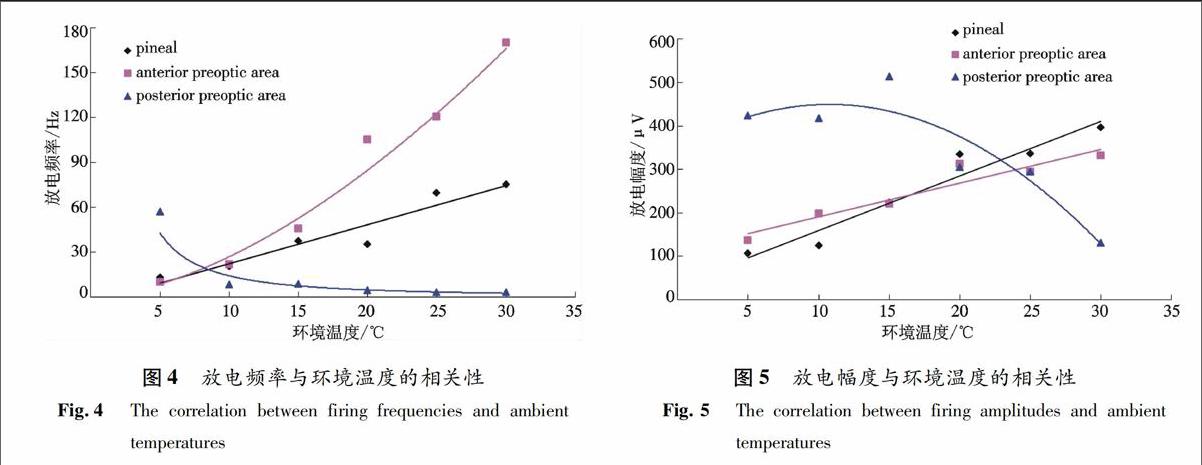
摘 要 应用微电极电生理技术记录不同环境温度下中华蟾蜍间脑神经元电活动,观察环境温度对中华蟾蜍间脑神经元电活动的影响,探讨生理性体温调节在中华蟾蜍体温调节中的作用.结果,中华蟾蜍间脑松果体和下丘脑视前区前部神经元的放电频率和放电幅度随环境温度的升高而升高,呈兴奋性变化,相关显著,表明松果体和下丘脑视前区前部神经元对高温环境较敏感,参与了降温过程的体温调节,但下丘脑视前区前部较松果体变化明显;下丘脑视前区后部神经元的放电频率和放电幅度随温度的升高而降低,呈抑制性变化,相关显著,表明下丘脑视前区后部神经元对低温敏感,参与了升温过程的体温调节.
关键词 环境温度;中华蟾蜍;间脑;电活动;体温调节
中图分类号 Q42 文献标识码 A 文章编号 1000-2537(2017)03-0027-05
Impact of Ambient Temperature on Electrical Activities of
Bufo Gargarizans Diencephalon Neurons
DENG Xin-yanga, CHAO Hea, WANG Yongb, WANG Li-wena, LIANG Chuan-chenga*
(a.College of Life Science, b.Experiment Center, Shenyang Normal University, Shenyang 110034, China)
Abstract The objective of this study is to probe the impact of ambient temperature on physiological thermaregulation in Bufo gargarizans. The microelectrode technique was employed to record extracellularly spontaneous electrical activities of neurons in diencephalon of Bufo gargarizans at different ambient temperatures. Our results show that, as ambient temperature increases, the firing frequency, amplitude of neurons of anterior hypothalamus and pineal gland were also found increased. Significant correlations among them were observed, indicating that neurons in anterior hypothalamus and pineal gland are sensitive to the high temperature environment, and they are all involved in body temperature adjustment. We also found that changes in the anterior hypothalamus were more pronounced than those in pineal gland. The firing frequency and amplitude of neurons in posterior preoptic areas were seen decreased as the ambient temperature increased, suggesting that there was an inhibition process going on in posterior preoptic areas. This mechanism indicates that neurons in the posterior preoptic area are more sensitive to low temperatures and they play important roles in the process of fervescence.
Key words ambient temperature; Bufo gargarizans; diencephalon; electrical activities; thermoregulation
動物感知外界温度,躲避对自身有害的气候环境,调节体温,维持内环境的稳定[1].恒温动物通过下丘脑体温调定点的调节机制引起产热和散热活动,还可改变代谢速率,以维持体温的相对稳定.变温动物则通过行为性体温调节方式来维持自身的优选最适温度[2-5],它们的体温在一定范围内随环境温度的变化而变化[6].研究表明,变温动物的体温与环境温度呈正相关,但在环境温度较低时体温略高于环境温度,环境温度较高时体温又略低于环境温度,说明变温动物除具有行为性体温调……