罗杰?费德勒:从暴躁少年到温雅绅士
2017-04-11BySimonHattenstone
By+Simon+Hattenstone

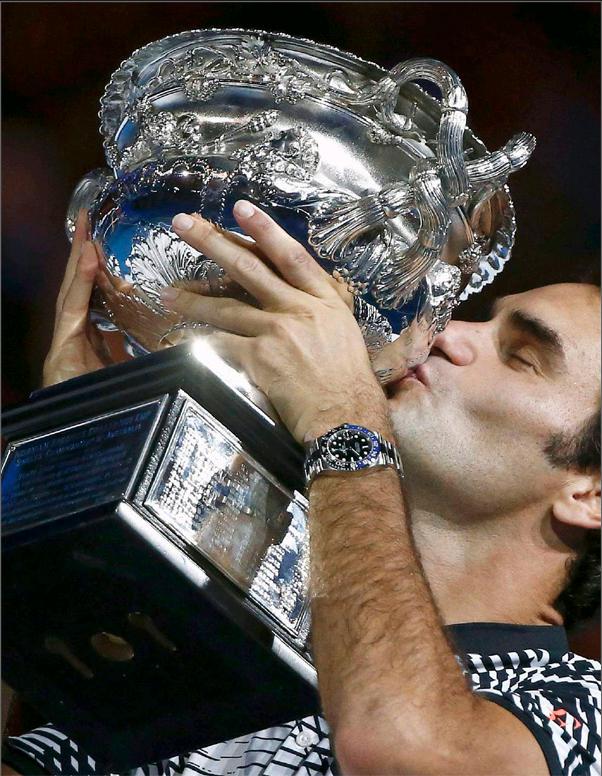

Roger Federer slowly, lovingly, takes the wrapping off his new racket, like a little boy with a giant lollipop. “Its my Wimbledon1) racket,” he says. He runs his fingers along the frame, bounces a hand against its head. He passes the racket to me—it is light and not highly strung2), which could also be said of the man. He looks lean, tanned, glowing, in the way only an elite athlete can.
Since winning his first major tournament3), he has been known for his calm. He doesnt shout at himself or his coaching team; he smiles rather than snarls on court; and he rarely questions decisions. The young Federer was a quite different proposition4).
He loved tennis from a young age, always playing against a wall at home, at a club with his Swiss father, a chemical engineer, and South African mother. But when he started to compete, aged eight, he would get frustrated, berating himself, telling himself he was rubbish. “Id commentate on each shot, saying, how in the world could I miss that, I cant believe how badly youre playing, this is just a joke.” For a second, he sounds like John “You cannot be serious” McEnroe5). Tournament officials would tick him off6) for being too verbal, and tell him he was putting off other players.
Could he have become a champion if hed stayed that way? “Yes, but not to the extent I am today.” He grins. “Well, Ive won 17 [grand slams7)], so maybe I could have won a few being a little bit cuckoo8), but Im not sure. You have to be mentally tough, physically strong, consistent, and I wasnt. So Im really proud I managed to turn it around.”
Federer is missing his first grand slam in 17 years. He has played in 65 successive slams, a testament to his hunger and his fitness. Then there is his record. Or records. Federers grand slam total makes him the greatest male tennis player ever. His closest rivals, Pete Sampras9) and Rafa Nadal10), have 14 each. Novak Djokovic11), who has achieved the near-impossible this year of holding all four major titles at once, is coming up fast behind—but has only 12.
Its not simply his record that makes Federer the greatest, its the way he plays. Only once in a blue moon12) does somebody come along who transcends their sport, elevating it into a thing of beauty: Lionel Messi13) in football, Muhammad Ali14) in boxing, Ronnie OSullivan15) in snooker, and Federer. Theres the spirit with which he plays, and the elegance—the single-handed backhand, the driving forehand. Federer can match todays baseline bullies, but he can also mix it up with the serve16) and volley17) that used to dominate the mens game. His appearance is every bit as stylish. It wasnt always that way: When Federer first emerged on to the scene, he looked fresh out of a teenage heavy metal band. But once he chopped off the ponytail he cut a different figure—more Jay Gatsby18) than Ozzy Osbourne19).
For all the achievements of Nadal and Djokovic, no player is loved quite like Federer. In a famous essay for the New York Times, the novelist David Foster Wallace20) wrote that watching him play was akin to a religious experience. And in 25 years of interviewing, I have never had such a swooning21) reaction from friends and colleagues when Ive told them who Im meeting—young and old, men and women, Federer crushes know no bounds.
Federer won junior Wimbledon at 16, but then his emotions kept getting the better of22) him. Other players realised he had a fatal flaw. “People knew, eventually hell crack,” he says. “Just stay with him and hell give you some easy mistakes. So I tried to create this aura of invincibility, of being tough to beat.” It took him a long time; Federer was almost 22 when he finally got the title.
So he had to move from being a tantrum23)-throwing McEnroe to a samurai24)-like Bjorn Borg25)? “To some extent, but Borg was all ice.” Federers heroes come from a later generation and are fiery types such as Goran Ivanisevic26). When coaches told him he had to quieten down, he agreed, but only up to a point. “I said, I have to get my emotion out, I cant handle it. They were like, yes, its good but not so much. Eventually I said, I need to find a balance. I cant just be ice, it becomes horribly boring. I need the fire, the excitement, the passion, the whole rollercoaster27). But I need it at a level where I can handle it: If Im all fire, I go nuts. It took two years to figure that out. It was a long road.”
Federer says there is a story that Mirka, his wife and the mother of his children (two sets of twins, identical girls Myla Rose and Charlene Riva, who will be seven in July; and fraternal28) boys Lenny and Leo, two), tells about the first time she set eyes on him. “I was playing club tennis in Switzerland and everybody said, ‘Go see this guy, hes super talented, the future of tennis. And the first thing she saw was me throwing a racket and shouting, and she was like [mockingly], ‘Yeah! Great player, he seems really good! Whats wrong with this guy?”
Federer says Mirka has played a huge part in his success. Look at the facts, he says. “When I met her I had zero titles, today I have 88, so shes been on this ride for the whole time.” He talks of her with tender pride: “She used to train five, six hours in a row. She was tough, and she taught me how to work.”
There is a conventional wisdom that natural talent gets you only so far: It takes elite performers 10,000 hours practice to fulfil their potential. Does this make Federer the exception to the rule? Has he achieved his success without putting in the hours?
God no, he says. He was always putting in the hours; just not necessarily in the right order and at the right time. Only when he put in Mirka-style stints29) did he start to fulfil his potential. Even then, his progress was hardly linear.
In 2001, he made headlines by beating Sampras at Wimbledon and reaching the quarter-finals; he also got to the quarters in the French Open30), but the following year he was knocked out of both in the first round. “All of a sudden, people started to ask, where had the talent gone?”
In 2003, he finally broke through, beating Mark Philippoussis31) in the Wimbledon final in straight sets32), and over the next six years established himself as the greatest. There is barely a record Federer hasnt broken: 10 consecutive grand slam finals, 23 consecutive semi-finals, 36 consecutive quarter-finals. He has spent 302 weeks as the No. 1 ranked player in the world, 237 consecutively. He is the only player to have won two grand slams five times consecutively—Wimbledon (2003~2007) and the US Open (2004~2008). He is ranked fourth in Forbes list of the worlds highest-paid athletes, earning around $67m over the past year, $60m of that for appearance fees and endorsements. He has earned more than any tennis player in prize money alone: $98m.
Unsurprisingly, there are endless rumours about his impending retirement, but he insists he has no plans. “I dont want to say Im enjoying it more, but its different. I have a deeper love for the game today. Before it was chasing the dream. Today it is living the dream and appreciating I can still do it. Its a wonderful feeling.”
So many fans thought that, as soon as he stopped bossing the game, he would just walk away. “Yes,” he says, “Ive heard retirement [talk] since 2009 when I won the French Open and people were like, well, what else are you playing for? Im like, whats wrong with you people? Dont you understand that playing tennis is great fun? I dont need to win three slams a year to be content. If the body doesnt want to do it, if the mind doesnt want to do it, if my wife doesnt want me to do it, if my kids dont like it, Ill stop tomorrow. Zero problem. But I love tennis in such a big way that I dont care if I dont win so much anymore. For me that is irrelevant.”
If theres one tournament hed like to win again, what would it be? “Wimbledon,” he says instantly. “This is where my heroes—Becker33), Edberg34), Sampras—won. I won the juniors there in 1998, my first slam. I won all these unbelievable matches there. Wimbledon is the holy grail.”
. New Oriental English
从暴躁少年到温雅绅士
今年1月29日,35岁的罗杰·费德勒在经历四年多的低迷后,重夺澳网男单冠军,收获第18个大满贯,创造了“高龄”夺冠的网坛奇迹。很多人觉得,费德勒能再次攀上大满贯之巅,靠的是天赋和近乎完美的技术。但实际上,一直支撑着“费天王”一次次走出低谷、重新夺冠的,是他对网球的热爱和绝不轻易放弃的精神。
I Need the Fire, the Excitement, the Whole Rollercoaster
罗杰·费德勒小心翼翼地慢慢揭开新球拍的包装,就像一个小男孩拿着一个超大的棒棒糖。“这是我的温布尔登球拍。”他说着,手指滑过拍框,又用手弹了弹拍头。他把球拍递给我——球拍很轻,球线并没有绷得很紧——这也可以用来形容他这个人。他看起来身形精瘦,皮肤黝黑,容光焕发,只有运动精英有这样的相貌。
自从第一次赢得大型锦标赛,他就以镇静闻名。他不大嚷大叫,也不吼自己的训练团队;他在球场上常常微笑,而不是咆哮;他很少质疑裁判的决定。而年轻时的费德勒可与此完全不同。
费德勒对网球的热爱始于很小的时候,他经常在家对着墙练习,或是在俱乐部和自己的父母打网球。他父亲是瑞士人,是一名化学工程师,母亲是南非人。费德勒八岁开始打比赛,但此时他常产生挫败感,会责备自己,骂自己是个废物。“我会点评每一次击球,对自己说怎么会没接住那个球呢,我不敢相信你打得这么烂,这简直是在开玩笑。”乍一听,他就像约翰·麦肯罗,后者常说:“你不是认真的吧。”锦标赛的裁判员们会因为他话多而批评他,说他干扰了其他运动员。……