新生儿低血糖观察与早期护理干预方式探讨
2017-03-08廖青慧
廖青慧
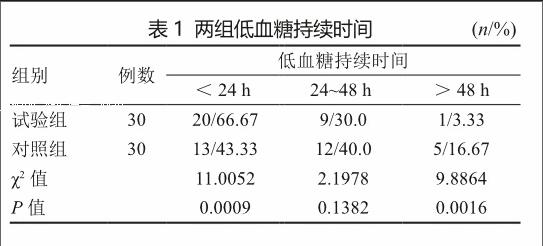
摘 要 目的:探讨新生儿低血糖观察与早期护理干预方法及应用效果。方法:收集2013年9月—2 0 1 6年8月接诊的低血糖新生儿60例,随机分为试验组与对照组各30例。两组都予以血糖监测与常规护理,试验组同时加用早期护理干预。观察两组血糖水平的变化情况,并比较治疗总有效率和家属满意度等指标。结果:试验组治疗总有效率和家属满意度分别为96.67%(29/30)和100.00%(30/30),对照组分别为83.33%(29/30)和80.0%(24/30),组间差异均有统计学意义(P<0.05)。试验组低血糖持续时间明显短于对照组(P<0.05)。结论:对低血糖新生儿辅以早期护理干预措施,可显著改善其血糖水平,缩短病情恢复时间,提高家属满意度。
关键词 低血糖;护理干预;满意度;新生儿
中图分类号:R722.19 文献标志码:A 文章编号:1006-1533(2017)04-0060-03
Observation of neonatal hypoglycemia and discussion of early nursing intervention
LIAO Qinghui
(Maternal and Child Health Care Center, Xinyu 338000, Jiangxi Province, China)
ABSTRACT Objective: To study neonatal hypoglycemia observation and early nursing intervention method and application effect. Methods: From Sept. 2013 to August 2016, 60 cases of neonatal hypoglycemia admitted into the department were collected and randomly divided into an experimental group and a control group with 30 cases each. Both groups were given blood glucose monitoring and routine care, while the experimental group given with early nursing intervention additionally. The changes of blood glucose levels in the two groups were observed and the total effective rate and family satisfaction index were compared. Results: The total effective rate and family satisfaction of the experimental group were 96.67%(29/30) and 100.0%(30/30), those of the control group was 83.33%(29/30) and 80.00%(24/30) and the differences were statistically significant(P<0.05). The duration of hypoglycemia in the experimental group was significantly shorter than that in the control group(P<0.05) and the difference was statistically significant(P<0.05). Conclusion: The early nursing intervention measure on the neonatal hypoglycemia can significantly improve the blood glucose level, shorten the recovery time and improve the satisfaction of family members.
KEY WORDS hypoglycemia; nursing intervention; satisfaction; neonate
臨床上,新生儿低血糖比较常见,可损伤患儿的中枢神经,并引发脑瘫亦或智力低下等后遗症[1],严重影响患儿的正常生长发育。新生儿低血糖的常见症状为嗜睡、青紫、苍白、哭声异常与发绀等[2],因缺乏典型性,所以易被家长忽视。因此,需加强对新生儿的血糖监测力度,以尽可能减少新生儿出现低血糖的风险。此外,针对已经出现低血糖症状的患儿,还应给予对症治疗与早期护理干预,方可提高患儿治疗效果,促进血糖水平恢复。本文探讨新生儿低血糖的观察与早期护理干预方式,为临床治疗提供一定借鉴。
1 资料与方法
1.1 一般资料
收集2013年9月—2016年8月新余市妇幼保健院接收的60例低血糖新生儿,血糖水平均≤2. 2 mmol/ L[3],符合新生儿低血糖症的临床诊断标准[4]。采用电脑随机盲法将60例患儿分为试验组与对照组各30例。试验组中,男17例,女14例;日龄1~9 d,平均(4.6±1.7)d;胎龄32~42周,平均(39.1±0.9)周;剖宫产12例,阴道分娩18例。对照组中,男16例,女14例;……