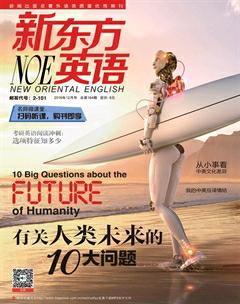
有关人类未来的10大问题
2016-12-05王炤翔
王炤翔
1 Does humanity have a future beyond Earth? 人类离开地球会有未来吗?
“I think its a dangerous delusion to envisage1) mass emigration from Earth. Theres nowhere else in the solar system thats as comfortable as even the top of Everest or the South Pole. We must address the worlds problems here. Nevertheless, Id guess that by the next century, there will be groups of privately funded adventurers living on Mars and thereafter perhaps elsewhere in the solar system. We should surely wish these pioneer settlers good luck in using all the cyborg2) techniques and biotech to adapt to alien environments. Within a few centuries they will have become a new species: The posthuman3) era will have begun. Travel beyond the solar system is an enterprise for posthumans—organic or inorganic.”
—Martin Rees, British cosmologist and astrophysicist
2 When and where do you think we will find extraterrestrial4) life? 你认为我们会在何时何地发现外星生命?
“If there is abundant microbial life on Mars, I suspect that we will find it within 20 years—if it is enough like our form of life. If an alien life-form differs much from what we have here on Earth, it is going to be difficult to detect. Its also possible that any surviving Martian microbes are rare and located in places that are difficult for a robotic lander to reach. Jupiters moon Europa and Saturns moon Titan5) are more compelling places. Europa is a water world where more complex forms of life may have evolved. And Titan is probably the most interesting place in the solar system to look for life. It is rich in organic molecules but very cold and has no liquid water; if life exists on Titan, it will be very different from life on Earth.”
—Carol E. Cleland, philosophy professor at the University of Colorado Boulder
3 Will the entire world one day have adequate health care? 是否会有一天全世界都能享有充足的医疗保障?
“The global community has made tremendous progress toward health equity over the past 25 years, but these advances have not reached the worlds most remote communities. Deep in the rain forest, where people are cut off from transportation and cellular networks, mortality is the highest; access to health care is the most limited and quality of care is the worst. The World Health Organization estimates that one billion people go their entire lives without seeing a health worker because of distance. Health workers recruited directly from the communities they serve can bridge the gap. They can even fight epidemics such as Ebola and maintain access to primary care when health facilities are forced to shut their doors. If the global community is serious about ensuring access to health care for all, it must invest in health workers who can reach the most remote communities.”
—Raj Panjabi, instructor at Harvard Medical School
4 Can we feed the planet without destroying it? 在不破坏地球的情况下我们能养活全人类吗?
“Yes. Heres what we need to do: Reduce crop waste, consumer waste and meat consumption; integrate appropriate seed technologies and management practices; engage consumers about the challenges farmers face in both the developed and the developing world; increase public funding for agricultural research and development; and focus on advancing the socioeconomic and environmental aspects of farming that characterize sustainable agriculture.”
—Pamela Ronald, professor in the University of California
5 Will we ever colonize outer space? 人类会把外太空变成殖民地吗?
“That depends on the definition of ‘colonize. If landing robots qualifies, then weve already done it. If it means sending microbes from Earth and having them persist and maybe grow, then, unfortunately, its not unlikely that weve done that as well—possibly on Mars with the Phoenix6) spacecraft and almost certainly inside the Curiosity rover7).
If it means having humans live elsewhere for a longer period of time, but not reproduce, then thats something that might happen within the next 50 years or so. But if the idea is to construct a self-sustaining environment where humans can persist indefinitely with only modest help from Earth, then Id say this is very far in the future, if its possible at all. We currently have a very inadequate understanding of how to build closed ecosystems that are robust to perturbation by introduced organisms or nonbiological events (Biosphere 28), for example), and I suspect that the contained ecosystem problem will turn out to be much more challenging than the vast majority of space colonization advocates realize. There are a wide range of technical problems to solve, another being air handling. We havent bothered to colonize areas underwater on Earth yet. Its far more challenging to colonize a place where theres hardly any atmosphere at all.”
—Catharine A. Conley, NASA planetary protection officer
6 Will we discover a twin Earth? 我们会发现另一个地球吗?
“My moneys on yes. Weve found that planets around other stars are far more abundant and diverse than scientists imagined just a couple of decades ago. And weve also found that the crucial ingredient for life on this planet—water—is common in space. Id say nature seems to have stacked the deck9) in favor of a wide range of planets, including Earth-like planets. We just have to look for them.”
—Aki Roberge, research astrophysicist focusing on exoplanets at NASA
7 Will there ever be a cure for Alzheimers10)? 究竟有没有治愈阿尔茨海默病的方法?
“I am not sure if there will be a cure, per se, but I am very hopeful that there will be a successful disease-modifying therapy for Alzheimers disease within the next decade. We have now started prevention trials that are testing biological interventions even before people show clinical symptoms of the disease. And we dont have to cure Alzheimers—we just need to delay dementia11) by five to 10 years. Estimates show that a five-year delay in the terrible and expensive dementia stage of the disease would reduce Medicare12) dementia costs by nearly 50 percent. Most important, that would mean that many older people could die while out ballroom dancing rather than in nursing homes.”
—Reisa Sperling, professor of neurology at Harvard Medical School
8 Will we ever figure out what dark matter13) is? 我们会弄懂暗物质究竟是什么吗?
“Whether we can determine what dark matter is depends on what it turns out to be. Some forms of dark matter allow detection through small interactions with ordinary matter that have so far evaded detection. Others might be detectable through their influence on structures such as galaxies. Im hopeful we will learn more through experiments or observations. But its not guaranteed.”
—Lisa Randall, professor of science in Harvard University
9 Could we one day replace all of the tissues in the human body through engineering?
未来我们能借助工程学替换人体所有的组织吗?
“In 1995 I wrote for a magazine about advances in artificial pancreas technology14), plastic-based tissues such as artificial skin and electronics that might permit blind people to see. All of these are coming to pass15), either as real products or in clinical trials. Over the next few centuries it is quite possible that nearly every tissue in the body may be able to be replaced by such approaches. Creating or regenerating tissues such as those found in the brain, which is extremely complex and poorly understood, will take an enormous amount of research. The hope is, however, that research in this area will happen quickly enough to help with brain diseases such as Parkinsons.”
—Robert Langer, Professor at the Massachusetts Institute of Technology
10 Will we use wearable technologies to detect our emotions? 我们会利用可穿戴技术检测情绪吗?
“Emotions involve biochemical and electrical signals that reach every organ in our bodies—allowing, for example, stress to impact our physical and mental health. Wearable technologies let us quantify the patterns in these signals over long periods of time. In the coming decade wearables will enable the equivalent of personalized weather forecasts for our health: 80 percent increased probability in health and happiness for you next week, based on your recent stress/sleep/social-emotional activities. Unlike with weather, however, smart wearables can also identify patterns we might choose to change to reduce unwanted ‘storm events: Increase sleep to greater than or equal to nine hours per night and maintain current low-moderate stress, for a 60 percent reduced likelihood of seizure16) in the next four days. Over the next 20 years, wearables, and analytics derived from them, can dramatically reduce psychiatric and neurological disease.”
—Rosalind Picard, founder and director of the Affective Computing17) research group at the M.I.T. Media Lab
时光荏苒,曾经科幻小说里那些天马行空的想象,有些已成为我们的生活日常。如今的我们对未来同样有着种种的憧憬:人类移民外太空,人人享有医保,科学家治愈阿尔茨海默病……这些期盼何时能实现?如何实现?《美国科学人》杂志邀请了十位科学精英针对这些困扰我们的问题给出了回答。
“我认为设想大规模移居外星是一种危险的妄想。太阳系的其他任何星球甚至还不如珠峰或南极舒服。我们必须在地球上解决这个世界的问题。但是我猜想,到下个世纪,将会有成群的探险家在私人的资助下到火星居住,以后可能到太阳系的其他星球居住。我们当然应该祝福这些先驱移民者们,愿他们能利用半机器人技术和生物技术适应外星环境。几世纪之后,他们将变成一个新物种:后人类时代就开始了。飞出太阳系的旅行是那些有机或无机后人类的事业。”
——英国宇宙学家和天体物理学家马丁·里斯
“如果火星上存在大量的微生物,我猜测20年内我们就能发现外星生命——如果这些生命与我们的生命形式足够相似。