尼古拉?特斯拉和他的塔:一世沉浮
2016-12-05廖鹏程
廖鹏程
他是一位开创性的发明家,一生独自取得700多项发明专利,创造了一系列令人惊叹甚至是改变世界的装置。他在电磁场领域有着多项革命性的发明,他的相关专利以及电磁学的理论研究是现代无线通信和无线电的基石。他不仅发现了旋转磁场,更将人们引向机器人、计算机以及导弹科学等领域。他被称为人类有史以来最伟大的天才,但一生充满坎坷:成就在有生之年未得到应有认可;身体状况欠佳,长期遭受强迫症和恐惧症的困扰;晚年穷困潦倒。他,就是天才科学家尼古拉·特斯拉。本文中,我们就来走近谜一样的特斯拉,了解他那令人唏嘘的一生。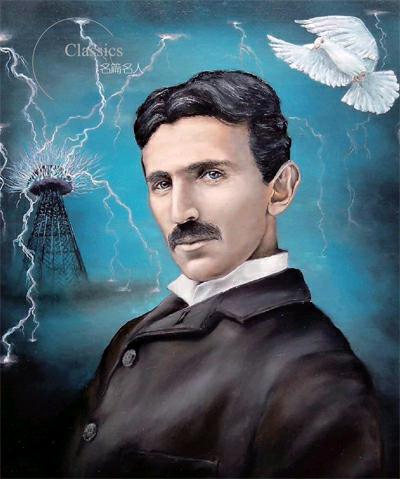
By the end of his brilliant and tortured life, the Serbian physicist, engineer and inventor Nikola Tesla was penniless and living in a small New York City hotel room. He spent days in a park surrounded by the creatures that mattered most to him—pigeons—and his sleepless nights working over mathematical equations and scientific problems in his head. That habit would confound scientists and scholars for decades after he died, in 1943. His inventions were designed and perfected in his imagination.
Tesla believed his mind to be without equal, and he wasnt above chiding1) his contemporaries, such as Thomas Edison, who once hired him. “If Edison had a needle to find in a haystack,” Tesla once wrote, “he would proceed at once with the diligence of the bee to examine straw after straw until he found the object of his search. I was a sorry witness of such doing that a little theory and calculation would have saved him ninety percent of his labor.”
But what his contemporaries may have been lacking in scientific talent (by Teslas estimation), men like Edison and George Westinghouse2) clearly possessed the one trait that Tesla did not—a mind for business. And in the last days of Americas Gilded Age3), Nikola Tesla made a dramatic attempt to change the future of communications and power transmission around the world. He managed to convince J. P. Morgan4) that he was on the verge of a breakthrough, and the financier gave Tesla more than $150,000 to fund what would become a gigantic, futuristic and startling tower in the middle of Long Island, New York. In 1898, as Teslas plans to create a worldwide wireless transmission system became known, Wardenclyffe Tower5) would be Teslas last chance to claim the recognition and wealth that had always escaped him.
The Early Life of the Great Genius
Nikola Tesla was born in modern-day Croatia in 1856; his father, Milutin, was a priest of the Serbian Orthodox Church. From an early age, he demonstrated the obsessiveness that would puzzle and amuse those around him. He could memorize entire books and store logarithmic6) tables in his brain. He picked up languages easily, and he could work through days and nights on only a few hours sleep.
At the age of 19, he was studying electrical engineering at the Polytechnic Institute at Graz in Austria, where he quickly established himself as a star student. He found himself in an ongoing debate with a professor over perceived design flaws in the direct-current (DC) motors that were being demonstrated in class. “In attacking the problem again I almost regretted that the struggle was soon to end,” Tesla later wrote. “I had so much energy to spare. When I undertook the task it was not with a resolve such as men often make. With me it was a sacred vow, a question of life and death. I knew that I would perish if I failed. Now I felt that the battle was won. Back in the deep recesses of the brain was the solution, but I could not yet give it outward expression.”
He would spend the next six years of his life “thinking” about electromagnetic fields and a hypothetical motor powered by alternate-current that would and should work. The thoughts obsessed him, and he was unable to focus on his schoolwork. Professors at the university warned Teslas father that the young scholars working and sleeping habits were killing him. But rather than finish his studies, Tesla became a gambling addict, lost all his tuition money, dropped out of school and suffered a nervous breakdown. It would not be his last.
In 1881, Tesla moved to Budapest, after recovering from his breakdown, and he was walking through a park with a friend, reciting poetry, when a vision came to him. There in the park, with a stick, Tesla drew a crude diagram in the dirt—a motor using the principle of rotating magnetic fields created by two or more alternating currents (AC). While AC electrification had been employed before, there would never be a practical, working motor run on alternating current until he invented his induction motor7) several years later.
The Inventions and Researches in the USA
In June 1884, Tesla sailed for New York City and arrived with four cents in his pocket and a letter of recommendation from Charles Batchelor—a former employer—to Thomas Edison, which was purported to say, “My Dear Edison: I know two great men and you are one of them. The other is this young man!”
A meeting was arranged, and once Tesla described the engineering work he was doing, Edison, though skeptical, hired him. According to Tesla, Edison offered him $50,000 if he could improve upon the DC generation plants Edison favored. Within a few months, Tesla informed the American inventor that he had indeed improved upon Edisons motors. Edison, Tesla noted, refused to pay up.
Tesla promptly quit and took a job digging ditches. But it wasnt long before word got out that Teslas AC motor was worth investing in, and the Western Union Company put Tesla to work in a lab not far from Edisons office, where he designed AC power systems that are still used around the world. “The motors I built there,” Tesla said, “were exactly as I imagined them. I made no attempt to improve the design, but merely reproduced the pictures as they appeared to my vision, and the operation was always as I expected.”
Tesla patented his AC motors and power systems, which were said to be the most valuable inventions since the telephone. Soon, George Westinghouse, recognizing that Teslas designs might be just what he needed in his efforts to unseat Edisons DC current, licensed his patents for $60,000 in stocks and cash and royalties8) based on how much electricity Westinghouse could sell. Ultimately, he won the “War of the Currents,” but at a steep cost in litigation and competition for both Westinghouse and Edisons General Electric Company.
Fearing ruin, Westinghouse begged Tesla for relief from the royalties Westinghouse agreed to. “Your decision determines the fate of the Westinghouse Company,” he said. Tesla, grateful to the man who had never tried to swindle him, tore up the royalty contract, walking away from millions in royalties that he was already owed and billions that would have accrued in the future. He would have been one of the wealthiest men in the world—a titan of the Gilded Age.
His work with electricity reflected just one facet of his fertile mind. Before the turn of the 20th century, Tesla had invented a powerful coil9) that was capable of generating high voltages and frequencies, leading to new forms of light, such as neon and fluorescent10), as well as X-rays. Tesla also discovered that these coils, soon to be called “Tesla Coils,” made it possible to send and receive radio signals. He quickly filed for American patents in 1897, beating the Italian inventor Guglielmo Marconi to the punch.
Tesla continued to work on his ideas for wireless transmissions when he proposed to J. P. Morgan his idea of a wireless globe. After Morgan put up the $150,000 to build the giant transmission tower, Tesla promptly hired the noted architect Stanford White of McKim, Mead, and White in New York.
“As soon as completed, it will be possible for a business man in New York to dictate instructions, and have them instantly appear in type at his office in London or elsewhere,” Tesla said at the time. “He will be able to call up, from his desk, and talk to any telephone subscriber on the globe, without any change whatever in the existing equipment. An inexpensive instrument, not bigger than a watch, will enable its bearer to hear anywhere, on sea or land, music or song, the speech of a political leader, the address of an eminent man of science, or the sermon of an eloquent clergyman, delivered in some other place, however distant. In the same manner any picture, character, drawing or print can be transferred from one to another place. Millions of such instruments can be operated from but one plant of this kind.”
White quickly got to work designing Wardenclyffe Tower in 1901, but soon after construction began it became apparent that Tesla was going to run out of money before it was finished. An appeal to Morgan for more money proved fruitless, and in the meantime investors were rushing to throw their money behind Marconi. In December 1901, Marconi successfully sent a signal from England to Newfoundland. Tesla grumbled that the Italian was using 17 of his patents, but litigation eventually favored Marconi and the commercial damage was done. Thus the Italian inventor was credited as the inventor of radio and became rich. Wardenclyffe Tower became a 186-foot-tall relic, and the defeat—Teslas worst—led to another of his breakdowns. “It is not a dream,” Tesla said, “it is a simple feat of scientific electrical engineering, only expensive—blind, faint-hearted, doubting world!”
Later Years
By 1912, Tesla began to withdraw from that doubting world. He was clearly showing signs of obsessive-compulsive disorder, and was potentially a high-functioning autistic. He became obsessed with cleanliness and fixated11) on the number three; he began shaking hands with people and washing his hands. He had to have 18 napkins on his table during meals, and would count his steps whenever he walked anywhere.
Near the end of his life, Tesla became fixated on pigeons, especially a specific white female. One night, Tesla claimed the white pigeon visited him through an open window at his hotel, and he believed the bird had come to tell him she was dying. The pigeon died in his arms, and the inventor claimed that in that moment, he knew that he had finished his lifes work.
He died in 1943, in debt, although Westinghouse had been paying his room and board at the hotel for years.
尼古拉·特斯拉,塞尔维亚裔物理学家、工程师、发明家,才华横溢却又一生坎坷,在其风烛残年之际,落得身无分文,寄居在纽约市的一家小旅馆里。白天,他待在公园里,与自己最喜爱的动物鸽子为伴;无眠的夜晚,他钻研着脑子里的数学方程式和科学难题。他的这一习惯在他1943年去世之后困扰科学家和学者们达几十年之久。他凭借想象设计并完善他的发明创造。
特斯拉认为自己的头脑举世无双,他还常嘲笑同时期的一些科学家,比如曾聘用过他的托马斯·爱迪生。“如果爱迪生要在干草堆中找一根针的话,”特斯拉曾写道,“他会像勤劳的蜜蜂一样立即开始检查每根干草,直至发现搜寻的目标。看到他这么做我觉得他真可怜,原本用上一点点理论和计算就能省去他90%的劳动。……