房颤的危险因素及其对心肌重构的影响研究
2016-10-19郭玉君杨峰赵利等
郭玉君 杨峰 赵利 等
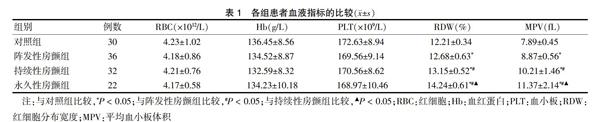
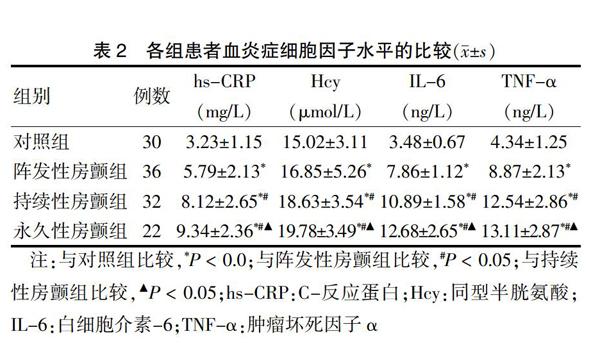
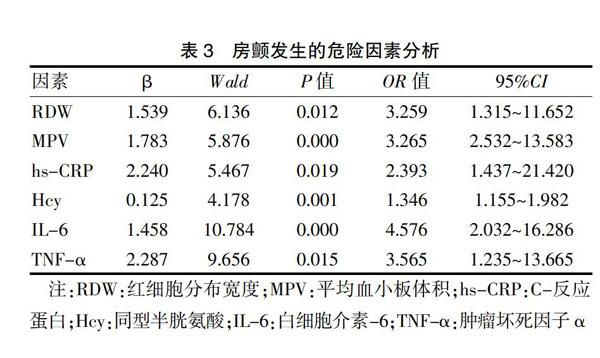
[摘要] 目的 觀察房颤患者血液指标、炎症细胞因子水平的变化,分析房颤的危险因素,观察房颤对心肌重构的影响。 方法 选择2014年5月~2015年5月在新疆医科大学第一附属医院住院治疗的90例心房颤动患者为研究对象,根据其病情分为阵发性心房颤动组(36例),持续性心房颤动组(32例)和永久性心房颤动组(22例),同时选取30例健康成人作为对照组。观察各组患者血液相关指标、炎症细胞因子水平和心肌重构指标的差异。 结果 四组患者红细胞(RBC)、血红蛋白(Hb)和血小板(PLT)水平差异无统计学意义(P > 0.05),而四组患者间的红细胞分布宽度(RDW)和平均血小板体积(MPV)水平差异有统计学意义(P < 0.05),且永久性房颤组>持续性房颤组>阵发性房颤组>对照组;四组患者的同型半胱氨酸(Hcy)、C-反应蛋白(hs-CRP)、白细胞介素-6(IL-6)、肿瘤坏死因子α(TNF-α)水平差异有统计学意义(P < 0.05),且为永久性房颤组>持续性房颤组>阵发性房颤组>对照组。Logistic回归分析显示:RDW、MPV、hs-CRP、Hcy、IL-6和TNF-α水平是患者发生房颤的危险因素(OR = 3.259、3.265、2.393、1.346、4.576和3.565,95%CI值:1.315~11.652、2.532~13.583、1.437~21.420、1.155~1.982、2.032~16.286、1.235~13.665,P < 0.05)。四组间的左房内径(LAD)、右房上下径(RAD)水平差异有统计学意义(P < 0.05),且永久性房颤组>持续性房颤组>阵发性房颤组>对照组;左室射血分数水平比较,永久性房颤组和持续性房颤组差异无统计学意义(P > 0.05),但均低于阵发性房颤组(P < 0.05),且阵发性房颤组低于对照组(P < 0.05)。四组患者的左室舒张功能末内径(LVEDD)水平差异无统计学意义(P > 0.05)。 结论 RDW、MPV、hs-CRP、Hcy、IL-6和TNF-α的高水平是心房颤动发生的危险因素,且房颤的严重程度与心肌重构有关。
[关键词] 心房颤动;炎症细胞因子;心肌重构;红细胞分布宽度
[中图分类号] R541.75 [文献标识码] A [文章编号] 1673-7210(2016)02(b)-0055-04
Risk factors of atrial fibrillation and the effect on myocardial remodeling
GUO Yujun1 YANG Feng2 ZHAO Li1 Ailiman·Mahemuti1 ZHANG Ling1
1.Heart Center, the First Affiliated Hospital of Xinjiang Medical University, Xinjiang Uygur Autonomous Region, Urumqi 830054, China; 2.Department of Emergency, the Second Jikun Hospital of Xinjiang Uygur Autonomous Region, Xinjiang Uygur Autonomous Region, Urumqi 830057, China
[Abstract] Objective To observe the changes of blood indexes and inflammatory cytokines in patients with atrial fibrillation, analyze the risk factors of atrial fibrillation, and observe the effect of atrial fibrillation on myocardial remodeling. Methods From May 2014 to May 2015, in the First Affiliated Hospital of Xinjiang Medical University, 90 patients with atrial fibrillation were selected as object of study, they were divided into paroxysmal atrial fibrillation group (36 cases), persistent atrial fibrillation group (32 cases), permanent atrial fibrillation group (22 cases), according to condition of apatient, and 30 healthy adults were selected as control group. The differences of blood related indexes, inflammatory cytokines and myocardial remodeling indexes of patients were observed. Results There were no statistically significant differences in PLT, Hb and RBC levels between the four groups (P > 0.05), but there was statistically significant difference in red cell distribution width (RDW) and the mean platelet volume (MPV) level between the four groups (P < 0.05), permanent atrial fibrillation group > persistent atrial fibrillation group > paroxysmal atrial fibrillation group > control group. There were significant differences in hs-CRP, IL-6, Hcy and TNF- levels in the four groups (P < 0.05), permanent atrial fibrillation group > persistent atrial fibrillation group > paroxysmal atrial fibrillation group > control group. The level of RDW, MPV, hs-CRP, IL-6, Hcy and TNF-α were the risk factors of atrial fibrillation (OR = 3.259, 3.265, 2.393, 1.346, 4.576, 3.565; 95%CI:1.315-11.652, 2.532-13.583, 1.437-21.420, 1.155-1.982, 2.032-16.286, 1.235-13.665, P < 0.05). There were statistically significant differences in LAD and RAD between the four groups (P < 0.05), and permanent atrial fibrillation group > persistent atrial fibrillation group > paroxysmal atrial fibrillation group > control group. The left ventricular ejection fraction was compared: there was no statistically significant difference between the permanent atrial fibrillation group and the persistent atrial fibrillation group (P > 0.05), but these were lower than those in paroxysmal atrial fibrillation group (P < 0.05), and these in paroxysmal atrial fibrillation group were lower than those in control group (P < 0.05). There was no statistically significant difference in LVEDD level between the four groups (P > 0.05). Conclusion The high level of RDW, MPV, hs-CRP, Hcy, IL-6 and TNF-α are the risk factors of atrial fibrillation, and the severity of atrial fibrillation is related to myocardial remodeling.
[Key words] Atrial fibrillation; Inflammatory cytokines; Myocardial remodeling; Red cell distribution width
心房颤动(简称房颤)是临床较为常见的持续性心律失常病症之一,常发于老年人群,报道指出80岁以上患者发病率为70%。房颤患者发病时,心室率快,舒张期短,减少了舒张期心室灌注,射血分数减低,极易出现心力衰竭、脑卒中与动脉系统血栓,对患者的生命安全造成严重威胁[1-3]。早期诊断与治疗,对缓解房颤有重要……
