藤黄酸对人结肠癌HCT116细胞增殖及Gankyrin表达的影响
2016-10-19邱旭彬曹杰杨平
邱旭彬 曹杰 杨平

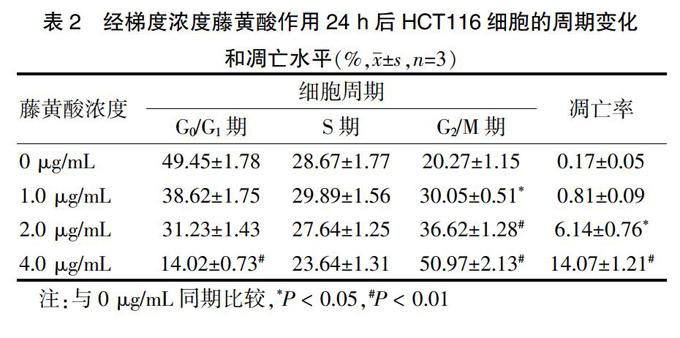
[摘要] 目的 觀察藤黄酸对人结肠癌HCT116细胞增殖和Gankyrin表达的影响,探讨其抑制人结肠癌生长增殖的作用机制。 方法 以1.0、2.0、4.0 μg/mL的藤黄酸作用体外培养的人结肠癌HCT116细胞,并设未予藤黄酸处理的对照组。处理12、24、36 h后,分别采用CCK-8法检测细胞增殖活性,流式细胞仪检测细胞周期分布和细胞凋亡率,Western blot检测Gankyrin蛋白水平的变化。 结果 藤黄酸对人结肠癌HCT116细胞生长增殖具有抑制作用,且呈浓度和时间依赖性,相同浓度不同时间点的抑制率差异有统计学意义(P < 0.05),不同浓度相同时间点的抑制率差异有统计学意义(P < 0.05)。流式细胞仪结果提示,藤黄酸阻滞HCT116细胞于G2/M期,1.0、2.0、4.0 μg/mL的藤黄酸处理24 h后,处于G2/M期的细胞数量均较对照组明显增加,差异均有统计学意义(P < 0.05或P < 0.01);HCT116细胞的凋亡率随藤黄酸浓度增加而逐步上升,2.0、4.0 μg/mL的藤黄酸处理后HCT116细胞的凋亡率均高于对照组,差异均有统计学意义(P < 0.05或P < 0.01)。用不同浓度的藤黄酸处理HCT116细胞24 h,Gankyrin蛋白水平随药物浓度的增加而下降(P < 0.05)。 结论 藤黄酸能够抑制人结肠癌HCT116细胞的生长增殖,诱导HCT116细胞阻滞于G2/M期,使Gankyrin的表达水平下降,其诱导肿瘤细胞凋亡的作用可能与抑制Gankyrin的表达相关。
[关键词] 人结肠癌;HCT116细胞;藤黄酸;Gankyrin
[中图分类号] R735.35 [文献标识码] A [文章编号] 1673-7210(2016)02(b)-0004-04
Effect of gambogic acid on human colon cancer HCT116 cell proliferation and expression of Gankyrin
QIU Xubin CAO Jie▲ YANG Ping ZENG Shanqi WANG Chengxing WU Qianlong CHEN Huacui
Area Two of Department of Gastrointestinal Surgery, Affiliated Guangzhou First Municipal People's Hospital, Guangzhou Medical University, Guangdong Province, Guangzhou 510180, China
[Abstract] Objective To observe the effect of gambogic acid on human colon cancer HCT116 cell proliferation and expression of Gankyrin, and to discuss the suppression mechanism. Methods 1.0, 2.0, 4.0 μg/mL of gambogic acid was used in human colon cancer HCT116 cells which were cultured in vitro, and the control group that without gambogic acid was set. 12, 24, 36 hours after gambogic acid treatment, the cell proliferation activity was tested by methyl thiazolyl tetrazolium (CCK-8) assay, the cell-cycle kinetics and cell apoptosis were tested by flow cytometry (FCM), and the change of expression of Gankyrin protein were tested by Western blot respectively. Results The proliferation of HCT116 cells was suppressed by gambogic acid in concentration and time dependent manner, inhibition rate of the same concentration in different time points had statistically significant difference (P < 0.05), and the inhibition rate of the HCT116 cells with different concentration at the same time points had statistically significant difference (P < 0.05). Results of FCM showed that, the HCT116 cell was stopped at G2/M period, 24 h after 1.0, 2.0, 4.0 μg/mL gambogic acid treatment, the number of cells in G2/M period increased significantly, compared with the control group, the differences were statistically significant (P < 0.05 or P < 0.01). The apoptosis of HCT116 cell rose with the increase of gambogic acid concentration, after 2.0, 4.0 μg/mL gambogic acid treatment, apoptosis rate of HCT116 cells was higher than that of the control group, the differences were statistically significant (P < 0.05 or P < 0.01). 24 hours after different concentration of gambogic acid treatment, the level of Gankyrin protein decreased as the concentration increased (P < 0.05). Conclusion Gambogic acid can significantly inhibit the proliferation of human colon cancer HCT116 cell, and induces the HCT116 cell stopped at G2/M period, decreases the level of Gankyrin expression, its effect of inducing apoptosis on tumor cells may related to the suppression of Gankyrin expression.
[Key words] Colon cancer; HCT116 cells; Gambogic acid; Gankyrin
结肠癌是一种发病率较高的消化道恶性肿瘤。近年来随着经济条件改善,人民生活水平逐渐提高,生活方式、饮食习惯及外部环境因素也随之发生了改变,我国结肠癌发病率呈4.2%的增长趋势逐年增长,当前已高居我国消化道肿瘤发病率的第2位,发病及病死人数已超过美国[1]。藤黄酸(gambogic acid,GA)是从中药藤黄中提取的主要活性成分,为一种低毒性广谱抗癌药。本课题组前期的研究表明,其对消化道肿瘤疗效显著,尤其对结直肠癌细胞具有良好的抑制作用[2]。本研究观察不同浓度的藤黄酸对体外培养的人结肠癌HCT116细胞作用情况,探讨藤黄酸对人结肠癌HCT116细胞的作用并检测其对Gankyrin蛋白表达的影响,分析中药成份藤黄酸诱导人结肠癌HCT116细胞发生凋亡的可能机制。
1 材料与方法
1.1 材料
人结肠癌HCT116细胞由美国ATCC公司引进,由南京凯基生物科技发展有限公司提供;……
