腹腔镜与开腹手术治疗胃癌术后对免疫细胞水平和凝血功能的影响
2016-09-26邓国军黎明泳蒙象沛严杰
邓国军+黎明泳+蒙象沛+严杰
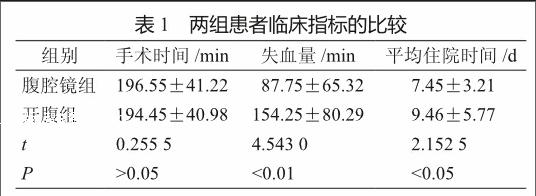


摘 要 目的:比较分析腹腔镜与开腹手术治疗胃癌术后对免疫细胞水平、凝血功能和IL-6和IL-10水平的影响。方法:随机选取我院2013年1月—2015年12月收治的胃癌患者100例,按照治疗方式的不同分为腹腔镜组和开腹组各50例,腹腔镜组采用腹腔镜下胃癌根治术,开腹组采用开腹胃癌根治术。比较分析两组患者的临床指标以及凝血指标、免疫细胞水平和IL-6和IL-10水平的变化。结果:腹腔镜组手术时间与开腹组比较差异无统计学意义;腹腔镜组失血量以及术后平均住院时间显著低于开腹组;术后第3天,两组患者腹腔引流液中IL-6浓度明显高于术前,但腹腔镜组显著低于开腹组;术后第3天,两组患者腹腔引流液中IL-10浓度均明显高于术前,且腹腔镜组明显高于开腹组;两组患者术后48 h CD4+,CD8+,CD4+/CD8+水平明显低于术前,且开腹组明显低于腹腔镜组;术后48 h两组患者凝血功能指标PT、APTT、INR较术前无明显改变(均P >0.05),且术后48 h两组比较无明显的统计学意义;术后48 h内,两组患者的FIB均有不同程度的升高,且腹腔镜组明显高于开腹组(P<0.01)。结论:腹腔镜手术较之开腹手术治疗胃癌,具有创伤小,术后恢复快,对机体的创伤应激和免疫功能的影响较小等优点,是治疗胃癌的有效术式。但其易造成血液呈现高凝状态,增加术后血栓的发生率,故应做好围术期的血栓防治工作。
关键词 腹腔镜下胃癌根治术 免疫细胞水平 凝血功能 IL-10水平
中图分类号:R735.2 文献标识码:A 文章编号:1006-1533(2016)15-0033-04
Effects of laparoscopy and laparotomy on immune cell level and blood coagulation function in patients with gastric cancer*
DENG Guojun**, LIN Mingyong, MENG Xiangpei, YAN Jie
(Department of General Surgery, the First Peoples Hospital of Nankang District, Ganzhou City, Ganzhou 341000, China)
ABSTRACT Objective: To compare and analyze the effects of laparoscopy and laparotomy on the levels of immune cell, IL-6 and IL-10 and blood coagulation function in patients with gastric cancer. Methods: One hundred cases of the patients were randomly selected and divided into a laparoscopic group (undergoing laparoscopic radical gastrectomy) and laparotomy group(undergoing open radical gastrectomy) with 50 cases each according to their different methods for surgery. The clinical indexes, the changes of blood coagulation indexes and the levels of immune cell, IL-6 and IL-10 were analyzed and compared between the two groups. Results: There were no significant differences in the surgical time between the two groups (P>0.05). The blood loss and postoperative hospitalization time were significantly less in the laparoscopic group than in the laparotomy group (P<0.05). The levels of IL-6 and IL-8 in the peritoneal drainage fluid on the third day were significantly higher after operation than before, however, the IL-6 levels were significantly lower and the IL-8 levels were significantly higher in the laparoscopic group than in the laparotomy group (P<0.01). CD4+, CD8+, CD4+/CD8+ levels in the postoperative 48 hours were significantly lower than before operation and in the laparotomy group than in the laparoscopic group (P<0.01). There were no significant changes in the blood coagulation indexes such as Pt, APTT, INR in the postoperative 48 hours between two groups compared with the preoperative ones (P>0.05). The FIB levels of the patients were increased to different extent within postoperative 48 hours and were significantly higher in the laparoscopic group than in the laparotomy group (P<0.01). Conclusion: Laparoscopic surgery possesses some advantages such as less trauma, faster recovery, less impact on the stress response and immune function of the body compared with laparotomy and is an effective surgery for gastric cancer. However, it is easy to make the blood into high coagulation state and increase the incidence of postoperative thrombosis, therefore the prevention and treatment of perioperative thrombosis should be focused on.
KEY WORDS laparoscopic radical prostatectomy for gastric carcinoma; immune cell level; blood coagulation function; IL-10 levels
胃癌在我国是发病率较高的恶性肿瘤之一。研究资料显示[1],胃癌患者的免疫功能是处于抑制状态的,胃癌患者术后由于手术创伤和应激反应的出现,免疫功能亦会进一步受到抑制,胃癌患者术后肿瘤的复发和转移的发生率与患者机体术后免疫功能的状态关系密切。研……
