胰岛素泵联合饮食运动干预治疗妊娠糖尿病的临床研究
2016-07-10李学燕
李学燕
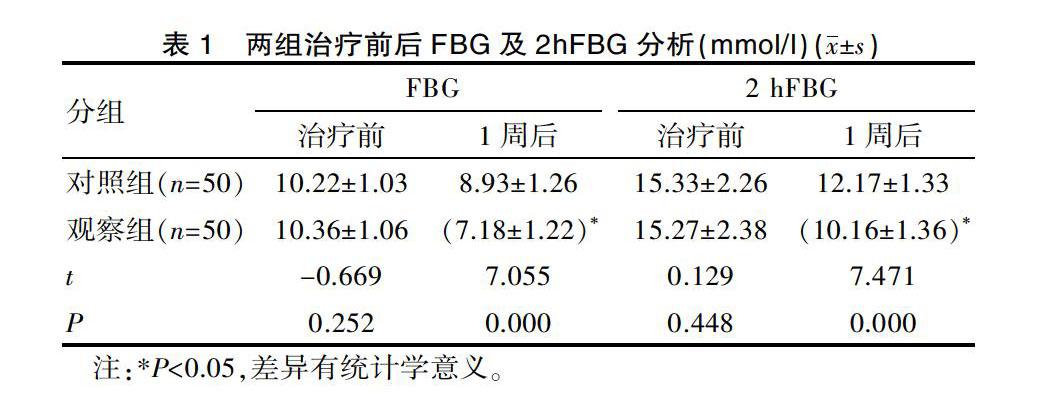
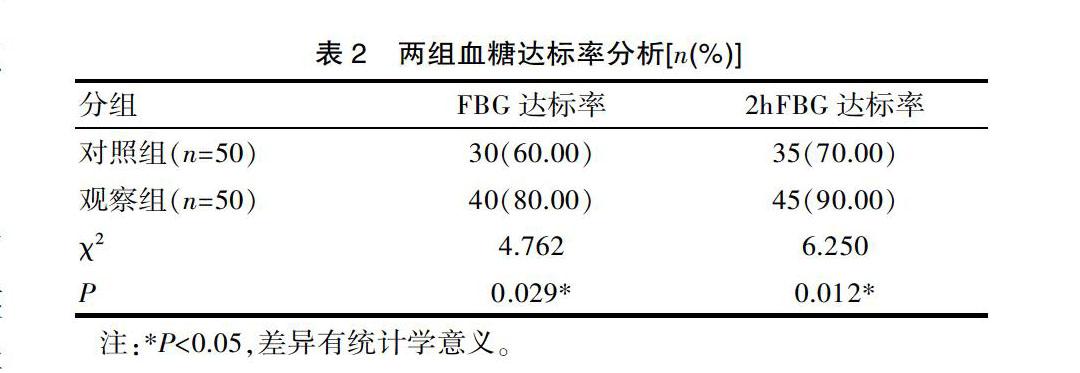
[摘要] 目的 探讨联合胰岛素泵及饮食运动干预治疗妊娠糖尿病的应用效果。方法 随机将100例妊娠糖尿病患者分为两组,每组50例。以在饮食运动疗法的基础上应用常规胰岛素治疗者为对照组,以在饮食运动疗法的基础上应用胰岛素泵治疗者为观察组。对比两组临床治疗效果。 结果 两组治疗前空腹血糖(FBG)及餐后2 h血糖(2 hFBG)比较差异无统计学意义(P>0.05),而在接受治疗1周后,观察组明显低于对照组(P<0.05)。同时观察组FBG达标率及2 hFBG达标率明显高于对照组(P<0.05)。结论 联合胰岛素泵及饮食运动疗法在妊娠糖尿病患者的治疗中具有着更为理想的应用效果。
[关键词] 妊娠糖尿病;胰岛素泵;饮食;运动
[中图分类号] R714 [文献标识码] A [文章编号] 1672-4062(2016)03(a)-0114-02
Clinical Research the Effect of Insulin Pump Joint Exercise Intervention in Gestational Diabetes
LI Xue-yan
Hebei Province Wuan City Maternal and Child Health Hospital of Obstetrics and Gynecology,Wuan,Hebei Province,056300 China
[Abstract] Objective To study the research the effect of insulin pump joint exercise intervention in gestational diabetes.Methods 100 cases of gestational diabetes patients randomly divided into two groups, 50 cases in each group. In the diet, exercise therapy on the basis of the application of conventional insulin therapy as controlgroup. In the diet, exercise therapy on the basis of the application of insulin pump therapy as observation group. Compare the clinical effect of two groups. Results There was no statistical differenceof fasting blood glucose(FBG) and postprandial 2 hours blood glucose(2HFBG) of the two groups before treatment(P>0.05). But after1-week treatment, observation group significantly lower than the control group(P<0.05). While FBG success rate and 2 HFBG success rate of observation group was obviously higher than that of control group(P<0.05). Conclusion combined insulin pump and diet, exercise therapy in the treatment of patients with gestational diabetes has the better application effect.
[Key words] Gestational diabetes; Insulin pump; Diet; Movement
妊娠糖尿病为发生于妊娠阶段的糖尿病特殊类型,可对产妇的分娩结局造成严重的影响[1]。因胰岛素的副作用低,故目前在该病的治疗中,胰岛素已成为临床的首先治疗药物[2]。而为有效的提高妊娠糖尿病患者的临床治疗效果,该院近年来在妊娠糖尿病患者的临床治疗过程中,在饮食运动疗法的同时,将胰岛素泵应用于其中,现报道如下。
1 资料与方法
1.1 一般资料
以2014年1月—2015年7月间就诊于该院的100例妊娠糖尿病患者作为观察对象,所有入选者孕周均为24~28周,且签署知情同意书。并以随机数字表法随机分为两组。以在饮食运动疗法的基础上应用常规胰岛素治疗者为对照组,以在饮食运动疗法的基础上应用胰岛素泵治疗者为观察组,每组50例。对照组,年龄21~40岁,平均(30.36±5.71)岁;孕周25~27周,平均(26.12±0.35)周。观察组,年龄21~39岁,平均(30.41±5.66)岁;孕周25~28周,平均(26.22±0.38)周。两组年龄及孕周资料经统计学分析,差异无统计学意义,具可比性。