Toth水解剖技术在经侧裂入路高血压脑出血显微手术中的应用研究
2016-05-14莫泉梁才干赖为峰
莫泉 梁才干 赖为峰
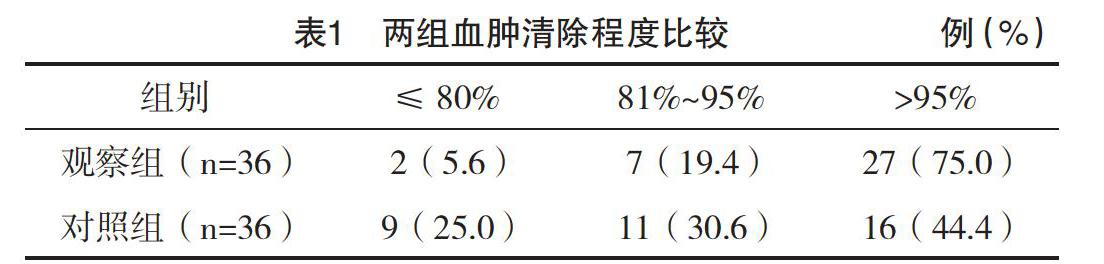

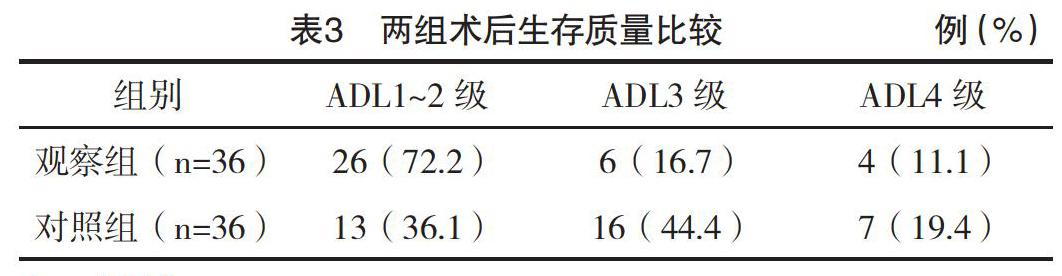
【摘要】 目的:探讨Toth水解剖技术在经侧裂入路高血压脑出血显微手术中的应用。方法:选取2011年1月-2015年1月本院收治的72例基底节区高血压脑出血患者作为研究对象,按随机数字表法将其分为对照组和观察组,每组36例。对照组行传统经外侧裂入路显微手术,观察组在经外侧裂入路显微手术中应用Toth水解剖技术。比较两组患者术后24 h的血肿清除率、术后并发症发生情况及术后6个月的生存质量。结果:两组术后24 h CT检查结果显示,观察组有27例(75.0%)患者血肿清除率>95%,81%~95%者7例(19.4%),≤80%者2例(5.6%);对照组中血肿清除率>95%者16例(44.4%),81%~95%者11例(30.6%),≤80%者9例(25.0%),观察组的血肿清除率明显优于对照组,差异有统计学意义(H=17.987,P<0.001)。观察组术后共出现并发症4例,包括术后再出血、肺部感染各1例,泌尿系统感染2例,发生率为11.1%;对照组共出现并发症15例,包括术后再出血、消化道出血各3例,肺部感染5例,泌尿系统感染4例,发生率为41.7%,观察组的术后并发症发生率明显低于对照组,差异有统计学意义(P<0.05)。观察组术后6个月ADL评级结果为:ADL1~2级26例(72.2%),ADL3级6例(16.7%),ADL4级4例(11.1%);对照组为:ADL1~2级13例(36.1%),ADL3级16例(44.4%),ADL4级7例(19.4%);观察组的生存质量明显优于对照组,差异有统计学意义(H=19.091,P<0.001)。结论:在经侧裂入路显微手术中联合应用Toth水解剖技术治疗高血压脑出血的效果显著,血肿清除彻底,手术创伤小,手术效果满意,术后并发症少,生存质量高,可作为一种有效技术在临床加以推广应用。
【关键词】 Toth水解剖技术; 经侧裂入路; 高血压脑出血; 显微手术
【Abstract】 Objective:To investigate the application of Toth water dissection technique during the micro-surgery of transsylvian approach in hypertensive cerebral hemorrhage.Method:72 patients with hypertensive cerebral hemorrhage at basal ganglia region admitted to our hospital from January 2011 to January 2015 were selected as the research objects,they were divided into the control group and the observation group according to the random number table method,36 cases in each group.The control group adopted the traditional micro-surgery of transsylvian approach and the observation group adopted the Toth water dissection technique during the micro-surgery of transsylvian approach.The clearance rate of hematoma after 24 hours of treatment,postoperative complications and quality of life after 6 months of treatment between the two groups were compared.Result:According to 24 h CT examination results,the observation group had 27 cases(75.0%) with clearance rate that was greater than 95%,7 cases(19.4%) with clearance rate that was between 81% and 95%,2 cases(5.6%) with clearance rate that was less than or equal to 80%.The control group had 16 cases(44.4%) with clearance rate that was greater than 95%,11 cases(30.6%) with clearance rate that was between 81% and 95%,9 cases(25.0%) with clearance rate that was less than or equal to 80%,the clearance effect of the observation group was better than the control group,the difference was statistically significant(H=17.987,P<0.001).After treatment,the observation group had 4 cases with complications including 1 case of rebleeding,1 case of pulmonary infection,2 cases of urinary system infection,the incidence rate was 11.1%.The control group had 15 cases with complications including 3 cases of rebleeding,3 cases of gastrointestinal bleeding,5 cases of pulmonary infection,4 cases of urinary system infection,the incidence rate was 41.7%.The incidence rate of the observation group was significantly lower than the control group,the difference was statistically significant(P<0.05).After 6 months of treatment,the observation group had 26 cases(72.2%) with level 1-2 of ADL,6 cases(16.7%) with level 3 of ADL,4 cases(11.1%) with level 4 of ADL,the control group had 13 cases(36.1%) with level 1-2 of ADL,16 cases(44.4%) with level 3 of ADL and 7 cases(19.4%) with level 4 of ADL.The quality of life in the observation group was better than the control group,the difference was statistically significant(H=19.091,P<0.001).Conclusion:For hypertensive cerebral hemorrhage,the micro-surgery of transsylvian approach combined with Toth water dissection technique can completely clear the hematoma, has minimal operation injury and satisfaction, fewer complications and higher quality of life. The effective technique can be promoted and applied in clinical practices.
【Key words】 Toth water dissection technique; Transsylvian approach; Hypertensive cerebral hemorrhage; Micro-surgery
First-authors address:The Peoples Hospital of Huaiji County,Huaiji 526400,China
doi:10.3969/j.issn.1674-4985.2016.05.017
据统计,在各种非损伤性脑出血的病因中,高血压约占60%[1]。高血压脑出血(HICH)是指由于长期高血压和脑动脉硬化使脑内小动脉因发生病理性改变所导致的破裂出血,基底节区出血是最常见的高血压脑出血的部位,约占70%,具有高发病率、高致残率和高致死率等特点[2-4]。在高血压脑出血的临床治疗中,手术仍为其首选方式,其目的主要在于清除血肿、降低颅内压,恢复受压神经元[5]。传统手术方式为经颞叶皮层入路,方便清除血肿,但手术需从正常脑组织进入血肿腔,因此术后易发生瘫、癫痫、语言功能障碍等多种并发症;且手术创伤大,术后并发症多,经外侧裂入路显微手术是近年来发展起来的一种新的手术方式,该术式从正常脑组织间隙进入,不损伤正常脑组织,因此手术创伤小[6]。本研……
