不同手术方法治疗腹股沟斜疝的疗效
2016-05-14赵健
赵健
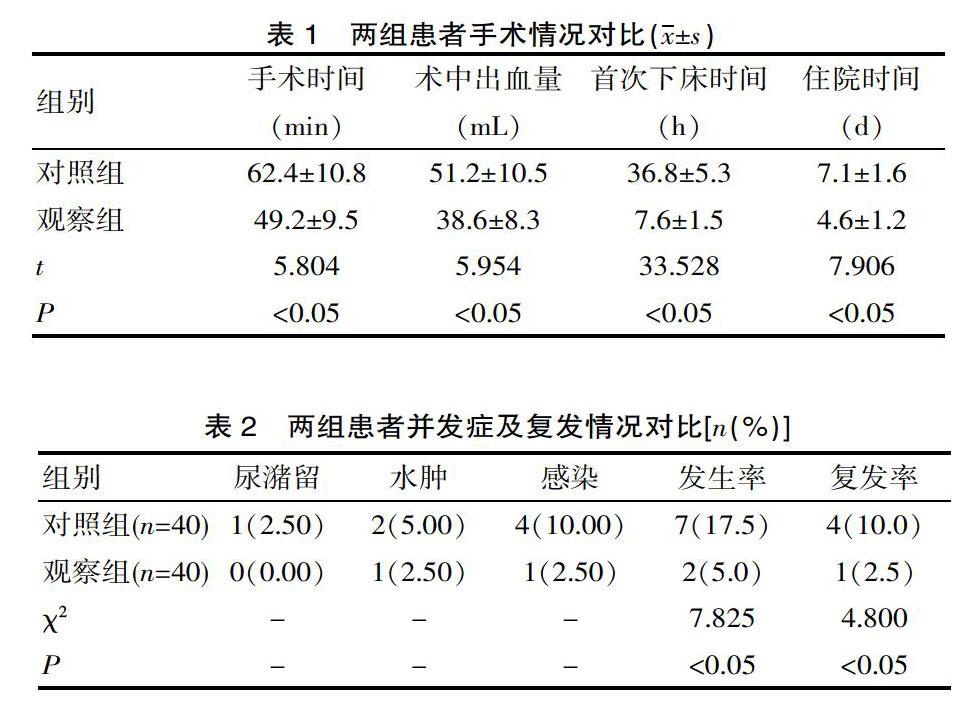
[摘要] 目的 研究腹股沟斜疝患者使用不同手术方法治疗的临床效果。 方法 随机选取临床80例该院2013年7月—2015年7月期间收治的腹股沟斜疝患者,所有患者按随机数字表法分为腹股沟疝修补术和无张力修补术两组各40例。 结果 观察组手术时间、术中出血量、首次下床时间以及住院时间均短于对照组(P<0.05);观察组并发症发生率及复发率仅为5%、2.5%,低于对照组的17.5%、10%(P<0.05)。 结论 相对于传统腹股沟疝修补术,无张力修补术在腹股沟斜疝患者中应用效果较佳,术后并发症及复发少,值得临床应用及推广。
[关键词] 腹股沟斜疝;治疗效果;无张力修补术;腹股沟疝修补术
[中图分类号] R5 [文献标识码] A [文章编号] 1674-0742(2016)02(c)-0052-02
Curative Effect of Different Operation Methods in Treatment of Indirect Inguinal Hernia
ZHAO Jian
Second Department of Surgery, the Second People's Hospital of Zhaotong City,Zhaotong, Yunnan Province, 6570000 China
[Abstract] Objective To research the clinical effect of different operation methods in treatment of indirect inguinal hernia. Methods 80 cases of patients with indirect inguinal hernia admitted and treated in our hospital from July 2013 to July 2015 were selected and randomly divided into the inguinal hernia repair group and the inguinal hernia tension-free repair group with 40 cases in each. Results The operation time, intraoperative blood loss, getting out-of-bed time and length of stay in the observation group were lower than those in the control group(P<0.05), the incidence and recurrence rate of complications were only 5% and 2.5%, which were lower than those in the control group(17.5%, 10%)(P<0.05). Conclusion The effect of tension-free repair in the application of patients with indirect inguinal hernia is better than that of traditional inguinal hernia repair with few postoperative complications and less recurrence, which is worth application and promotion in clinic.
[Key words] Inguinal hernia; Treatment effect; Tension-free repair; Inguinal hernia repair
疝气是指人体脏器离开原来的解剖部位通过薄弱点进入另一个部位。在婴幼儿时期,脐疝较为常见,而成年患者腹股沟疝较为常见,其中又以斜疝居多。据我国数据统计[1-2],我国腹股沟疝患者中约90%均为斜疝。在腹股沟疝发病时,轻者不能行走或站立,重者甚至不能用力呼吸,疼痛难忍,严重影响患者生活质量。有效的治疗腹股沟斜疝对患者有重要意义。临床上以手术方式为主,采用疝修补术可有效治疗腹股沟斜疝,解决患者的病患[3]。该研究随机选取该院2013年7月—2015年7月期间收治的腹股沟斜疝患者80例进行研究,观察两种手术方法治疗腹股沟疝的临床效果,现报道如下。
1 资料与方法
1.1 一般资料
该次80例研究对象均为随机选取该院2013年7月—2015年7月期间收治的腹股沟斜疝患者,所有患者经检查和诊断均符合腹股沟斜疝诊断标准[4]。根据随机数字表法将患者分为对照组、观察组各40例。对照组中男性患者29例,女性患者11例,年龄20~72岁,平均年龄(32.6±5.2)岁。病程1~32个月,平均病程(16.8±4.5)个月。……