远端缺血后适应对急性脑梗死患者NIHSS评分及血清超敏C反应蛋白水平的影响
2016-05-14陈杰英
陈杰英
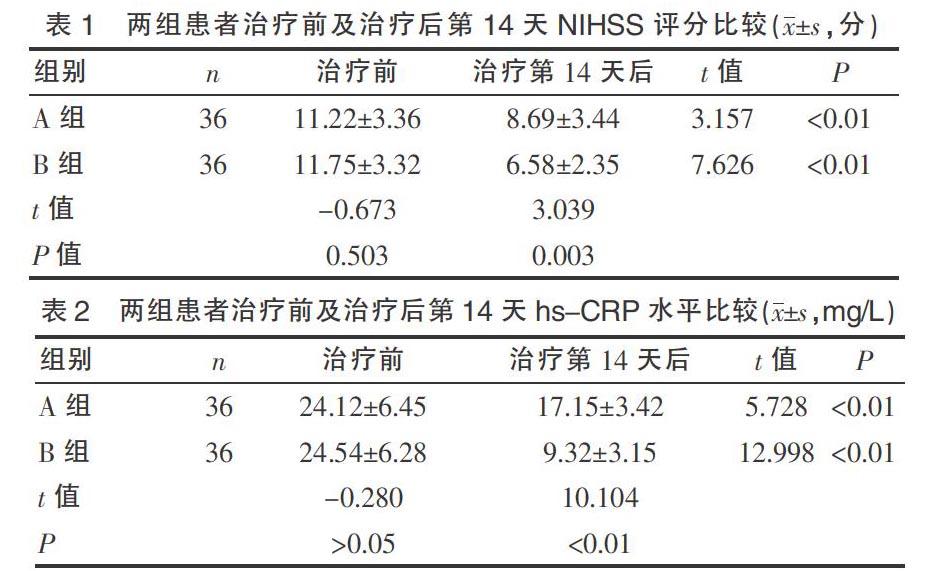
[摘要] 目的 观察远端缺血后适应对脑梗死急性期患者NIHSS评分及血清超敏C反应蛋白(hs-CRP)水平的影响。方法 将我院2015年3月1日~7月31日收治的急性脑梗死患者72例纳入本研究,随机分为两组:A组(药物治疗组)36例,B组(药物治疗加远端缺血后适应治疗组)36例。A组患者接受阿司匹林肠溶片、依达拉奉针、血塞通冻干粉针治疗,B组在药物治疗的基础上给予远端缺血后适应治疗,疗程均为14 d。在治疗前及治疗后第14天对患者进行NIHSS评分及hs-CRP水平测定,对两组数据进行统计学分析。 结果 治疗前A组患者NIHSS评分[(11.22±3.36)分]及B组患者NIHSS评分[(11.75±3.32)分]比较,差异无统计学意义(P>0.05),治疗后第14天B组患者NIHSS评分[(6.58±2.35)分]较A组患者NIHSS评分[(8.69±3.44)分]明显降低,差异有统计学意义(P<0.05)。治疗前A组患者血清hs-CRP水平[(24.12±6.45)mg/L]与B组患者血清hs-CRP水平[(24.54±6.28)mg/L]比较,差异无统计学意义(P>0.05);治疗第14天后A组患者血清hs-CRP水平[(17.15±3.42)mg/L]与B组患者血清hs-CRP水平[(9.32±3.15)mg/L]比较,B组血清hs-CRP水平明显降低,差异有统计学意义(P<0.05)。 结论 远端缺血后适应治疗在联合药物治疗的基础上,比单纯药物治疗更能减少急性脑梗死患者的NIHSS评分及血清超敏C反应蛋白(hs-CRP)水平。
[关键词] 急性脑梗死;远程缺血后适应;NIHSS评分;超敏C反应蛋白
[中图分类号] R743.3 [文献标识码] B [文章编号] 1673-9701(2016)09-0072-04
[Abstract] Objective To observe the effects of adaption after remote ischemia on NIHSS scores and level of high-sensitivity C-reactive protein (hs-CRP) for patients with acute cerebral infarction. Methods 72 patients with acute cerebral infarction who were admitted to our hospital from March 1st, 2015 to July 31st, 2015 were included in the study. They were randomly assigned to two groups: 36 patients in group A (drug treatment group), and 36 patients in group B (drug treatment plus adaption after remote ischemia). The patients in group A were given the treatment of aspirin enteric-coated tablets, edaravone injection, and xuesaitong lyophilized powder injection. The patients in group B were further given the therapy of adaption after remote ischemia on the basis of drug treatment. The course of treatment was both 14 days. NIHSS was scored and hs-CRP level was determined in the patients before the treatment and 14 days after the treatment, and the two groups of data were statistically analyzed. Results NIHSS score in group A before the treatment was (11.22±3.36), and the score in group B was (11.75±3.32). The comparison was not statistically different (P>0.05). NIHSS score in group B 14 days after the treatment was (6.58±2.35), significantly lower than that of (8.69±3.44) scores in group A, and there was statistical difference(P<0.05). Before the treatment, there was no significant difference compared between serum hs-CRP level of (24.12±6.45) mg/L in group A and serum hs-CRP level of (24.54±6.28) mg/L in group B (P>0.05); 14 days after the treatment, in the comparison between serum hs-CRP level of (17.15±3.42) mg/L in group A and serum hs-CRP level of (9.32±3.15) mg/L in group B, the level of serum hs-CRP in group B was significantly reduced, and there was statistical difference (P<0.05). Conclusion On the basis of drug treatment, adaption after remote ischemia is more effective than single drug treatment in reducing NIHSS scores and serum hs-CRP levels in the patients with acute cerebral infarction.
[Key words] Acute cerebral infarction; Adaption after remote ischemia; NIHSS scores; High-sensitivity C-reactive protein (hs-CRP)
脑血管疾病是危害中老年人身体健康和生命的主要疾病之一。卒中是目前导致人类死亡的第二位原因,它与缺血性心脏病、恶性肿瘤构成多数国家的三大致死疾病。而在我国2008年卫生部公布的第三次全国死因调查中,卒中已超过恶性肿瘤成为我国第一致死病因。同时卒中也是单病种致残率最高的疾病。而脑梗死约占卒中的70%~80%,是卒中的最常见类型[1]。因此寻求对脑梗死的有效治疗方法显得尤为重要。
远程缺血适应通俗地讲就是让肢体做一个反复的缺血,肢体就会对缺血产生一种抵抗,缺血的过程中会产生多种物质(一氧化氮、腺苷、缓激肽),这样的物质会随着血液流到全身,到达大脑、心脏、肾脏,随后再次发生缺血的话,就会对缺血产生耐受。远程……
