双相Ⅰ型抑郁障碍患者缓解期与抑郁发作期神经认知功能损害比较
2016-05-14陈倩倩曹敏敏汤义平
陈倩倩 曹敏敏 汤义平
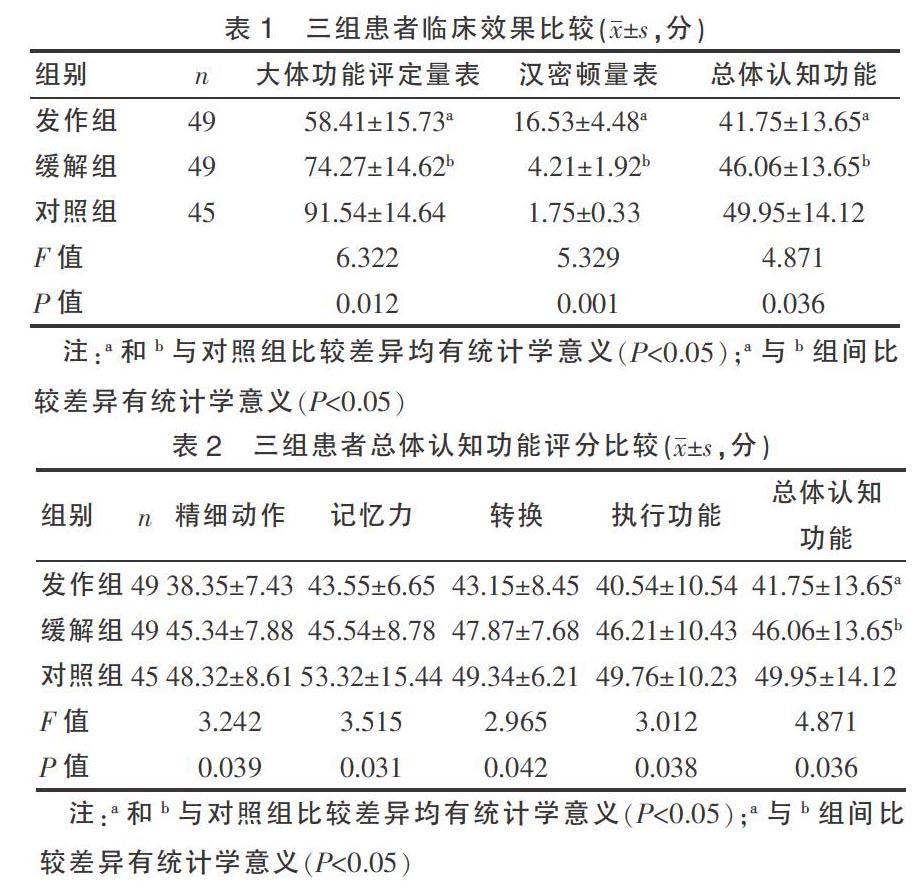
[摘要] 目的 探讨双相I型抑郁障碍患者缓解期与抑郁发作期神经认知功能损害比较。 方法 随机抽取我院收治的双相I型抑郁障碍患者作为研究对象,选取49例障碍缓解期患者为缓解组,49例抑郁发作期患者为发作组,另外选取本院45例同期体检的健康者为对照组。通过对三组实验者进行大体功能评定量表评分、汉密顿量表评分以及总体认知功能评分比较。 结果 缓解组的大体功能评定量表、汉密顿量表以及总体认知功能分别为(74.27±14.62)分、(4.21±1.92)分、(46.06±13.65)分;发作组大体功能评定量表、汉密顿量表以及总体认知功能分别为(58.41±15.73)分、(16.53±4.48)分、(41.75±13.65)分;对照组大体功能评定量表、汉密顿量表以及总体认知功能分别为(91.54±4.64)分、(1.75±0.33)分、(49.95±14.12)分。三组比较,发作组的汉密顿量表评分要比其他两组高,缓解组又比对照组评分高,三组比较差异具有统计学意义(P<0.05)。 结论 在临床缓解时,患者的信息处理速度、视觉空间记忆等方面的认知功能损害在双相障碍、单相抑郁障碍中都可见,而单相抑郁障碍中常见执行功能的损害。因此,执行功能的损害对双相障碍患者来说就是一种状态指标。
[关键词] 双相I型抑郁障碍;缓解期;抑郁发作期;神经认知功能;损害
[中图分类号] R749.4 [文献标识码] A [文章编号] 1673-9701(2016)09-0013-03
[Abstract] Objective To compare the neurocognitive impairment between remission stage and depressive episode of patients with bipolar I depressive disorder. Methods Patients with bipolar I depressive disorder admitted to our hospital were randomly selected and 49 cases were assigned to the remission group and 49 assigned to the episode group. Other 45 healthy people who did physical examination at the same period were selected as the control group. The scores of Global Assessment Function(GAF), Hamilton Depressing Rating Scale(HDRS) and overall cognitive function of the three groups were compared. Results The scores of the GAF, HRDS and overall cognitive function of patients from remission group were as follows(74.27±14.62), (4.21±1.92) and (46.06±13.65); the scores of patients from episode group were(58.41±15.73), (16.53±4.48) and (41.75±13.65); the scores of patients from control group were(91.54±4.64), (1.75±0.33) and(49.95±14.12). Scores of HDRS of patients from episode group were higher than patients from the other two groups and the remission group had higher HDRS scores than control group and the differences had statistic significance(P<0.05). Conclusion During clinical remission stage, the neurocognitive impairments like information process speed and visual spatial memory can be seen in patients with bipolar and unipolar depressive disorder and executive function impairments were more frequently seen in patients with unipolar depressive disorder. Therefore, executive function impairment is just a status index in the patients with bipolar depressive disorder.
[Key words] Bipolar I depressive disorder; Remission stage; Depressive episode; Neurocognitive function; Impairment
双相障碍(bipolar disorder,BD)是临床中由多种因素引起的疾病,又称为狂躁抑郁症,该疾病的临床症状主要有不定期出现的狂躁与抑郁[1]。同时,狂躁抑郁症反复交替出现。除以上表现,患者还有睡眠的不规律变化以及神经认知方面功能的不断改变[2]。根据调查显示,该疾病不仅包括情绪调控异常,还包括睡眠觉醒异常以及认知方面的缺陷[3]。同时,双相障碍的患者除了患有躁狂急性发作期和抑郁急性发作期外,还在一定程度上存在对认知方面的功能异常[4]。……
