发动机曲轴多工序装配的质量预测模型研究
2016-03-25刘明周吕旭泽王小巧
刘明周++吕旭泽++王小巧

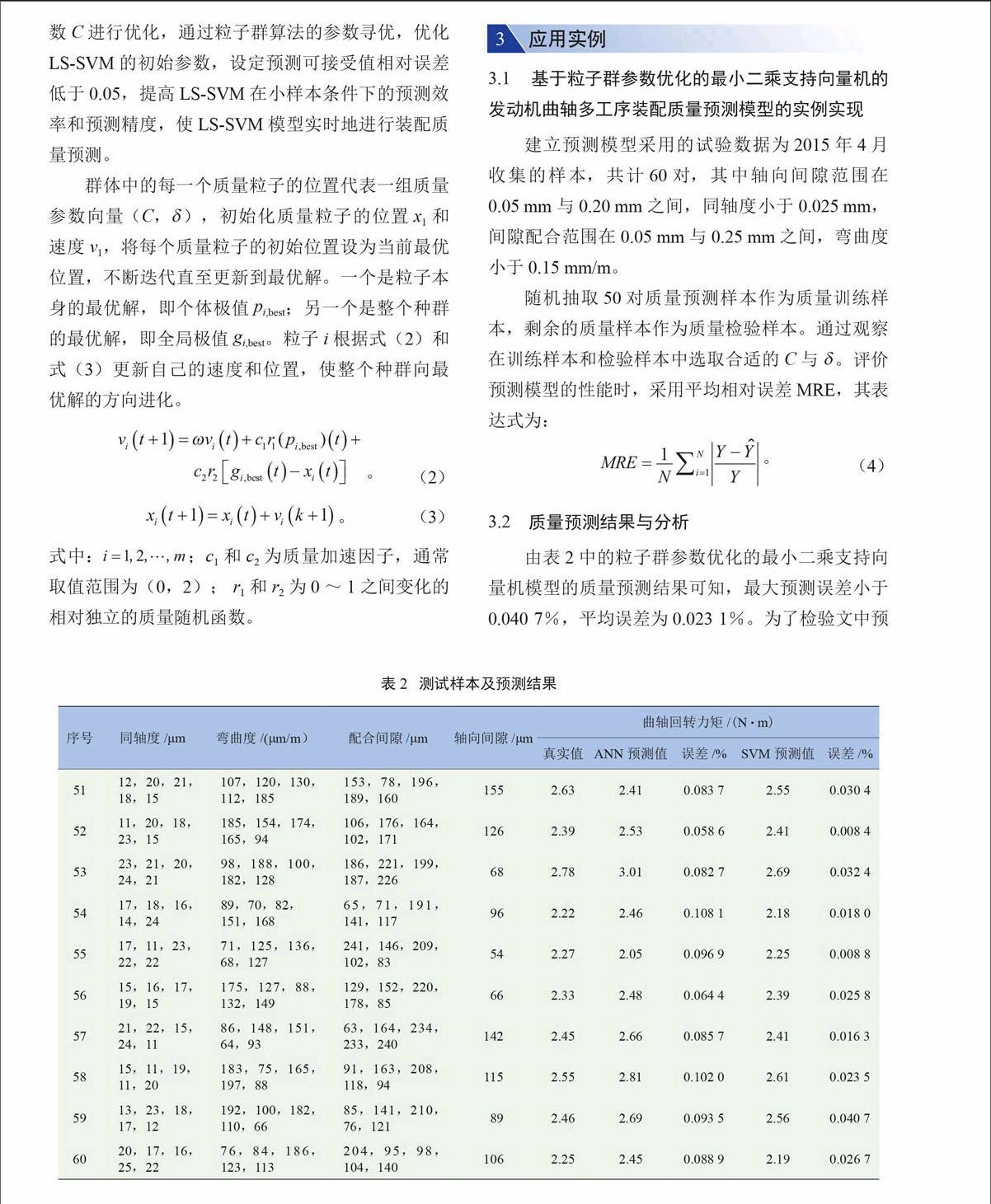
摘 要:针对发动机曲轴回转力矩检测中较大的误差波动性影响装配质量的问题,构建了基于粒子群参数优化(Particle Swarm Optimization,PSO)的最小二乘支持向量机(Least Squares Support Vector Machines,LS-SVM)的发动机曲轴装配质量预测模型。综合考虑了装配质量的不确定性和装配工序相对确定的特征,选取了轴向间隙、同轴度、间隙配合、弯曲度等主要因素作为输入特性,曲轴回转力矩作为输出特性。根据采集整理后的质量数据进行训练学习,利用粒子群算法对最小二乘支持向量机中的参数进行优化,预测曲轴回转力矩。以曲轴回转力矩检测为例,对比分析了神经网络模型,结果表明了该模型的实用性与有效性。
关键词:装配质量;回转力矩;粒子群优化;最小二乘支持向量机;预测模型
中图分类号:TK422文献标文献标识码:A文献标DOI:10.3969/j.issn.2095-1469.2016.01.04
Abstract:The large error volatility in the torque measurement of engine crankshaft will affect the assembly quality. Therefore an assembly quality prediction model for engine crankshaft based on particle swarm optimization(PSO) of least squares support vector machines(LS-SVM) was constructed. Considering the uncertainty in assembly quality and the relative certainty in assembly process, the paper selected the axial clearance, alignment, clearance fit and deflection as inputs, and chose crank torque as the output. With the sorted data for training and learning from the field, the paper used the particle swarm optimization algorithm of least squares support vector machine for optimization. Then the trained model was applied to predict the corresponding crankshaft torsional moment. In the end, the engine crankshaft torque calculated by using the neural network model was compared and analyzed and the results show the applicability and validity of the proposed model.
Keywords:assembly quality; gyroscopic moment; particle swarm optimization; least squares support vector machines; prediction model
由于装配能力变化或其它不确定因素的影响,在回转力矩检测过程中具有较大的误差波动,造成装配精度不高、装配质量不稳定等问题,从而导致装配不合格[1]。而曲轴回转力矩检测工序一旦出现异常问题,会对发动机曲轴服役的稳定性和可靠性造成重大影响。对发动机曲轴装配质量进行有效的评估及预测,为其异常问题的事前预防控制提供决策支持,已成为发动机曲轴装配类企业迫切需要解决的重要问题之一[2-4]。因此,为提高发动机的装配质量及稳定性,在发动机曲轴装配工序过程中对其回转力矩预测具有重要意义。国内外学者对传统的质量预测方法作了大量的研究。……