社区康复对婴幼儿精神发育迟缓的疗效及父母情绪的影响
2016-03-24陆碧蕾赵学军
陆碧蕾+赵学军

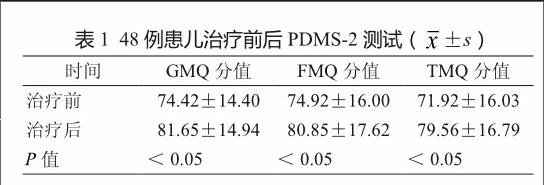
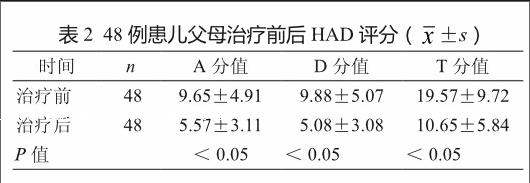
摘 要 目的:探讨社区康复对婴幼儿精神发育迟缓的疗效及对家长情绪的影响。方法:对2013年1月—2014年6月来社区卫生服务中心康复治疗的48例精神发育迟缓患儿采用康复训练、理疗、结合头针推拿治疗。并同时采用Peabody运动发育量表(PDMS-2)对治疗前后的疗效进行比较,医院焦虑抑郁量表(HAD)观察患儿家长的情绪变化。结果:经6个月综合康复治疗后,患儿的智力、运动功能均有明显改善。PDMS-2测试分值也见显著提高(P<0.05);家长情绪发生改观,HAD分值下降(P<0.05);满意度上升。结论:康复训练对婴幼儿精神发育迟缓确有明显效果。
关键词 精神发育迟缓 社区康复训练 综合治疗
中图分类号:R174 文献标识码:A 文章编号:1006-1533(2016)04-0060-03
Effect of the community rehabilitation on the infant mental retardation and the emotion of their parents
LU Bilei, ZHAO Xuejun
(Fangsong Community Health Service Center of Songjiang District, Shanghai 201620, China)
ABSTRACT Objective: To discuss the effect of the community rehabilitation on the infant mental retardation and the emotion of their parents. Methods: From Jan. 2013 to June 2014, 48 cases of the infant mental retardation were treated with the rehabilitation training, physiotherapy, scalp acupuncture and massage in the community health service center. The Peabody developmental motor scale (PDMS-2) was used to compare the effects before and after the treatment and the hospital anxiety depression scale (HAD) to observe the emotional changes in their parents. Results: The intelligence and motor function of the infants were significantly improved after the comprehensive rehabilitation treatment for 6 months. PDMS-2 test scores were also significantly improved(P<0.05). The emotion of their parents was better while HAD scores decreased (P<0.05). Meanwhile, the satisfaction was increased. Conclusion: There is an obvious treatment effect of the rehabilitation training on the infant mental retardation.
KEY WORDS mental retardation; community rehabilitation training; comprehensive treatment
精神发育迟缓[1]是指小儿生长期内智能和运动发育明显落后于同年龄平均水平,智力发育始终不能成熟,因此在生活、学习、行为等方面难以适应客观环境的要求,治疗较为棘手,给家庭和社会造成了极重的负担。婴儿期主要表现为运动发育落后,故常不易被发现而错过关键治疗时间,而早期诊断,早期干预是治疗本病的关键。对此我们社区卫生服务中心采用现代康复和传统康复技术相结合的治疗方法对48例婴幼儿精神发育迟缓进行的综合治疗,并对其父母的心理因素进行干预,取得了一定的效果,现报道如下。
1 对象和方法
1.1 对象
本组收治的对象为2013年1月—2014年6月来我们社区康复治疗的48例精神发育迟缓患儿。诊断标准均符合1989年中华神经精神科学会制订的精神发育迟滞的诊断标准[1]。其中男23例,女25例;年龄<1岁26例,>1岁22例。
本组中12例患儿有高危因素:其中伴有早产4例;……