全科-专科联合管理518例社区2型糖尿病患者效果评价
2016-03-07徐小花胥玉萍
徐小花+胥玉萍
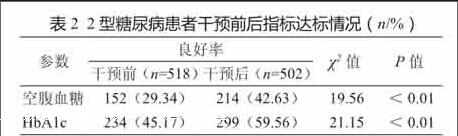

摘 要 目的:评价全科-专科(全专)联合管理社区2型糖尿病(T2D)患者的防治效果。方法:2014年3月—2015年2月在嘉定区外冈镇社区筛选518例已签约的2型糖尿病患者,分别纳入8个家庭医生团队进行管理,依托全专联合的技术支持策略,进行为期1年的随访与管理。结果:1年后,2型糖尿病患者空腹血糖、糖化血红蛋白(HbA1c)平均值均比干预前降低,差异有统计学意义(P<0.01)。空腹血糖控制良好率为42.63%,与干预前相比差异有统计学意义(P<0.01)。HbA1c控制良好率为59.56%,高于干预前的45.17%,差异有统计学意义(P<0.01)。结论:应用全专联合管理2型糖尿病患者能够有效提高全科、专科医生的诊治效率、减轻患者的病情,改善患者的生活质量。
关键词 2型糖尿病 全科-专科联合 效果评价
中图分类号:R587.1 文献标识码:A 文章编号:1006-1533(2016)02-0057-03
Assessment of the effect of the integrated management of the general practitioner and specialist on 518 cases of the patients with type II diabetes in the community
XIU Xiaohua, XU Yuping
(Waigang Community Health Service Centre of Jiading District, Shanghai 201806, China)
ABSTRACT Objective: To evaluate the effect of the integrated management of the general practitioner and specialist on the patients with type II diabetes (T2D) in the community. Methods: In Waigang Community Health Service Center of Jiading District, 518 cases of T2D who signed the contract with the community health service center were selected and divided into the management of 8 family doctor teams and received the integrated management of the general practitioner and specialist. They were followed up and managed for a year with the technology support strategy of the integrated management of the general practitioner and specialist. Results: After one year, the average values of the patients fasting blood glucose and glycosylated hemoglobin (HbA1c) were lower than before the intervention and the difference had the statistical significance (P<0.01). The rate of the good blood glucose control was 42.63% and the difference had the statistical significance compared with that before the intervention (P<0.01). The rate of the good HbA1c control was 59.56%, which was higher than 45.17% before the intervention and the difference had the statistical significance (P<0.01). Conclusion: The integrated management of the general practitioner and specialist can efficiently promote the diagnosis and treatment effect for the patients with T2D, improve their physical conditions and the quality of their life.
KEY WORDS type II diabetes; the integration of the general practitioner and specialist; effect evaluation
随着生活方式的改变和人口老龄化的加速,糖尿病在世界范围内呈现日益严重的流行趋势,中国作为发展中国家,糖尿病患病率同样呈现逐年升高的趋势,2010年一项研究显示,中国的糖尿病患者约9 240万,其中95%为2型糖尿病(T2D)[1]。糖尿病不仅严重影响人们的生活质量和身心健康,更导致了巨大的经济负担[2]。
近年来,国内外一些与T2D防治相关的大型临床试验发现,除了一些药物外,生活方式及多个以临床指标达标为主要控制手段的干预,即通过强化控制血糖、血压、减低胆固醇、增加运动、减轻体重、强化自我监测等,均可能有助于帮助控制糖尿病的进程,减少和延缓各类并发症的发生。在具体实施中,西方发达国家通过加强社区基层医务人员专病防治能力,进行综合防治,取得了很好的效果[2-5]。然而,在中国,庞大的患者群体,薄弱的基层卫生服务力量,改革和变化中的医疗卫生服务系统和医疗保险体系,都制约了对T2D社区综合管理的发展。……