皮艇测功仪上运动员不同桨频划桨对技术动作的影响
2015-06-10李梦张林
李梦 张林
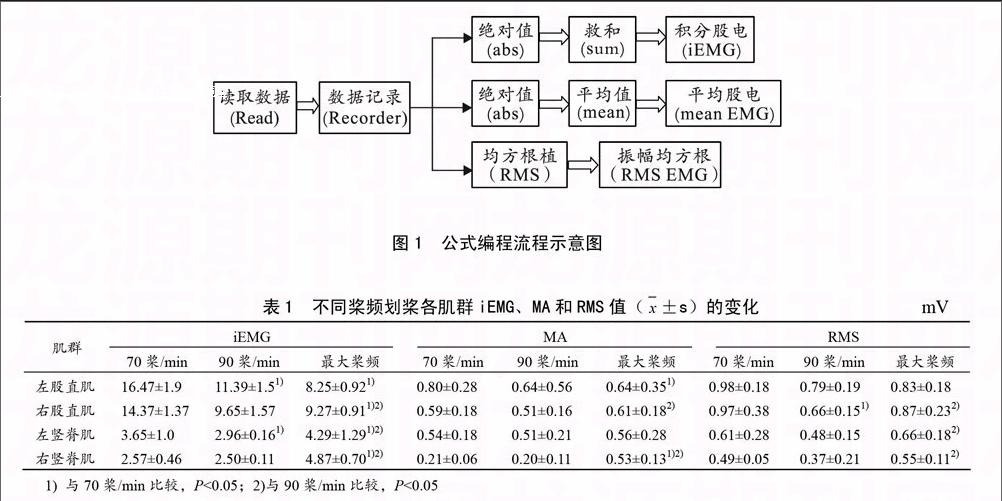
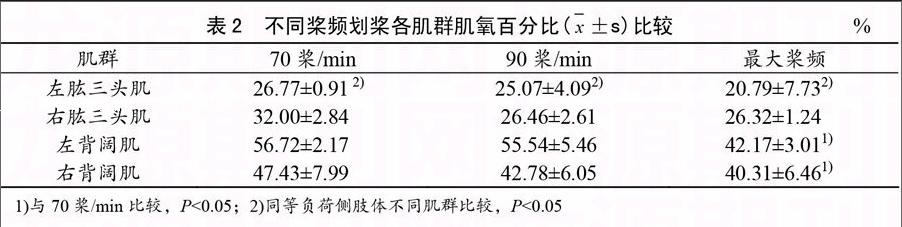
摘 要:运用表面肌电和肌氧分析技术,对23名1级以上皮艇运动员以3种不同桨频负荷(70桨/min、90桨/min和最大桨频)分别在测功仪上进行连续划桨训练过程中相关肌肉工作情况进行研究。结果发现:随桨频负荷的提高,竖脊肌肌电活动增强并伴随着股直肌肌电活动趋弱;与70桨/min相比,最大桨频下肱三头肌氧百分比下降无显著性差异,而左右背阔肌均呈现显著性降低(P<0.05)。结果说明提高划桨频率会造成运动员身体发力构成的变化,随着划桨频率的增大,下肢贡献有所减少,腰腹和背部用力增大,上臂用力增大但不明显。
关 键 词:运动生理学;肌电;肌氧;划桨桨频;皮艇测功仪
中图分类号:G804.2 文献标志码:A 文章编号:1006-7116(2015)03-0123-04
Abstract: By applying surface myoelectricity and muscle oxygen analysis technology, the authors study the working conditions related muscles of 23 class 1 or higher kayakers in the process of training for continuous paddling on an ergometer at 3 different paddling frequency loads (70 strokes/min, 90 strokes/min and maximum paddling frequency) respectively, and revealed the following findings: with the increase of paddling frequency load, the myoelectricity activity of erector spinae was intensified, accompanied by the gradual weakening of myoelectricity of rectus femoris; as compared with 70 strokes/min, the increase of muscle oxygen percentage of triceps brachii had no significant difference, while the left and right latissimus dorsi showed a significant decrease (P<0.05). The said findings indicated the followings: increasing paddling frequency would cause the changing of kayakers body power generation composition; with the increase of paddling frequency, the contribution of lower limbs decreased somewhat, power generated by waist and abdomen and back increased, power generated by upper arms increased but not significantly.
Key words: sports physiology; myoelectricity;muscle oxygen;stroke rate;kayak ergometer
皮艇运动为水上运动项目之一,对体能和技术均有较高要求,是一项以较高的体能输出为依托,展示运动员平衡能力和技术技巧的竞技项目,通过进行大强度的划桨功率输出,推动船艇高速前进。
皮艇测功仪(Kayak Ergometer)通过最大限度的模拟皮艇划桨动作情况[1],实现陆地专项训练,可较为准确地模拟水上短时、高强度皮艇运动对人体生理的刺激[2-3],由于其阻力可调,相对于水上划船,可在稳定环境中使用,同时可量化训练负荷,是训练和科研测试的理想仪器[4]。本研究要求运动员在测功仪上以不同桨频负荷进行划桨练习,并进行相关肌肉的肌电、肌氧指标采集分析,旨在了解不同桨频对划桨技术动作的影响。
1 研究对象与方法
1.1 研究对象
河北皮划艇队1级以上(含1级)皮艇运动员23人,男11人,女12人。年龄(19.86±2.71)岁,身高(181.27±6.97) cm,体重(73.97±10.74) kg。训练年限(5.77±2.21)年。由于本实验设计主要对运动员技术动作进行考察,根据相关文献,在重要的技术参数上(如桨频、划桨时间构成、动作对称性、关节活动幅度等)男女运动员不存在差异[5],故不进行性别分组。……
