外科术后护理中护理程序的应用效果评价
2015-03-31张春云
张春云
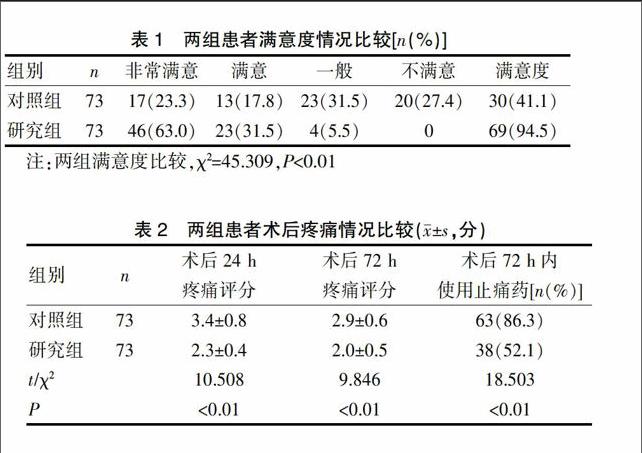
[摘要] 目的 评价外科术后护理中护理程序的应用效果。 方法 回顾性分析146例外科手术患者的一般资料,根据患者术后护理方法分为研究组和对照组各73例,研究组采用术后护理程序护理,对照组采用常规护理,比较两组患者对护理的满意度和术后24 h、72 h疼痛情况以及术后72 h内使用止痛药比例。 结果 研究组满意度为94.5%,显著高于对照组的67.1%,差异具有统计学意义(P<0.01)。术后24 h和72 h研究组患者疼痛评分显著低于对照组,72 h内使用止痛药的比例也显著低于对照组,差异有统计学意义(P<0.05)。 结论 护理程序的实施使护理的针对性显著增强,使外科患者术后护理的质量得到提升,从而有利于患者满意度的提高及病情的有效恢复。
[关键词] 外科手术;护理程序;评价
The application effect evaluation of the nursing process in surgical postoperative nursing care
ZHANG Chunyun
Urinary Tract Disease Treatment Center, Anyang Peoples Hospital in Henan Province, Anyang 455000, China
[Abstract] Objective To discuss effect of the nursing process in surgical postoperative nursing care. Methods Clincal data of 146 cases with surgery were respectively analyzed. All patients were divided into study group and control group according to nursing methods. Study group was nursed by nursing process, and control group was nursed by normal caring. Degrees of satisfaction of two groups were compared, and VAS after 24 h and 72 h of operation and within 72 h postoperative useing of painkillers proportions of two groups were compared. Results After being nursed by nursing process, degrees of satisfaction was 94.5%, which was higher than before being nursed(67.1%), and there was significant difference(P<0.05).VAS scores of study after 24 h and 72 h of operation were lower than control group, and 72 h postoperative using of painkillers proportion of study group was lower than control group(P<0.01). Conclusion The implementation of the nursing process significantly enhances care of targeted, improve the quality of surgical postoperative nursing care, so it is conducive to the improvement of patient satisfaction and the effective recovery of disease.
[Key words] Surgery; Nursing process; Evaluation
护理程序是一种系统的护理方法,是护理服务的PDCA,能够全面、合理、科学地进行评估、诊断、计划及实施。护理程序的贯彻是护理改革的基础,其优越性护理措施显而易见。我院2010~2012年对73例外科手术患者应用了护理程序,取得满意结果,现报道如下。
1 资料与方法
1.1一般资料
选取2010~2012年我院救治的外科手术患者146例,男85例,女61例;年龄18~85岁,平均(46.5±3.5)岁。其中肛肠外科患者18例,泌尿外科患者22例,骨外科患者24例,心胸外科患者28例,神经外科患者2例,普通外科患者52例。其中73例患者采用常规护理为对照组,73例患者采用护理程序护理为研究组。所有患者除本次手术治疗疾病外,无其他系统严重疾病,无其他影响患者术后恢复等因素存在。两组患者性别比、平均年龄、手术类别匹配无显著差异(P>0.05),有可比性。
1.2方法
1.2.1 研究组 采用护理程序进行术后护理。(1)护理评估:责任护士经病史采集、护理查体、病历阅读等方式掌握住院患者的诊治情况。患者完成手术返回病房后,护士对其生命体征进行监测,并进行管道护理。……