210例重症患者中心静脉置管发生感染的原因分析及护理对策
2015-03-31张丽红等
张丽红等

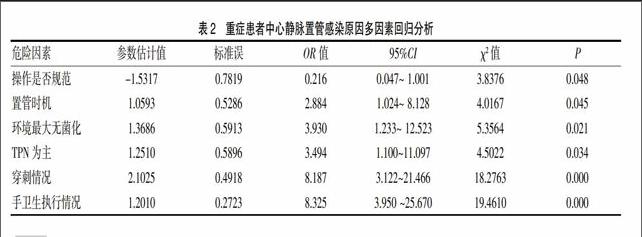
[摘要] 目的 分析重症患者中心静脉置管感染相关性危险因素,并采取相应护理措施控制预防。 方法 回顾性分析2012年12月~2013年12月重症监护病房210例中心静脉置管患者的临床资料,分析置管感染相关性危险因素,进一步探讨预防措施。 结果 发生置管感染率6.19%,致病菌以革兰阳性菌(G+)为主,占61.54%(8/13);革兰阴性菌(G-)次之,占23.08%(3/13);真菌占15.38%(2/13);单因素及多因素Logistic回归分析表明:规范性操作、环境最大无菌化、置管时机、手卫生执行情况、管内输注液体成分、穿刺情况是置管感染的独立危险因素(P<0.05)。 结论 中心静脉置管感染与多种危险因素有关,加强规范医务人员操作及消毒管理、重视监测工作、建立一套完整有效的置管护理流程等措施对降低中心静脉置管相关性感染发生率非常重要。
[关键词] 重症患者;中心静脉置管;感染;危险因素;护理对策
Analysis of risk factors with central venous catheter-related infection of 210 severe patients and nursing intervention
ZHANG Lihong1 WANG Wei2
1.Department of ICU, Zhejiang Xiaoshan Hospital, Hangzhou 310000, China; 2.Department of Blood Dialysis, the First Affiliated Hospital of Medical School of Zhejiang University, Hangzhou 310000, China
[Abstract] Objective To investigate the risk factors related to central venous catheter-related infection of severe patients and take preventive nursing measures. Methods Clinical and follow-up data of 210 patients in ICU (intensive care unit) recieved central venous catheter from December 2012 to December 2013 were reviewed retrospectively. The association of related infection factors and central venous catheter was analyzed, and preventive nursing measures were discussed. Results The infection rate was 6.19%, the sample training of the catheter front end showed that pathogenic bacteria was mainly gram-positive bacteria(G+), which was 61.54%(8/13), while gram-negative(G-) was 23.08%(3/13) and fungus was 15.38%(2/13); The results of univariate and multiple logistic regression analysis showed that standard practice, the greatest degree of aseptic environment, the time to intubation, hand hygiene performence, infusion liquid and piercing process were the independent factors correlated with central venous catheter-related infection(P<0.05). Conclusion Central venous catheter-related infection occurs with many risk factors, and it is important to strengthen the management of intubation, and disinfection management, pay attention to the monitoring, and establish a complete, effective catheter care process measures in order to reduce catheter-related infection rate.
[Key words] Severe patients; Central venous catheter-related; Infection; Risk factors-related; Nursing intervention
重症患者往往需放置中心静脉导管(central venous catheters,CVC)用于补液、输血、全胃肠外营养(TPN)支持及中心静脉压监测等,能最大限度地减少重症患者的外周血管损伤和刺激,缓解患者痛苦[1]。但其作为一种有创操作,也导致了一系列的并发症发生,其中导管相关性感染(catheter-related infections,CRI)是比较严重的并发症之一,发生率约为5%~30%,病死率约为10%~20%,症状多为不明原因的发热,如不严格控制,可导致菌血症、败血症等严重后果[2,3]。据不完全统计,在美国每年估计有75 000人次发生中心静脉置管相关性感染,治疗感染的花费为(3~23)亿美元,病死率为10%~20%,重症监护病房则高达25%以上[4]。本研究通过回顾性分析2012年12月~2013年12月重症监护病房内中心静脉置管210例患者的临床资料,结合我院实际情况,研究置管感染的相关危险因素,并提出针对性护理措施,以期有效预防并降低感染的发生率。
1 资料与方法