神经元烯醇化酶和S100蛋白检测在肠道病毒71型感染中的临床意义
2014-10-21董加秀周广慧杨艳李艳
董加秀 周广慧 杨艳 李艳

DOI:10.3760/cma.j.issn.1671-0282.2014.09.017
作者單位:277100 山东省枣庄 枣庄市妇幼保健院感染科(董加秀、杨艳),检验科(李艳) ;枣庄矿业集团东郊医院肺科(周广慧)
通信作者:董加秀,Email:dongjiaxiu@126.com
【摘要】目的 研究肠道病毒71型(enterovirus 71,EV71)感染后血清中神经特异性烯醇化酶(NSE)、S100蛋白的变化及其临床意义。
方法 采用前瞻性对照研究方法。选择2012年3月1日至2012年10月31日枣庄市妇幼保健院收治的EV71感染患儿176例,依据肠道病毒71型(EV71)感染重症病例临床救治专家共识(2011年版)标准,结合病情轻重将患儿分为3组:普通组62例、重型组65例、危重组49例。另选30例健康体检婴幼儿作为对照组,对照组与普通组、重型组、危重组的年龄和性别差异无统计学意义,具有可比性。患儿于入院后治疗前第1天,治疗后第1天、第2天、第3天分别采空腹静脉血4 mL;健康对照组留取就诊当天空腹静脉血4 mL。分离血浆,采用电化学发光法测定各组血浆中NSE、S100蛋白水平。同时收集入院后24 h内的血常规、生化、心肌酶谱、C反应蛋白等临床资料。所有数据采用SPSS 13.0统计软件进行统计处理。计量资料采用均数±标准差(x±s)表示,多组样本均数比较采用单因素方差分析,两组间比较采用t检验。以P<0.05为差异有统计学意义。
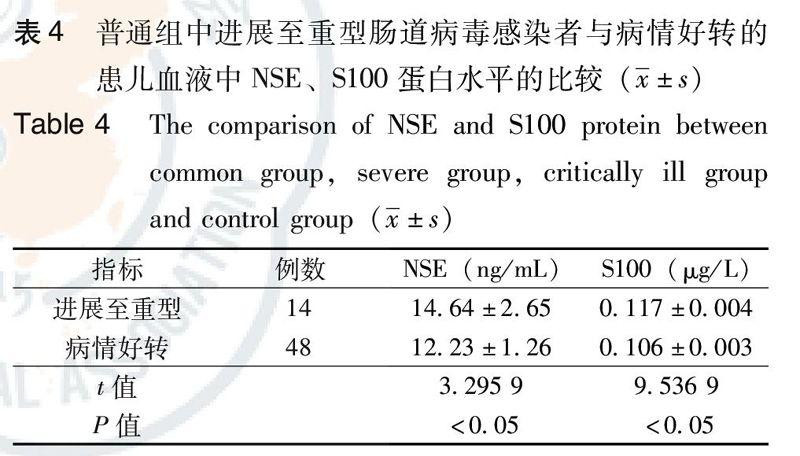
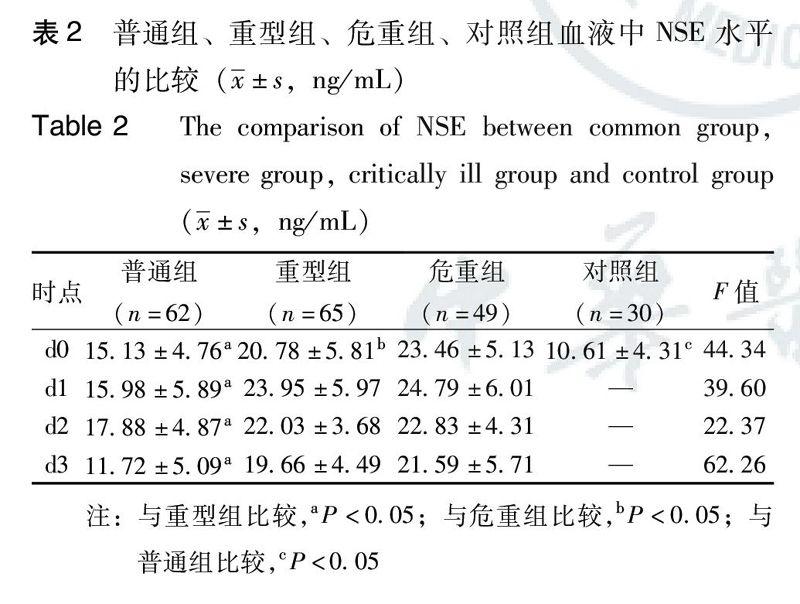
结果 ①与普通组和对照组比较:重型组及危重组的NSE、S100蛋白含量均明显升高(P<0.05)。②普通组中进展至重型肠道病毒感染者血液中NSE、S100蛋白的水平显著高于病情好转的患儿(P<0.05)。
结论 血清NSE、S100蛋白均可以作为判断EV71感染重症的生化标记物,两者的联合检测对于评估病情及判断预后具有一定的临床意义。
【关键词】 肠道病毒71型;神经特异性烯醇化酶;S100蛋白
The significance of NSE and S100 protein in blood serum in patients with enterovirus 71 infection
Dong Jiaxiu*,Zhou Guanghui,Yang Yan,Li Yan. *Infectious Disease Department,Maternal and Child Health Hospital of Zaozhuang City,Zaozhuang 277100,China
Corresponding author:Dong Jiaxiu,Email:dongjiaxiu@126.com
【Abstract】Objective To investigate the clinical significance and changes of neuron-specific enolase(NSE) and S100 protein in blood serum in patients with enterovirus 71 infection.Methods A total of 176 children with enterovirus 71 infection admitted from March 1,2012 through October 31,2012 were enrolled for a prospective and control study. According to diagnostic criteria of the enterovirus 71 (EV71) infection instituted by expert consensus for treatment of severe patients sets in 2011,the patients were divided into three groups:mild group(n=62),severe group(n=65) and critically care group(n=49), and another 30 healthy children served as control group. The demographics of patients including age and sex were comparable between control group and the sick children groups. Four milliliter of peripheral blood were taken from ill children on the first day before treatment and on the first,second,third day after treatment. The blood samples of healthy children were taken on the first day after physical examination. At the same time, the clinical data of blood routine, blood biochemistry, myocardial enzymes and C-reactive protein during the first 24 hours were collected. Immunohistochemical technique was used to study the change of NSE and S100 levels in serum. Data were expressed in mean±standard deviation(x±s)and were statistically analyzed by using SPSS 13.0 statistical software.Comparisons were carried out among different groups with one way analysis of variance (ANOVA) and between groups were performed with the Student t test. Changes were considered as statistically significant if P values was less than 0.05. Results ①Compared with mild group and control group, the levels of NSE and S100 protein were significantly higher in severe group and critically care group(P<0.05).②The serum levels of NSE and S100 protein in severe group were higher than in those in mild group with better outcomes (P<0.05).Conclusion The serum levels of NSE and S100 protein as biomarkers can be used to evaluate the severity of EV71 infection, and can also be used to determine the efficacy of treatment.
【Key words】 Enterovirus 71; Neuron-specific enolase;S100 protein
手足口病(hand-foot-mouth disease,HFMD)是肠道病毒引起的常见传染病之一,多发生于5岁以下的婴幼儿,临床上表现为发热和手、足、口腔等部位的皮疹,个别患者可引起心肌炎、肺水肿、无菌性脑膜脑炎等致命性并发症,严重者可致死亡。……