亚低温治疗犬心脏骤停复苏后心功能研究
2014-10-21王义辉金奇邹雅茹蒋婕朱莹史雯陶然君叶静陆一鸣童建菁
王义辉 金奇 邹雅茹 蒋婕 朱莹 史雯 陶然君 叶静 陆一鸣 童建菁


DOI:10.3760/cma.j.issn.1671-0282.2014.09.011
基金項目:上海市自然科学基金(11ZR1422100)
作者单位:200025 上海,上海交通大学医学院附属瑞金医院急诊科
通信作者:童建菁,Email:tongjj_h@163.com
【摘要】目的 明确亚低温对室颤复苏后犬心功能及心律失常的影响。
方法 12头比格犬随机(随机数字法)分成两组(n=6):常温复苏组(37.0 ± 0.2) ℃和亚低温组(34.0 ± 0.2) ℃,通过快速电刺激诱导室颤,7 min后行心肺复苏,动态观察比较两组犬的心率、左心室收缩力指数、室性心律失常、除颤能量、肾上腺素用量及复苏后1周心超变化。
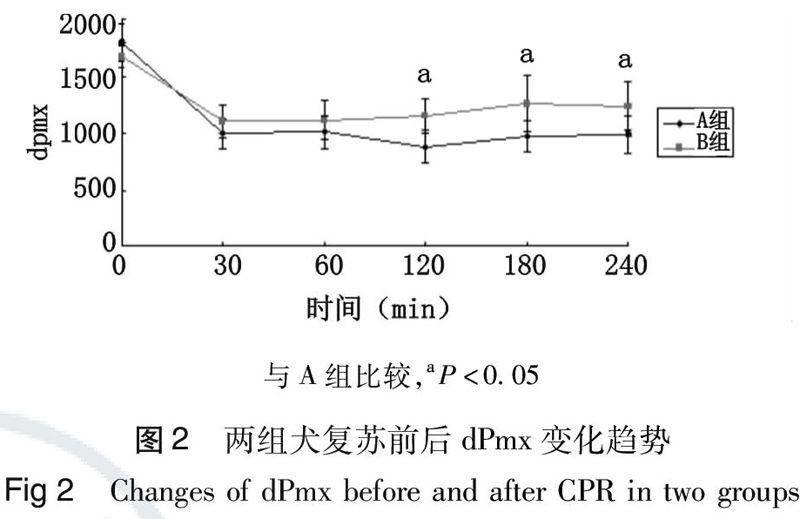
结果 ①与室颤前比较,两组犬左心室收缩力指数在复苏后均有不同程度降低(P< 0.05),但亚低温组下降幅度小于常温组,且心率低于常温组(141 ± 19)次/min vs.(163 ± 31)次/min,P<0.05。②与常温组比较,亚低温组犬室性心律失常发生的次数明显减少(P<0.05),但是除颤次数、肾上腺素用量差异无统计学意义(P> 0.05)。③复苏后1周,两组犬的心超结果显示,心脏结构及射血分数均恢复正常。
结论 亚低温治疗可改善心脏骤停复苏后心肌收缩力,降低室性心律失常发生率。本研究结果提示,亚低温对复苏后心功能有一定的保护作用。
【关键词】心脏骤停;心室颤动;心肺复苏;亚低温;犬
Effects of mild hypothermia on myocardial function following resuscitation in canine models of cardiac arrest
Wang Yihui,Jin Qi, Zou Yaru, Jiang Jie, Zhu Ying, Shi Wen, Tao Ranjun, Ye Jing, Lu Yiming, Tong Jianjing. Emergency Department, Shanghai Ruijin Hospital, Shanghai Jiaotong University of Medicine, Shanghai 200025, China
Corresponding author:Tong Jianjing,Email:tongjj_h@163.com
【Abstract】Objective To investigate the effects of mild hypothermia on post-resuscitation myocardial function and arrhythmia incidence after ventricular fibrillation (VF) in canines. Methods A total of 12 beagles were randomly(random number) divided into 2 groups(n=6), normothermic resuscitation group (37.0±0.2) ℃ and hypothermia group (34.0±0.2) ℃. VF was induced by burst electrical stimulation on the epicardium. Cardiopulmonary resuscitation was initiated 7 min after VF. The heart rate (HR), index of left ventricular contractility (dPmx), ventricular arrhythmias, defibrillation energy, dosage of epinephrine during resuscitation were documented, and echocardiographic examinations were carried out a week after resuscitation for observing dynamically. Results The value of dPmx was lowered after successful defibrillation following prolonged VF in both normothermic and hypothermia groups (P<0.05). Compared with the normothermic resuscitation group, the hypothermia group had lower descend range of dPmx, lower HR(141 ± 19) bpm vs.(163 ± 31)bpm,P<0.05; and lower incidence of ventricular arrhythmias(P<0.05). However, there were no significant differences in defibrillation energy and dosage of epinephrine between two groups(P>0.05). One week after resuscitation, the post-resuscitation cardiac structure and left ventricular ejection fraction resumed to nomal in both groups without difference between them. Conclusions Mild hypothermia could improve the left ventricular contractility and decrease the incidence of ventricular arrhythmias following resuscitation of cardiac arrest. The findings of this study indicated that mild hypothermia could exert protective effects on myocardial function following resuscitation in a canine model of cardiac arrest.
【Key words】Cardiac arrest; Ventricular fibrillation; Cardiopulmonary resuscitation; Mild hypothermia; Canine
研究已证实,人工诱导亚低温可改善心搏骤停(cardiac arrest, CA)患者的神经功能,目前已被广泛推荐[1-7]。但是,复苏后存在低血压、低心排、心功能障碍以及心律失常,是导致复苏后患者生存率不高的重要原因[8]。本研究通过建立7 min犬室颤心肺复苏模型,用4 °C生理盐水诱导并维持亚低温进行复苏,以明确亚低温对复苏后心肌功能及心律失常的影响。
1 材料与方法
1.1 实验动物分组
12头成年健康比格犬,雌雄不限,体质量(12±2)kg,由上海交通大学农学院动物中心提供[SYXK(沪)2008-0050]。随机(随机数字法)分为常温组(n=6):在常温下行标准心肺复苏,实验过程中犬体温维持在正常体温(37.0± 0.2) ℃;……