钙钛矿薄膜的发光特性及钝化处理后的放大自发辐射效应研究
2024-06-21严小亮
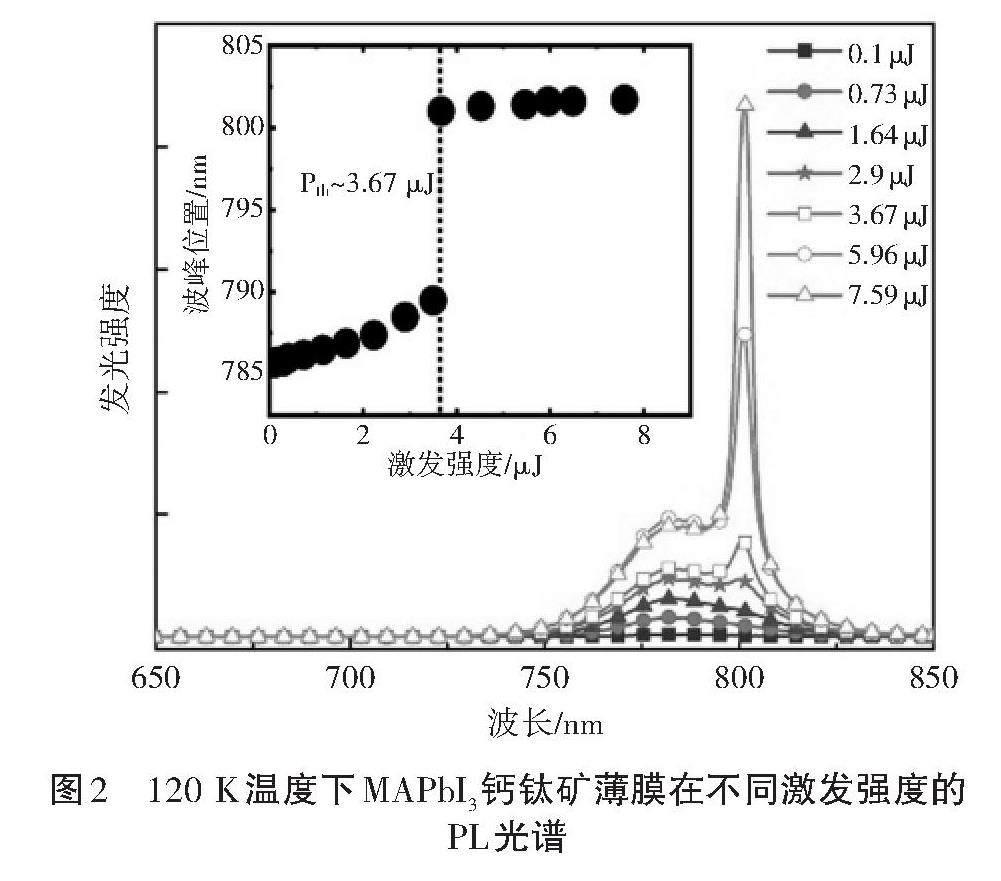
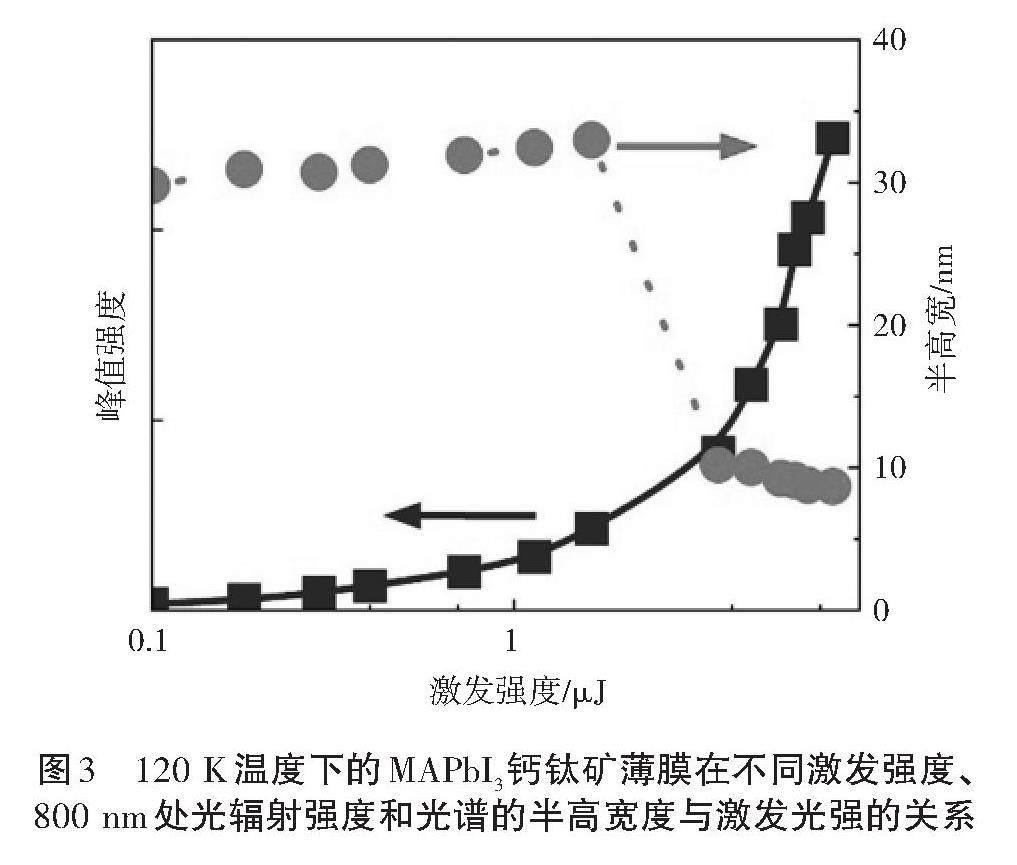
摘 要:【目的】钙钛矿材料是一种发展前景良好的激光应用光学增益介质。钙钛矿激光器件实际应用的一个关键因素是实现较低的激光阈值。为解决这个问题,选用电子传输材料(PCBM)和空穴传输材料(spiro-OMeTAD)对钙钛矿(CH3NH3PbI3,MAPbI3)薄膜进行钝化处理,减少薄膜的缺陷密度,从而降低放大自发辐射(ASE)阈值。【方法】研究不同激发强度下MAPbI3薄膜的光致发光(PL)光谱与ASE现象,并通过与MAPbI3/ PCBM和MAPbI3/spiro-OMeTAD双层薄膜对比,研究将钙钛矿材料中的缺陷进行钝化处理后对ASE现象的影响。【结果】在特征温度120 K下,MAPbI3钙钛矿薄膜易产生ASE现象,产生ASE现象的阈值约为3.67 μJ,而MAPbI3/PCBM和MAPbI3/spiro-OMeTAD双层薄膜在特征温度下,产生ASE现象的阈值更低,分别为1.9 μJ和2 μJ。【结论】MAPbI3钙钛矿薄膜在位于800 nm左右的特征峰处易产生ASE现象,而经过钝化处理后的钙钛矿薄膜在相同波长位置的特征峰处更易产生ASE现象,产生ASE现象的阈值更低,这是因为PCBM and spiro-OMeTAD这两层薄膜能有效地钝化钙钛矿薄膜内的缺陷,使得薄膜的缺陷态密度降低,从而能有效降低ASE阈值。
关键词:钙钛矿材料;光谱学;钝化;放大自发辐射
中图分类号:O433 文献标志码:A 文章编号:1003-5168(2024)08-0075-05
DOI:10.19968/j.cnki.hnkj.1003-5168.2024.08.015
Study on the Optical Properties of Perovskite Films and the Amplified Spontaneous Emission Effect After Passivation Treatment
YAN Xiaoliang
(Jiangsu College of Engineering and Technology, Nantong 226006, China)
Abstract: [Purposes] Perovskite materials have emerged as a promising optical gain medium for laser applications, and one crucial factor for the practical use of perovskite laser devices is achieving a lower laser threshold. To address this, we have explored the use of electron transport materials (PCBM) and hole transport materials (spiro-OMeTAD) to passivate the perovskite film. This approach aims to reduce the defect density of the perovskite (CH3NH3PbI3,MAPbI3) film and consequently lower the threshold for amplified spontaneous emission. [Methods] This paper investigates the photoluminescence (PL) spectra and ASE phenomenon of MAPbI3 thin films under varying excitation intensities, as well as to examine the impact of defect passivation in perovskite material on the ASE phenomenon. This will be done by comparing the ASE phenomenon in MAPbI3/PCBM and MAPbI3/spiro-OMeTAD bilayer films. [Findings] The MAPbI3 perovskite thin film exhibits ASE phenomenon at a characteristic temperature of 120 K. The threshold for ASE generation is approximately 3.67 μJ. However, the threshold for ASE generation is even lower for MAPbI3/PCBM and MAPbI3/spiro-OMeTAD bilayer thin films, which are 1.9 μJ and 2 μJ, respectively, at the same characteristic temperature. [Conclusions] The MAPbI3 perovskite film exhibits ASE phenomenon at the characterstic peak around 800 nm. Similarly, the perovskite film after passivation treatment is also prone to ASE phenomenon at the same wavelength position, but with a lower threshold. This can be attributed to the effective defect passivation by the PCBM and spiro-OMeTAD within the perovskite film. Consequently, the density of defective states in the film decreases, leading to a lower ASE threshold.
Keywords: perovskite materials; spectroscopy; passivation; amplifying spontaneous emission
0 引言
金属卤化物钙钛矿已成为新一代光电器件中优秀的半导体材料的代表。最初对该材料的研究主要集中在光伏器件方面。由于其较高的光吸收和发射效率、可调谐的光谱特性,以及高缺陷容忍度,钙钛矿材料已成为具有巨大激光应用前景的光学增益介质[1-3]。Xing等[4]首次利用低温溶液沉积法制成CH3NH3PbI3(MAPbI3)钙钛矿薄膜,实现了放大自发辐射(Amplified Spontaneous Emission, ASE),其阈值为12 μJ/cm2,低阈值主要源于高质量的MAPbI3钙钛矿薄膜,其“缺陷”密度很低 。……