基于NF-κB、TNF-α信号通路探讨青蒿清热滋阴汤加减治疗玫瑰痤疮的临床效果
2024-04-21俞静
俞静
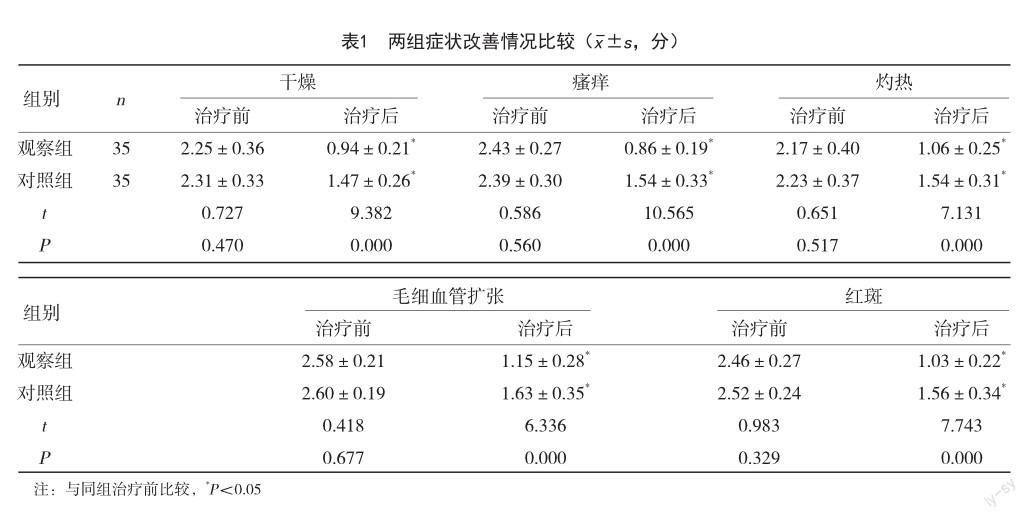
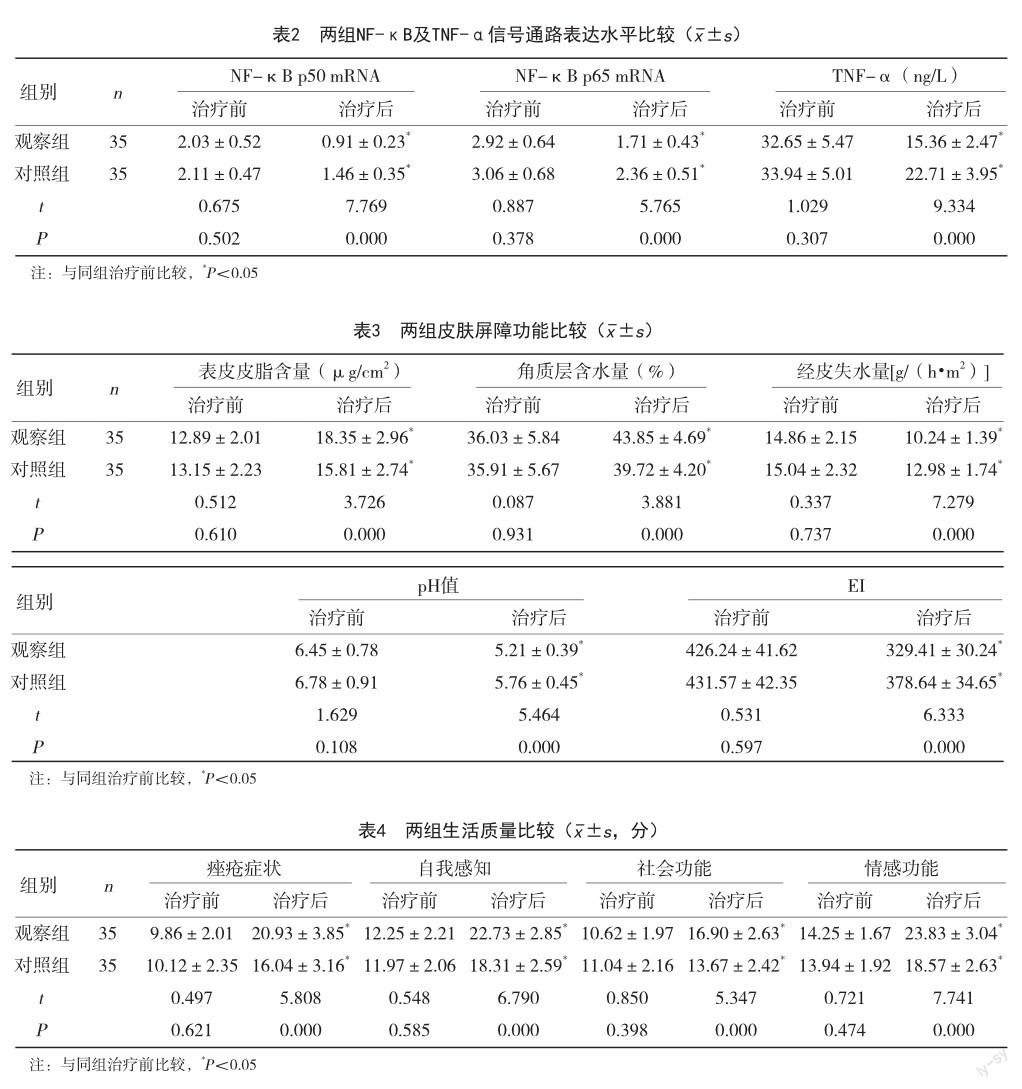
[摘 要]目的 基于核因子-κB(NF-κB)、腫瘤坏死因子-α(TNF-α)信号通路探讨青蒿清热滋阴汤加减治疗玫瑰痤疮的临床效果。方法 选取我院2021年9月-2023年3月收治的70例玫瑰痤疮患者为研究对象,按照随机数字表法分为对照组(n=35)及观察组(n=35)。对照组予以西医常规治疗,观察组在此基础上予以青蒿清热滋阴汤加减治疗,比较两组临床疗效、症状改善情况、NF-κB及TNF-α信号通路表达水平、皮肤屏障功能、生活质量及不良反应发生情况。结果 观察组治疗总有效率为91.43%,高于对照组的71.43%(P<0.05);观察组治疗后干燥、瘙痒、灼热、毛细血管扩张、红斑症状评分低于对照组(P<0.05);观察组治疗后NF-κB p50及p65 mRNA表达量、血清TNF-α水平均低于对照组(P<0.05);观察组治疗后表皮皮脂含量、角质层含水量高于对照组,经皮失水量、pH值、EI低于对照组(P<0.05);观察组治疗后痤疮症状、自我感知、社会功能及情感功能评分高于对照组(P<0.05);观察组不良反应发生率为11.43%,略高于对照组的8.57%,但差异无统计学意义(P>0.05)。结论 青蒿清热滋阴汤加减治疗玫瑰痤疮的效果确切,能有效改善患者症状,促进皮肤屏障功能恢复,提高生活质量,其机制可能与调节NF-κB、TNF-α信号通路,抑制炎症反应有关。
[关键词] 玫瑰痤疮;青蒿清热滋阴汤;核因子-κB;肿瘤坏死因子-α;信号通路
[中图分类号] R758.73+4; R275.9 [文献标识码] A [文章编号] 1004-4949(2024)05-0033-05
Clinical Effect of Qinghao Qingre Ziyin Decoction in the Treatment of Rosacea Based on NF-κB/TNF-α Signaling Pathways
YU Jing
(Department of Dermatology, Jiangsu Second Hospital of Traditional Chinese Medicine, Nanjing 210017, Jiangsu, China)
[Abstract]Objective To explore the clinical effect of modified Qinghao Qingre Ziyin decoction in the treatment of rosacea based on nuclear factor-κB (NF-κB) and tumor necrosis factor-α (TNF-α) signaling pathways. Methods A total of 70 patients with rosacea admitted to our hospital from September 2021 to March 2023 were selected as the research objects. According to the random number table method, they were divided into control group (n=35) and observation group (n=35). The control group was treated with conventional western medicine, and the observation group was treated with Qinghao Qingre Ziyin decoction on the basis of the control group. The clinical efficacy, symptom improvement, NF-κB and TNF-α signaling pathway expression levels, skin barrier function, quality of life and adverse reactions were compared between the two groups. Results The total effective rate of treatment in the observation group was 91.43%, which was higher than 71.43% in the control group (P<0.05). After treatment, the scores of dryness, itching, burning, telangiectasia and erythema in the observation group were lower than those in the control group (P<0.05). After treatment, the expression levels of NF-κB p50 and p65 mRNA and serum TNF-α levels in the observation group were lower than those in the control group (P<0.05). After treatment, the contents of epidermal sebum and stratum corneum water in the observation group were higher than those in the control group (P<0.05). After treatment, the percutaneous water loss, pH value and EI in the observation group were lower than those in the control group ,and the scores of acne symptoms, self-perception, social function and emotional function in the observation group were higher than those in the control group (P<0.05). The incidence of adverse reactions in the observation group was 11.43%, which was slightly higher than 8.57% in the control group, but the difference was not statistically significant (P>0.05). Conclusion Modified Qinghao Qingre Ziyin decoction is effective in the treatment of rosacea, which can effectively improve the symptoms of patients, promote the recovery of skin barrier function and improve the quality of life. The mechanism may be related to the regulation of NF-κB and TNF-α signaling pathways and the inhibition of inflammatory response.
[Key words] Rosacea; Qinghao Qingre Ziyin decoction; Nuclear factor-κB; Tumor necrosis factor-α; Signal pathway
玫瑰痤疮(rosacea)是多发于30~50岁女性群体的慢性皮肤病,具有病情迁延、反复发作等特点,易影响患者面部美观,增加其焦虑及社交恐惧等负性情绪[1]。现阶段西医多采用免疫抑制剂及抗生素等药物治疗玫瑰痤疮,虽具有起效快、短期效果确切等优点,但复发风险较高,且长期用药不良反应较多[2]。中医认为[3],玫瑰痤疮属于“酒渣鼻”“酒糟鼻”等范畴,主要是肺胃热邪蕴结于头面所致。此外,玫瑰痤疮虽以热证为主,但具有少阴、多虚及多热等特点,治以清泄肺胃积热、益气滋阴为主。青蒿清热滋阴汤以青蒿为主药,具有清热透邪、益气滋阴的功效[4]。现阶段玫瑰痤疮的发病机制尚未完全阐明,有研究显示[5],核因子-κB(NF-κB)、肿瘤坏死因子-α(TNF-α)信号通路与痤疮发生有关。……