不同容量连续性血液滤过对危重症合并脓毒症患者炎症因子的影响
2022-07-13李荷婷王少亭胡晓舟张燕安旭斌
李荷婷 王少亭 胡晓舟 张燕安 旭斌
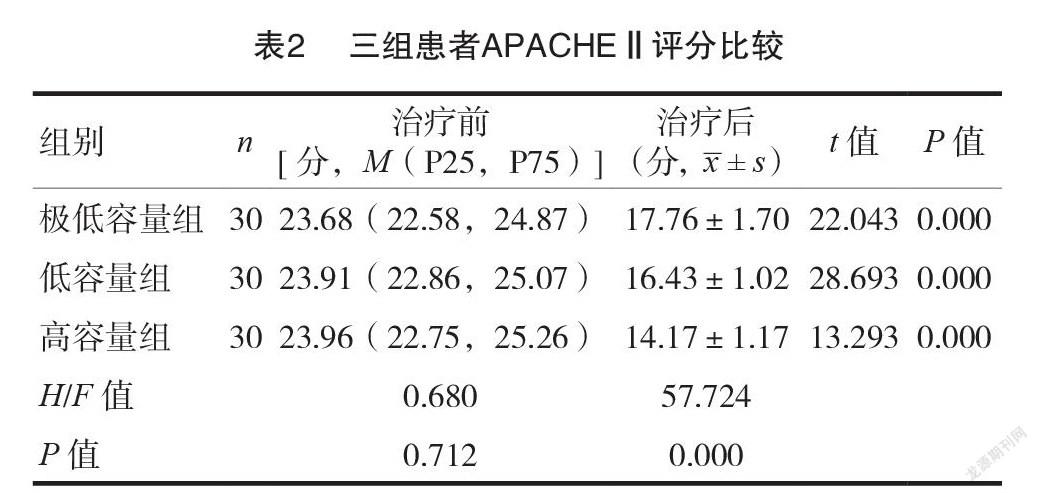

[摘要]目的觀察比较极低容量、低容量及高容量连续性血液滤过对危重症合并脓毒症患者炎症因子的影响。方法选择2019年1月至2020年12月郑州大学第五附属医院收治的90例危重症合并脓毒症患者为研究对象,根据不同超滤率将研究对象分为三组,极低容量组[<35 ml/(kg ·h)]、低容量组[35~50 ml/(kg ·h)]、高容量组[51~100 ml/(kg ·h)],每组各30例,行连续性血液滤过。观察三组患者经连续性血液滤过治疗后,白细胞介素-6(IL-6)、白细胞介素-10(IL-10)、肿瘤坏死因子-α(TNF-α)、C-反应蛋白(CRP)、降钙素原(PCT)的变化。比较治疗前后 APACHE Ⅱ评分,评估患者预后。结果三组患者经不同容量连续性血液滤过治疗后, IL-6、IL-10、TNF-α、CRP、PCT 水平均较治疗前明显降低,高容量组 IL-6、TNF-α、CRP、 PCT 水平较极低容量组、低容量组明显下降,差异有统计学意义(P <0.05)。经治疗后,三组患者 APACHE Ⅱ评分较治疗前均降低,高容量组较极低容量组、低容量组下降更为显著,差异有统计学意义(P <0.05)。结论危重症合并脓毒症患者行高容量连续性血液滤过治疗,炎症细胞因子清除更高效,机体免疫功能得到提升,改善免疫平衡状态,从而改善合并有脓毒症的总体病情。
[关键词]高容量;连续性血液滤过;炎症因子;脓毒症
[中图分类号] R459.7 [文献标识码] A [文章编号]2095-0616(2022)09-0192-04
Impacts of different capacities of continuous hemofiltration on inflammatory cytokines in critically ill patients complicated with pyohemia
LI Heting WANG Shaoting HU Xiaozhou ZHANG Yan AN Xubin
Department of Nephrology, the Fifth Affiliated Hospital of Zhengzhou University, Henan, Zhengzhou 450000, China [Abstract] Objective To observe and compare the impacts of extremely low capacity, low capacity, and high capacity continuous hemofiltration on inflammatory cytokines in critically ill patients complicated with pyohemia. Methods A total of 90 critically ill patients diagnosed with pyohemia admitted to and treated in the Fifth Affiliated Hospital of Zhengzhou University from January 2019 to December 2020 were selected as the research subjects. According to the different ultrafiltration rates, the research subjects were divided into the extremely low capacity group (<35 ml/[kg ·h]), the low capacity group (35-50 ml/[kg ·h]), and the high capacity group (51–100 ml/[kg ·h]), with 30 cases in each group. Continuous hemofiltration was performed. The patients in the three groups were observed to undergo continuous hemofiltration treatment. The changes of serum inflammatory cytokines such as interleukin-6(IL-6), interleukin-10(IL-10), tumor necrosis factor-α(TNF-α), C-reactive protein (CRP), and procalcitonin (PCT) were compared before and after treatment. The APACHE Ⅱ scores before and after treatment were compared to evaluate the prognosis of patients. Results After continuous hemofiltration treatment with different volumes in the three groups, the levels of IL-6, IL-10, TNF-α, CRP, and PCT were significantly lower than those before treatment, The levels of IL-6, TNF-α, CRP and PCT in the high capacity group were significantly lower than those in the extremely low capacity group and the low capacity group, and the difference was statistically significant (P <0.05). After treatment, the APACHE Ⅱ scores of the three groups were decreased compared with those before treatment, and the high capacity group decreased more significantly than the extremely low capacity group and the low capacity group, and the difference was statistically significant (P <0.05). Conclusion After high capacity continuous hemofiltration treatment, the inflammatory cytokines are cleared more efficiently, the immune function of the body is improved, and the immune balance is improved in critically ill patients complicated with pyohemia, thereby improving the overall condition of patients with complicated pyohemia.
[Key words] High capacity; Continuous hemofiltration; Inflammatory cytokines; Pyohemia
通过大量的临床试验、研究,医务工作者对危重症疾病有了广泛的认识,脓毒症及脓毒症休克一跃成为重症监护病房(ICU)多器官功能障碍综合征发生和病死的首要因素,相关病死率为30%~50%[1]。脓毒症休克引起的器官损害多由于过度活跃的免疫反应介导[2],从血液中清除炎症介质和/或细菌毒素可有益下调过度活跃的免疫反应,床旁连续性血液滤过成為其重要治疗手段。……